
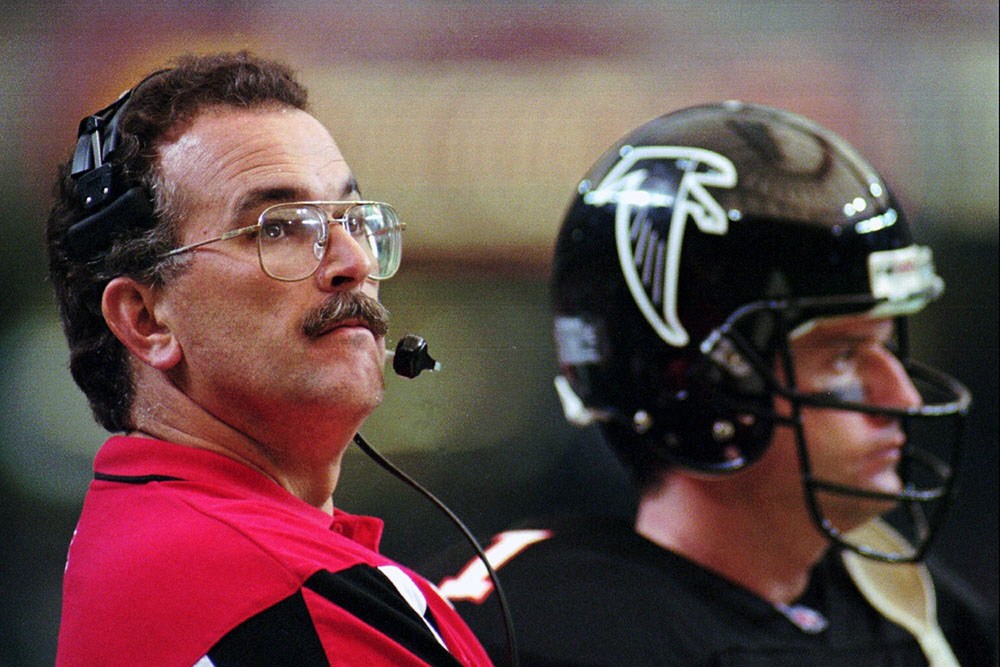
June Jones, the cutting-edge football coach who brought the run-and-shoot offense to the University of Hawaii and led the Rainbow Warriors to their greatest era, including an undefeated regular season that catapulted them all the way to the Sugar Bowl, died Thursday.
He was 73.
In a statement, Hawaii’s football program did not list a cause of death for Jones, who coached the NFL’s Atlanta Falcons for three seasons in the 1990s before his stint at Hawaii. The Honolulu Star-Advertiser cited a close family friend as saying Jones had entered hospice two weeks ago in his native Oregon.
“Coach Jones was a father figure, a mentor, and a visionary who revolutionized the game,” said Timmy Chang, the current Hawaii coach who set the NCAA record for career passing yards (since broken) as a quarterback under Jones. “He believed in a young kid from Hawaii and gave me the opportunity of a lifetime to run his offense.”
Hawaii was one of three colleges where Jones played quarterback, but it was his decision to transfer to Portland State that shaped the rest of his football career. He played there under Mouse Davis, who is largely credited with bringing to the big time an offense that featured four receivers who adjusted their routes on the fly, rarely ran the football, and most of all, moved fast.
It was dubbed the run-and-shoot.
Wayne Fontes, Kevin Gilbride, Jerry Glanville and Jack Pardee were among the few willing to throw out convention and use it. Jones might have had the most success.
After spending time in the 1980s with the Falcons, mostly as their third-string quarterback, Jones worked his way through assistant coaching jobs, landing on Glanville’s Houston Oilers staff in 1987, when prolific quarterback Warren Moon was taking the snaps. In 1991, Jones joined Glanville with the Falcons, then took over when Glanville got fired.
“A visionary in the passing game,” the Falcons called Jones in a statement Thursday.
Sticking with the run-and-shoot, Jones briefly thrived and led Atlanta to one playoff appearance with the help of quarterback Jeff George.
But as happened with so many of his run-and-shoot brethren, Jones got fired after a short tenure — three years — with his team’s defense wilting under the strain of all the time they spent on the field due to their own team’s offense that moved and scored quickly.
After that, Jones had a brief stint as an interim with the San Diego Chargers, replacing Gilbride after he was let go.
Jones returned to Hawaii in 1999 after the Warriors had gone 0-12, and he produced a remarkable turnaround, capping a 9-4 season with a win in the Oahu Bowl.
His most memorable season, though, ended at the Sugar Bowl. It came in 2007, when Colt Brennan ran the offense well enough for a 12-0 regular-season record that got Hawaii into the Bowl Championship Series, the precursor to today’s College Football Playoff to the determine the national champion in NCAA Division I’s top tier. In New Orleans, the Rainbow Warriors ran into fourth-ranked Georgia and lost 41-10.
Over nine seasons in Honolulu. Jones became the winningest coach in Hawaii history at 76-41. His run-and-shoot dazzled at Aloha Stadium, but also provided entertainment deep into the night on Saturdays (and into Sunday morning) when Hawaii games started late on the East Coast.
Jones’ success landed him a job on the mainland, at Southern Methodist University in the suburbs of Dallas, where he went 36-43 over six-plus years.
Even after he left Hawaii, though, Jones remained a towering figure on the islands — among the most popular sports celebrities in a state where surfing, golf and even basketball often grabbed more headlines than football.
Gov. Josh Green called him “an exceptional human being.”
“He was a motivator of young people, and he was a winner,” Green said. “He won big moments for us, and that put us into the spotlight.”