
Editor’s note: final in a series of four.
In preparation for a new era in Chattanooga parks, Dr. S.G. Cook, member of the Parks Commission, gathered interested citizens and the media on Nov. 19, 1910, for a special announcement. According to the Chattanooga News, Harold Swope had been appointed superintendent of city parks, and his first assignment was to “carry out the plans for beautifying this city recently completed by John Nolen, the noted Boston landscape architect.” Swope would relocate to Chattanooga by Dec. 1.
The new superintendent was described by Dr. Cook as “an efficient and experienced landscape gardener,” who had more than 12 years of experience with George W. Vanderbilt’s Biltmore Nursery near Asheville, North Carolina. “A native of Virginia, he is thoroughly southern and understands the conditions and environments of southern cities and their best needs in the matter of beautification. His experience and training will be eminently satisfactory …”
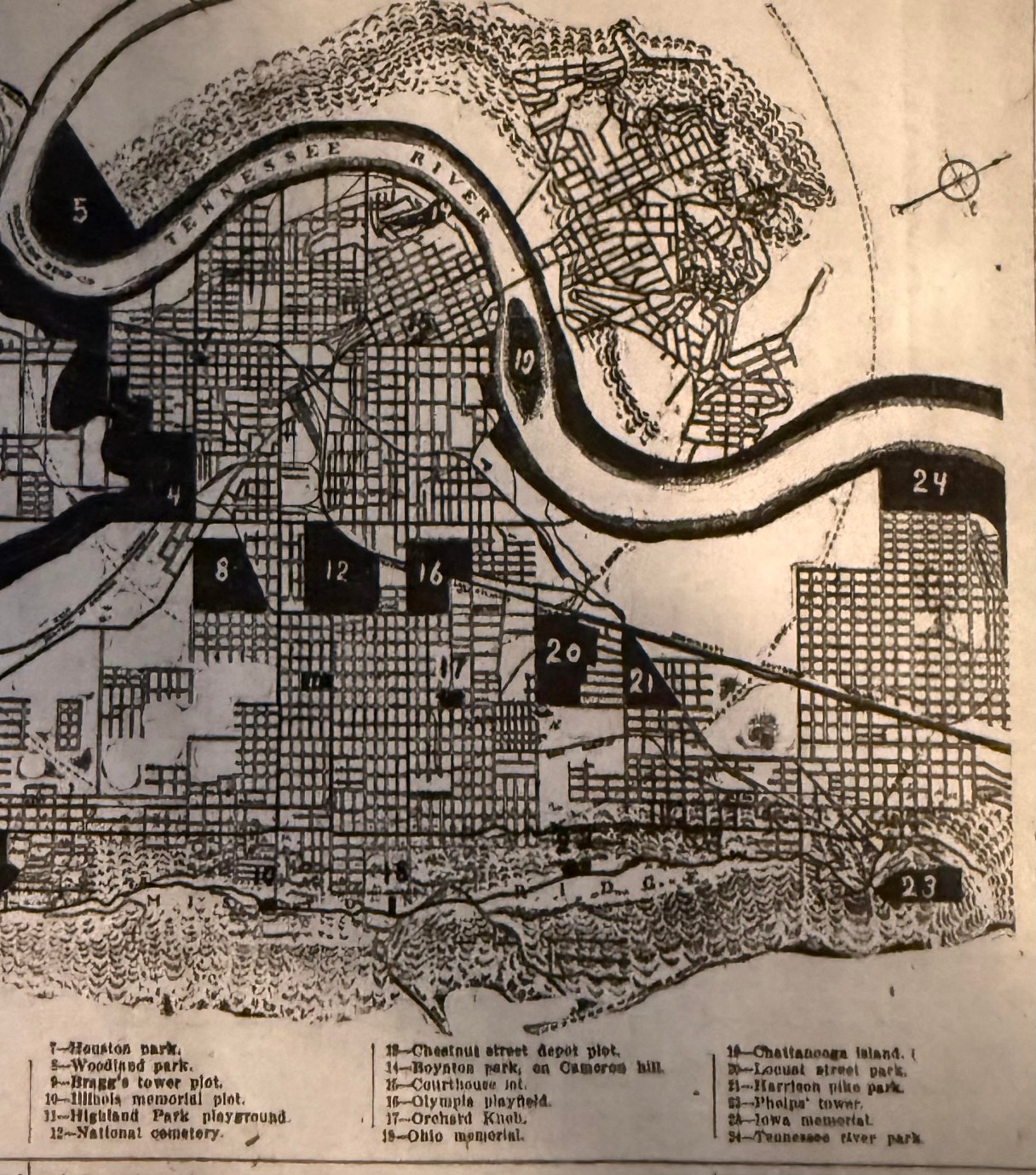
By January 1911, Chattanooga leaders agreed to move forward with the completed Nolen proposal. In a Parks Commission meeting on Jan. 21, the members stated that they were “now studying the map with a view to accepting it.” One member noted that, in addition to open space already existing, which would “be enlarged, developed and improved,” other larger parks appear in all parts of the city. One key feature was the proposal that “several of the longest and most prominent streets … will be turned into boulevards lined with beautiful trees, circles and squares of trees and flowers …”
A major feature of the idea would include the preservation of lands in the “toe of Moccasin Bend.” Nolen’s plan noted that the new bridge (the Chief John Ross structure, also called the Market Street Bridge) to be built would allow the construction of a parkway 1,000 feet wide along the banks of the Tennessee River and a similar thoroughfare along Chattanooga Creek.