
Tuesday, November 10, 2026Nov 10

European, Russian space agencies launch mission to Mars

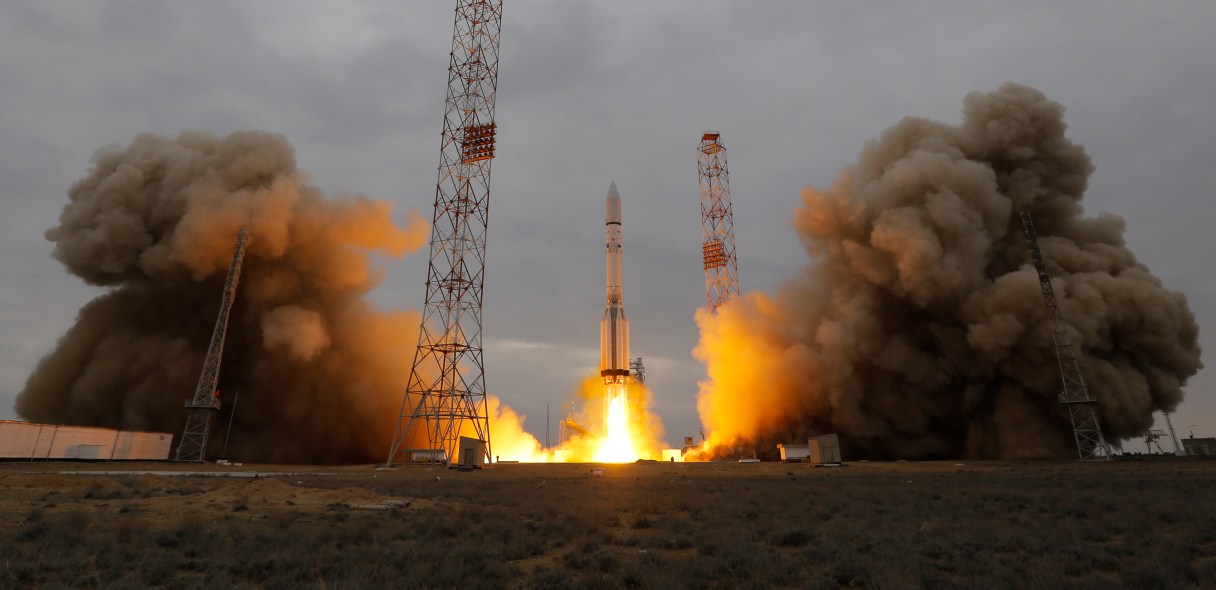
The Proton-M rocket booster blasts off at the Russian leased Baikonur cosmodrome, Kazakhstan, Monday, March 14, 2016. Europe and Russia launched a joint mission Monday to explore the atmosphere of Mars and hunt for signs of life on the red planet. The unmanned ExoMars probe, a collaboration between the European Space Agency and Roscosmos, took off aboard a Russian rocket and is expected to reach Mars in October. (AP Photo/Dmitri Lovetsky)
The Proton-M rocket booster blasts off at the Russian leased Baikonur cosmodrome, Kazakhstan, Monday, March 14, 2016. Europe and Russia launched a joint mission Monday to explore the atmosphere of Mars and hunt for signs of life on the red planet. The unmanned ExoMars probe, a collaboration between the European Space Agency and Roscosmos, took off aboard a Russian rocket and is expected to reach Mars in October. (AP Photo/Dmitri Lovetsky) The Proton-M rocket booster blasts off at the Russian leased Baikonur cosmodrome, Kazakhstan, Monday, March 14, 2016. Europe and Russia launched a joint mission Monday to explore the atmosphere of Mars and hunt for signs of life on the red planet. The unmanned ExoMars probe, a collaboration between the European Space Agency and Roscosmos, took off aboard a Russian rocket and is expected to reach Mars in October. (AP Photo/Dmitri Lovetsky)

DARMSTADT, Germany (AP) – Europe and Russia have launched a joint mission to explore the atmosphere of Mars and hunt for signs of life on the red planet.

The unmanned ExoMars probe- a collaboration between the European Space Agency and Roscosmos – took off Monday aboard a Russian rocket and is expected to reach Mars in October.

The probe’s Trace Gas Orbiter will analyze methane and other gases in the Martian atmosphere to determine where they are coming from, said Paolo Ferri, ESA’s head of mission operations.

Methane is created by biological or geological activity and breaks down within a relatively short period of time once it reaches the atmosphere.

“It cannot be older than 400 years. That means there has been either biological or geological activity in this timeframe,” said Ferri. “Four hundred years is nothing. If there is methane it means there is basically a process going on now.”