
Thursday, October 29, 2026Oct 29

This story is free to read.

United Methodist delegates vote to keep ban on same-sex marriage, LGBT clergy

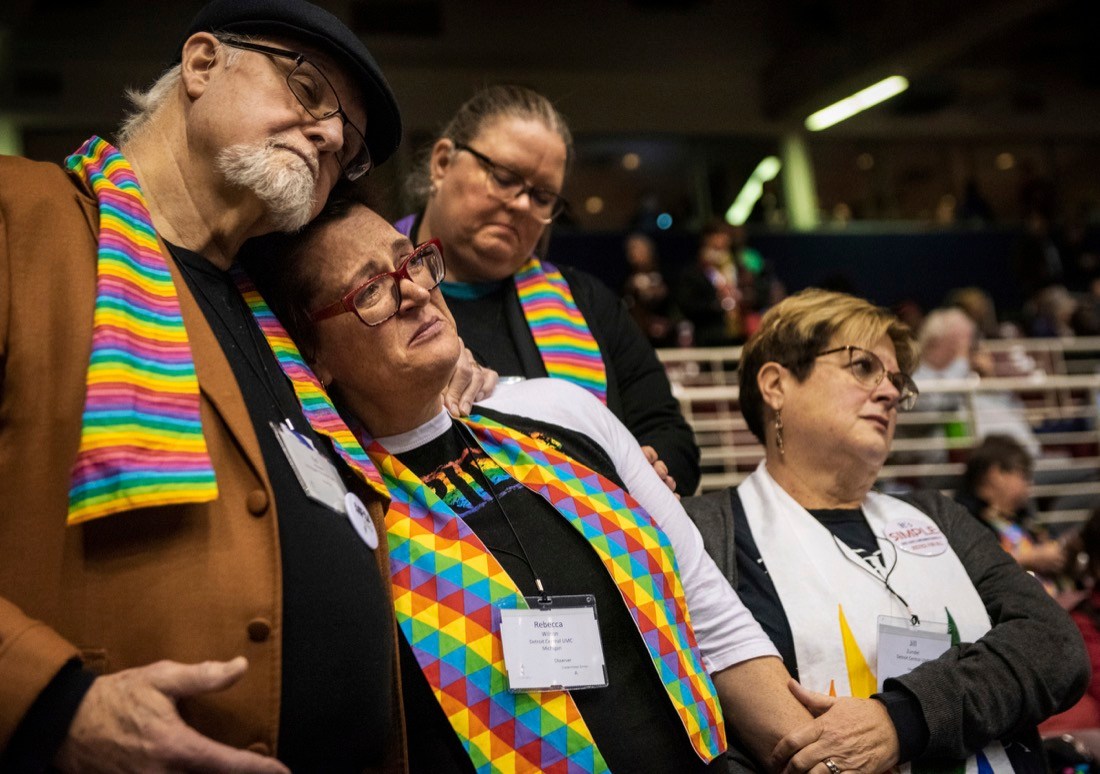
Ed Rowe, left, Rebecca Wilson, Robin Hager and Jill Zundel, react to the defeat of a proposal that would allow LGBT clergy and same-sex marriage within the United Methodist Church at the denomination's 2019 Special Session of the General Conference in St. Louis, Mo., Tuesday, Feb. 26, 2019. America's second-largest Protestant denomination faces a likely fracture as delegates at the crucial meeting move to strengthen bans on same-sex marriage and ordination of LGBT clergy. (AP Photo/Sid Hastings)
Ed Rowe, left, Rebecca Wilson, Robin Hager and Jill Zundel, react to the defeat of a proposal that would allow LGBT clergy and same-sex marriage within the United Methodist Church at the denomination's 2019 Special Session of the General Conference in St. Louis, Mo., Tuesday, Feb. 26, 2019. America's second-largest Protestant denomination faces a likely fracture as delegates at the crucial meeting move to strengthen bans on same-sex marriage and ordination of LGBT clergy. (AP Photo/Sid Hastings) Ed Rowe, left, Rebecca Wilson, Robin Hager and Jill Zundel, react to the defeat of a proposal that would allow LGBT clergy and same-sex marriage within the United Methodist Church at the denomination's 2019 Special Session of the General Conference in St. Louis, Mo., Tuesday, Feb. 26, 2019. America's second-largest Protestant denomination faces a likely fracture as delegates at the crucial meeting move to strengthen bans on same-sex marriage and ordination of LGBT clergy. (AP Photo/Sid Hastings)

ST. LOUIS (AP) – The United Methodist Church, America’s second-largest Protestant denomination, faces a likely surge in defections and acts of defiance after delegates at a crucial conference voted Tuesday to strengthen the faith’s divisive bans on same-sex marriage and ordination of LGBT clergy.

Emotions were high throughout the third and final day of the UMC’s meeting. Some supporters of greater LGBT inclusion were in tears, while others vented their anger when, midway through the session, delegates defeated a proposal that would have let regional and local church bodies decide for themselves on gay-friendly policies.

“Devastation,” was how former Methodist pastor Rebecca Wilson of Detroit described her feelings. “As someone who left because I’m gay, I’m waiting for the church I love to stop bringing more hate.”

After several more hours of debate, the conservatives’ proposal, called the Traditional Plan, was approved by a vote of 438-384. Opponents unsuccessfully sought to weaken the plan with hostile amendments or to prolong the debate past a mandatory adjournment time set to accommodate a monster truck rally in the arena. One delegate even requested an investigation into the possibility that “vote buying” was taking place at the conference.

The Traditional Plan’s success was due to an alliance of conservatives from the U.S. and overseas. About 43 percent of the delegates were from abroad, mostly from Africa, and overwhelmingly supported the LGBT bans.