
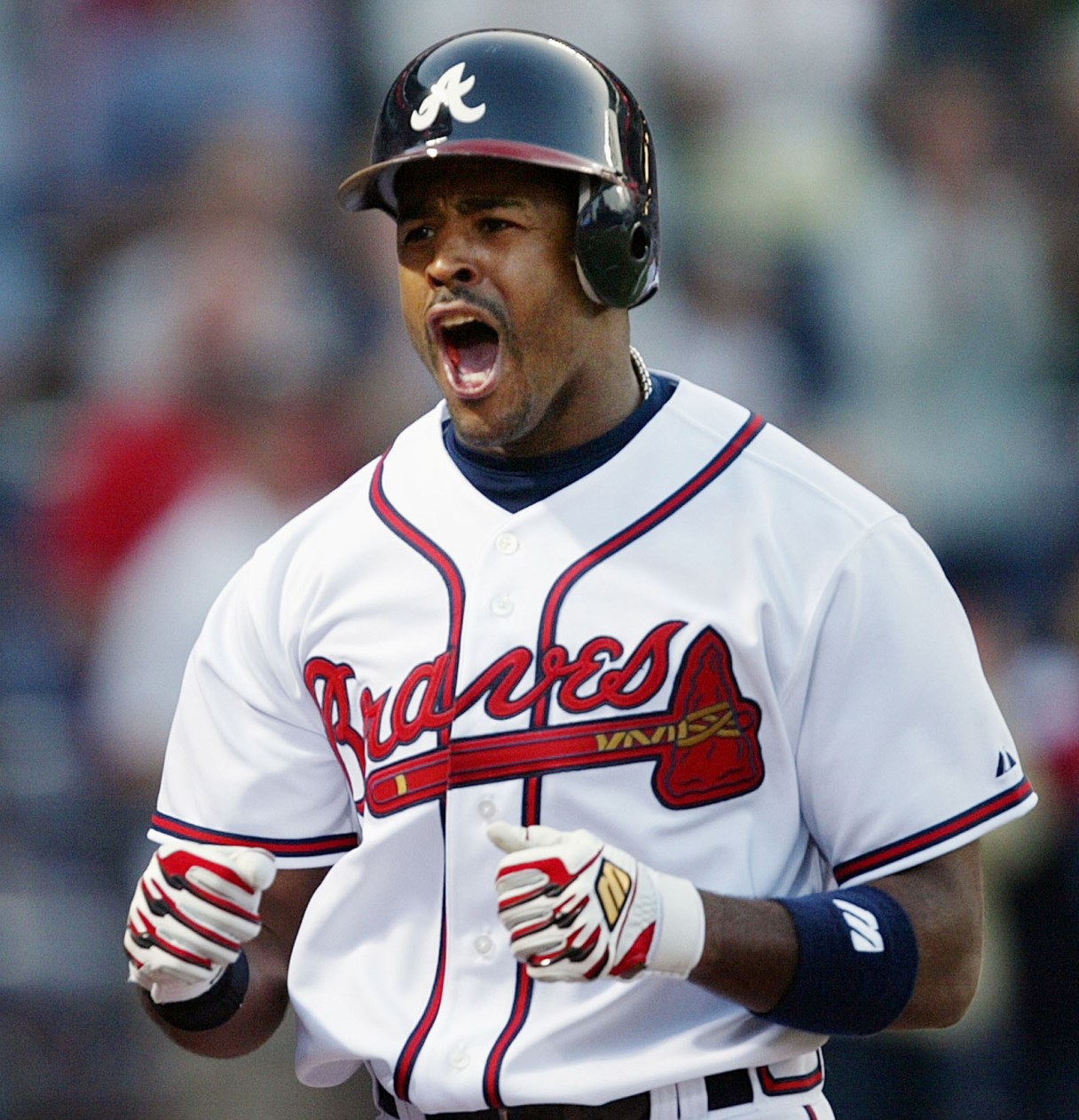
Dressed in a snappy beige suit and conservative tie, former Atlanta Brave and Atlanta Falcon Brian Jordan surveyed the Chattanooga Convention Center ballroom where he was about to address Junior Achievement’s Spirit of Achievement luncheon Tuesday.
“I wish I’d had Junior Achievement around to help teach me how to handle my money when I was young,” he said. “When you become a pro athlete you have so much money thrown at you and you often don’t have any idea how to manage it.”
Retired from major league baseball for a decade, Jordan has handled the money he made over 17 professional sports seasons well enough to have his Brian Jordan Foundation partner with Kennesaw State to start a program for single-parent homeless families.
“I started the foundation in 1998,” said Jordan, whose mother taught school and whose father was a steel worker in his home state of Maryland. “Our primary goal then was to give scholarships to help kids get in college. Literacy is so important, but you have to get them while they’re young.”
His own literacy has led him to become a children’s book author. But as time passed, Jordan saw a bigger need for youth than merely reaching college. After he failed to land a corporate sponsor, a Kennesaw State professor who’d heard him give a speech in inner-city Atlanta called one day to see if they could join forces. With a little help from the LakePoint Sporting Community, The Brian Jordan Center for Excellence and Professional Development was born and is expected to be housed at the LakePoint development in Bartow County.
Said Kennesaw State president Daniel S. Papp at the time of the announcement: “This agreement provides a unique opportunity for Kennesaw State to make an impact on health education efforts in the community and beyond.”
Added LakePoint CEO Earl Ehrhart last summer: “This partnership with the Brian Jordan foundation will further the LakePoint mission of making the world of sport a safer and better place.”
“The goal,” Jordan said Tuesday, “is to provide housing for these families, then teach them how to be workforce ready.”
In January of 1989, after wowing the NFL scouts during Senior Bowl week workouts, Jordan thought he’d made himself workforce ready for both the NFL and baseball’s St. Louis Cardinals, who owned his baseball rights.
“It was all I’d ever dreamed of,” he said. “I was going to be a first-round draft pick in both baseball and football.”
Was going to be. For early in the Senior Bowl, as he was about to tackle University of Miami star Cleveland Gary, Jordan broke his leg and dislocated his ankle. His football career suddenly appeared to be at an end and his promising baseball career was in jeopardy.
Yet four months later, his leg healed and his ankle filled with screws and plates on the mend, Jordan was back running in a straight line as well as he ever had. The Buffalo Bills chose him in the seventh round of the 1989 draft, then cut him at the end of training camp.
“(Buffalo coach) Marv Levy calls me in and says, ‘You’re the 46th man on a 45-man roster,'” Jordan told the Junior Achievement audience. “I told him to release me and if no one signed me I’d come back and play for the Bills the next season.”
But the Falcons signed him, Jordan playing both football for the Falcons and minor league baseball for the Cardinals for the next three years. He was even a NFL Pro Bowl alternate in 1991, the year he led the Falcons in tackles.
“Then I got smart, dropped football and played baseball for 15 seasons,” the University of Richmond alumnus said with a smile.
Yet just the seventh athlete since 1970 to play both in the NFL and MLB also leaves behind a pretty fair athletic career, especially on the baseball diamond, where his career statistics include a .282 batting average, 184 home runs and 821 RBIs.
A single memory of his time with the Cards and the Braves? Try Atlanta’s 1999 World Series loss to the New York Yankees.
“Being in the World Series was awesome,” Jordan said. “To be in New York, playing in Yankee Stadium. But the (Yankees) fans were terrible. Tough to focus on the game when your family’s getting hit in the head with popcorn.”
Now a member of the Braves’ pregame shows, Jordan won’t pencil in these Braves for the Fall Classic, but he does believe “they’ll be better than people think. The big question is the pitching, all those prospects they’ve brought in. Can they deliver?”
The biggest question for all former NFL players these days, especially defensive players who were always taught, in Jordan’s words, “to lead with our head,” is what murky life could await them down the road.
Just Monday, Jeff Miller – the NFL’s senior vice president for health and safety – told a U.S. House of Representatives discussion on concussions when asked if there was a link between football and neurodegenerative diseases such as chronic traumatic encephalopathy: “The answer to that question is certainly yes.”
Said Jordan on Tuesday: “I worry about it. I’ve reconnected with the NFL. I’m going to take all the tests and see how much damage was done, if any. But it is what it is. It’s a violent sport.”
Which might also be why he told the Junior Achievement audience, especially anyone dreaming of becoming a pro athlete one day: “It’s great to dream big. Everybody needs to dream. But have a backup plan. Have a plan B. And C. And D. Always put your education first.”
Always.
Contact Mark Wiedmer at mwiedmer@timesfreepress.com.