
The Cadek Conservatory of Music is pronounced with a “ch” sound, as in “chopping block.”
And the chopping block is what some fear may be the destination for the 111-year-old music conservatory on the University of Tennessee at Chattanooga’s campus, since UTC has identified Cadek as a money-loser in a “budget rebalancing” process meant to reallocate $5.8 million annually.
“The Cadek Conservatory does not serve UTC students and has no connection to UTC operations except that UTC pays for all of the facilities and equipment,” a university budget document states. “Cadek must become self-sufficient from a financial perspective.”
It’s not the first time university officials have wondered what to do about Cadek, a nonprofit organization housed in Cadek Hall, a circa 1962 three-story building on Oak Street a stone’s throw from the old Lupton Library.
“We’ve gone down this road before,” Cadek’s Director Paul Shurtz said.
When money is tight, UTC officials typically consider cuts to Cadek and two other nonprofit organizations on campus that don’t directly serve university students: The Challenger Center and the Children’s Center in the Tommie Brown Academy.
“It used to be called the ‘three Cs,'” Shurtz said.
Private music lessons are the main business of Cadek, which was founded in 1904 on Walnut Street in downtown Chattanooga by Joseph Ottokar Cadek, a celebrated violinist from Prague who performed with Gustav Mahler and other famed conductors.
Cadek has one full-time administrative assistant and 29 part-time instructors who give lessons to some 300 students from outside the university, mainly children. For example, Cadek’s Kindermusik program teaches music appreciation to children as young as 6 months old.
“We do pretty well — we cover our expenses,” Shurtz said. “[We] run on real money, [universities] run on budgets. Our budget is out of whack. The income expectations are way beyond what we can possibly bring in.”
University officials figure UTC could save about $114,000 annually if Cadek was self-sufficient.
If Cadek can’t pay for itself, then the university might be able to justify the ongoing expense if UTC students are benefiting from it in some way, spokesman Chuck Cantrell said. For example, UTC students might teach private lessons at Cadek, he said.
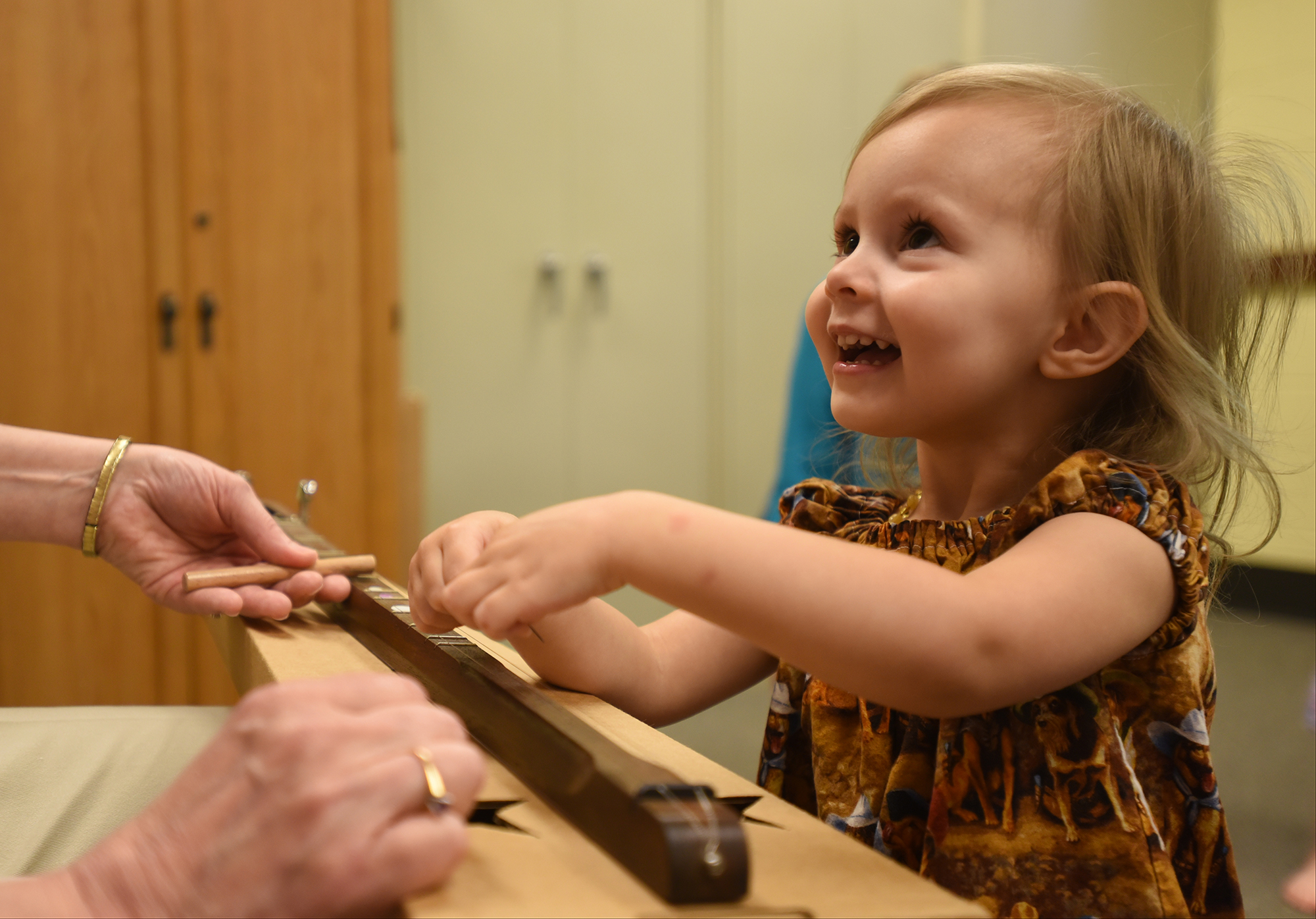 Abigail McNabb plays an instrument during a Kindermusik class at Cadek Conservatory.
“It’s not looking to get rid of Cadek,” Cantrell said.
But some Cadek supporters fear that UTC wants to tear down Cadek Hall, which the university owns, even though the cork-floored recital hall in the center of the building underwent around $140,000 in renovations, including new seating, about a decade ago. All of the money came from donors.
“The university didn’t pay a nickel for that,” Shurtz said.
Cadek Hall contains asbestos, Shurtz said, so it’s costly to make needed repairs, such as the replacement of the aging heating and cooling system. It produces humidity that’s hard on Cadek’s collection of Steinway grand pianos, including a concert grand that retails for about $150,000.
WUTC, the university’s public radio station, has its studios on Cadek Hall’s first floor. But university officials have suggested WUTC could merge with WTCI, Chattanooga’s public TV station, which might mean the radio station moves.
“It’s a prime piece of real estate,” Shurtz said of Cadek Hall’s central location. “They’re always eyeing that spot on campus.”
Fears were further stoked at a March 20 budget town hall meeting with Richard Brown, UTC’s executive vice chancellor of finance and operations, at which one of Brown’s computerized slides read, “Cadek — what to do with the building?”
While UTC does plan to demolish some buildings on campus, including what’s known as the doctors’ building, a five-story brick building at 744 McCallie Ave. with tall, skinny windows across from the Yellow Deli cafe, Cadek isn’t on the list, Cantrell said.
“It’s not on the tear-down list,” he said. “Cadek is not on there, I can tell you for sure.”
Shurtz doesn’t know what Cadek’s fate will be.
“I’m going to be gone as of June 30th,” said Shurtz, who plans to take the early retirement that UTC offered as part of its budget rebalancing process.
“It’s anybody’s guess what will happen,” he said. “Quite frankly, I don’t see anything drastic happening. It would be a dramatic move to eliminate Cadek. It would go down in the community very hard. There’s so many that went here.”
“These kids, they develop a skill they’ll use all their life,” Shurtz said. “There’s very few [programs that] can say that — even universities.”
Contact staff writer Tim Omarzu at tomarzu@timesfreepress.com or www.facebook.com/tim.omarzu or twitter.com/TimOmarzu or 423-757-6651.