
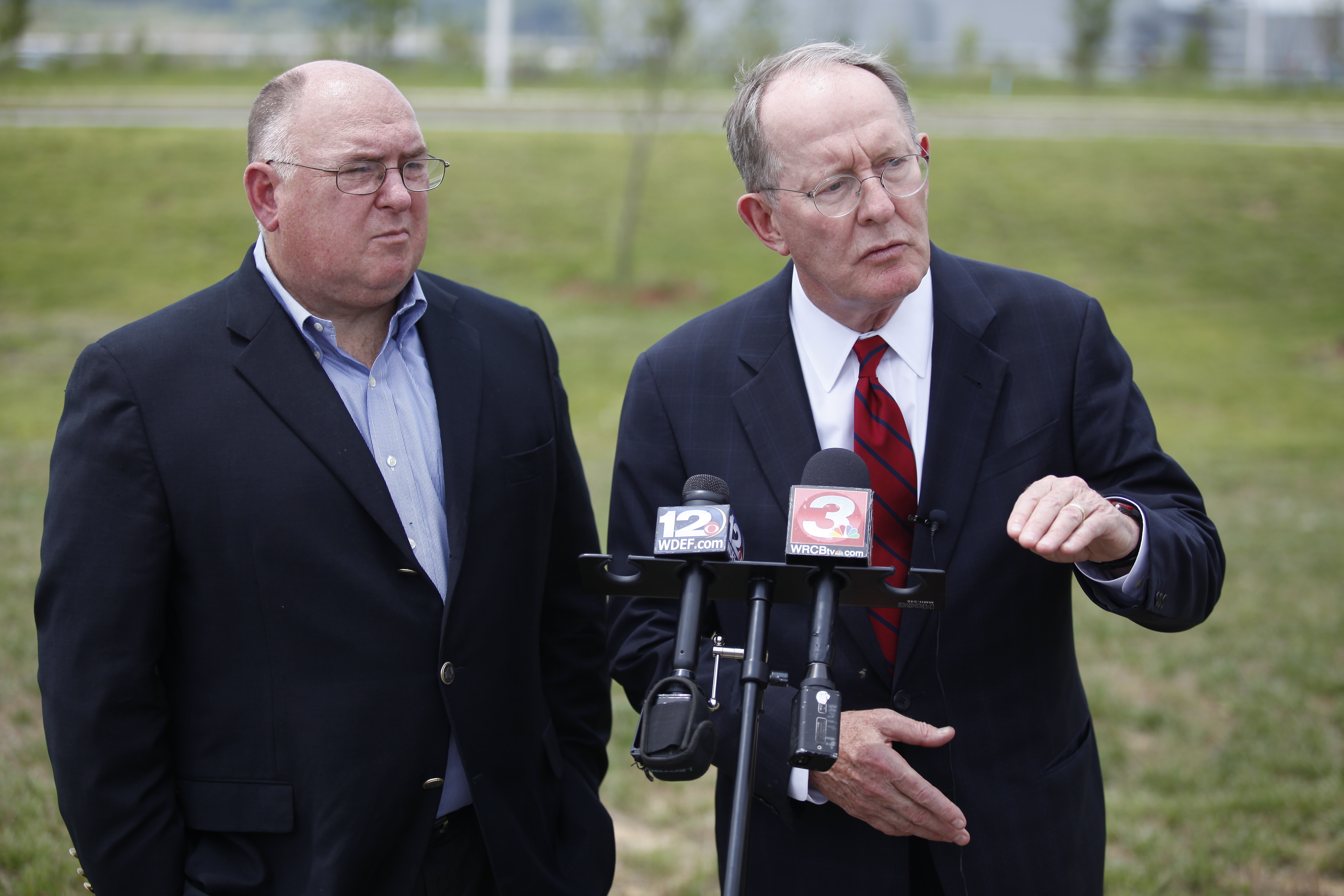
 Wayne Cropp, former director of the Chattanooga Hamilton County Air Pollution Control Bureau, left, stands with U.S. Sen. Lamar Alexander, R-Tenn., during a news conference near the Volkswagen plant in Chattanooga on Friday. Alexander announced his support for the utility MACT rule which will require upgrades of pollution controls at coal plants.


U.S. Sen. Lamar Alexander, R-Tenn., who stepped down as head of the Senate Republican Caucus last year, is breaking ranks with his GOP colleagues to support an Obama administration plan to impose stricter pollution controls on coal-fired power plants.
Despite a $400,000 television campaign urging him to fight the new rules, Alexander said Friday that the new EPA-ordered pollution controls on coal plants should help the economy and the environment of Tennessee. Alexander is the only Republican in the U.S. Senate so far to indicate he will oppose a measure to be voted on next Wednesday to overturn the EPA requirements for utilities to use maximum achievable control technologies (MACT) to limit pollution from coal plants.
“East Tennesseans know that we have a clean air problem,” Alexander said during a visit Friday to Knoxville, Athens and Chattanooga. “Knoxville has been the worst city in the country for asthma three times in the past eight years. Chattanooga is fifth. The Great Smokies is one of the most polluted national parks in the country.”
Standing in front of Volkswagen’s $1 billion auto assembly plant in Chattanooga later Friday, Alexander said VW and other automotive manufacturers wouldn’t be in Tennessee if the state had not taken steps to clean up the smog and toxic substances in the air.
“Every metropolitan area in Tennessee is struggling today to stay within the air quality standards that affect whether new industries are able to locate in those areas,” he said.