
Wednesday, November 11, 2026Nov 11

China launches 1st domestically-made aircraft carrier

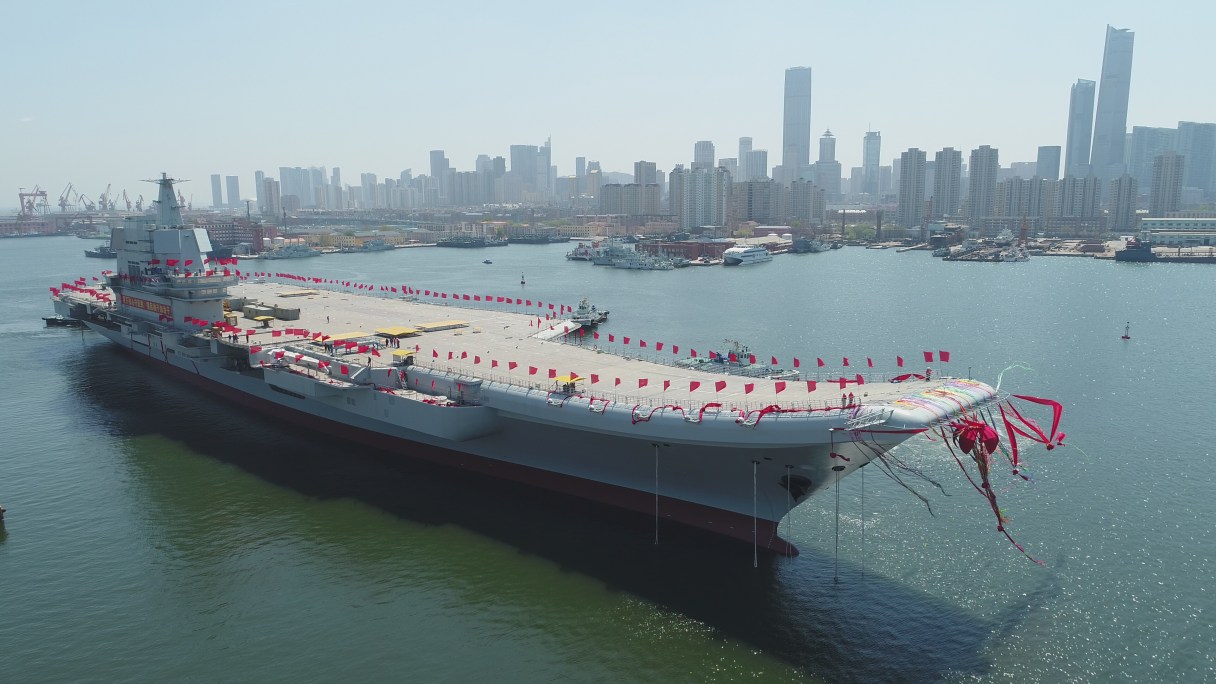
In this photo released by China's Xinhua News Agency, a newly-built aircraft carrier is transferred from dry dock into the water at a launch ceremony at a shipyard in Dalian in northeastern China's Liaoning Province, Wednesday, April 26, 2017. China launched its first aircraft carrier built entirely on its own on Wednesday, in a demonstration of the growing technical sophistication of its defense industries and determination to safeguard its maritime territorial claims and crucial trade routes. (Li Gang/Xinhua via AP)
In this photo released by China's Xinhua News Agency, a newly-built aircraft carrier is transferred from dry dock into the water at a launch ceremony at a shipyard in Dalian in northeastern China's Liaoning Province, Wednesday, April 26, 2017. China launched its first aircraft carrier built entirely on its own on Wednesday, in a demonstration of the growing technical sophistication of its defense industries and determination to safeguard its maritime territorial claims and crucial trade routes. (Li Gang/Xinhua via AP) In this photo released by China's Xinhua News Agency, a newly-built aircraft carrier is transferred from dry dock into the water at a launch ceremony at a shipyard in Dalian in northeastern China's Liaoning Province, Wednesday, April 26, 2017. China launched its first aircraft carrier built entirely on its own on Wednesday, in a demonstration of the growing technical sophistication of its defense industries and determination to safeguard its maritime territorial claims and crucial trade routes. (Li Gang/Xinhua via AP)

BEIJING (AP) – China launched its first aircraft carrier built entirely on its own on Wednesday, in a demonstration of the growing technical sophistication of its defense industries and determination to safeguard its maritime territorial claims and crucial trade routes.

The 50,000-ton carrier left its berth just after 9 a.m. in the northern port city of Dalian, where its predecessor, the Ukrainian-built Liaoning, also underwent extensive refurbishing before being commissioned in 2012, the Ministry of National Defense said.

The new carrier is expected to be formally commissioned sometime before 2020 following the completion of sea trials and the arrival of its full air complement.

Like the 60,000-ton Liaoning, the new carrier is based on the former Soviet Union’s Kuznetsov class design, with a ski jump-style deck for taking off and a conventional oil-fueled steam turbine power plant. That limits the weight of payloads its planes can carry, its speed and the amount of time it can spend at sea relative to American nuclear-powered carriers.

China is believed to be planning to build at least two and possibly as many as four additional carriers, with one of them, the Type 002, reported to be already under construction at a shipyard outside Shanghai. They are expected to be closer in size to the U.S. Navy’s nuclear-powered 100,000-ton Nimitz class ships, with flat flight decks and catapults to allow planes to launch with more bombs and fuel aboard.