
Tuesday, November 10, 2026Nov 10

Twinkle, twinkle giant star, astronomers see how far you are

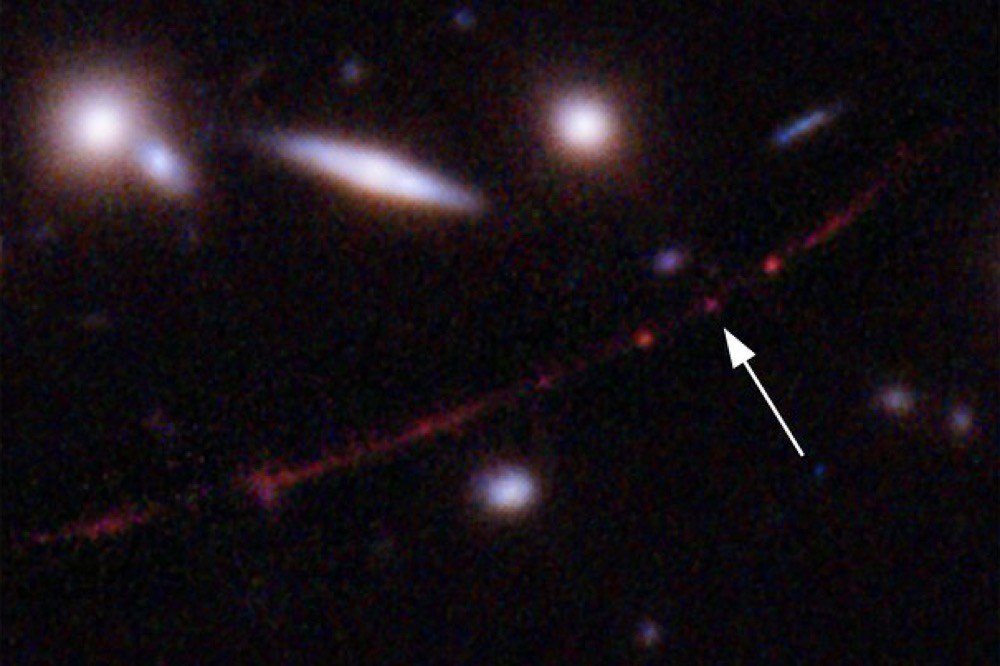
This image made available by NASA on Wednesday, March 30, 2022, shows the star Earendel, indicated by arrow, and the Sunrise Arc galaxy, stretching from lower left to upper right, optically bent due to a massive galaxy cluster between it and the Hubble Space Telescope which captured the light. The mass of the galaxy cluster serves as a magnifying glass, allowing Earendel to be seen. (NASA, ESA, Brian Welch (JHU), Dan Coe (STScI); Image processing: NASA, ESA, Alyssa Pagan (STScI) via AP)
This image made available by NASA on Wednesday, March 30, 2022, shows the star Earendel, indicated by arrow, and the Sunrise Arc galaxy, stretching from lower left to upper right, optically bent due to a massive galaxy cluster between it and the Hubble Space Telescope which captured the light. The mass of the galaxy cluster serves as a magnifying glass, allowing Earendel to be seen. (NASA, ESA, Brian Welch (JHU), Dan Coe (STScI); Image processing: NASA, ESA, Alyssa Pagan (STScI) via AP) This image made available by NASA on Wednesday, March 30, 2022, shows the star Earendel, indicated by arrow, and the Sunrise Arc galaxy, stretching from lower left to upper right, optically bent due to a massive galaxy cluster between it and the Hubble Space Telescope which captured the light. The mass of the galaxy cluster serves as a magnifying glass, allowing Earendel to be seen. (NASA, ESA, Brian Welch (JHU), Dan Coe (STScI); Image processing: NASA, ESA, Alyssa Pagan (STScI) via AP)

CAPE CANAVERAL, Fla. (AP) – Astronomers have discovered the farthest star yet, a super-hot, super-bright giant that formed nearly 13 billion years ago at the dawn of the cosmos.

But this luminous blue star is long gone, so massive that it almost certainly exploded into bits just a few million years after emerging. Its swift demise makes it all the more incredible that an international team spotted it with observations by the Hubble Space Telescope. It takes eons for light emitted from distant stars to reach us.

“We’re seeing the star as it was about 12.8 billion years ago, which puts it about 900 million years after the Big Bang,” said astronomer Brian Welch, a doctoral student at Johns Hopkins University and lead author of the study appearing in Wednesday’s journal Nature.

“We definitely just got lucky.”

He nicknamed it Earendel, an Old English name which means morning star or rising light – “a fitting name for a star that we have observed in a time often referred to as `Cosmic Dawn. “