
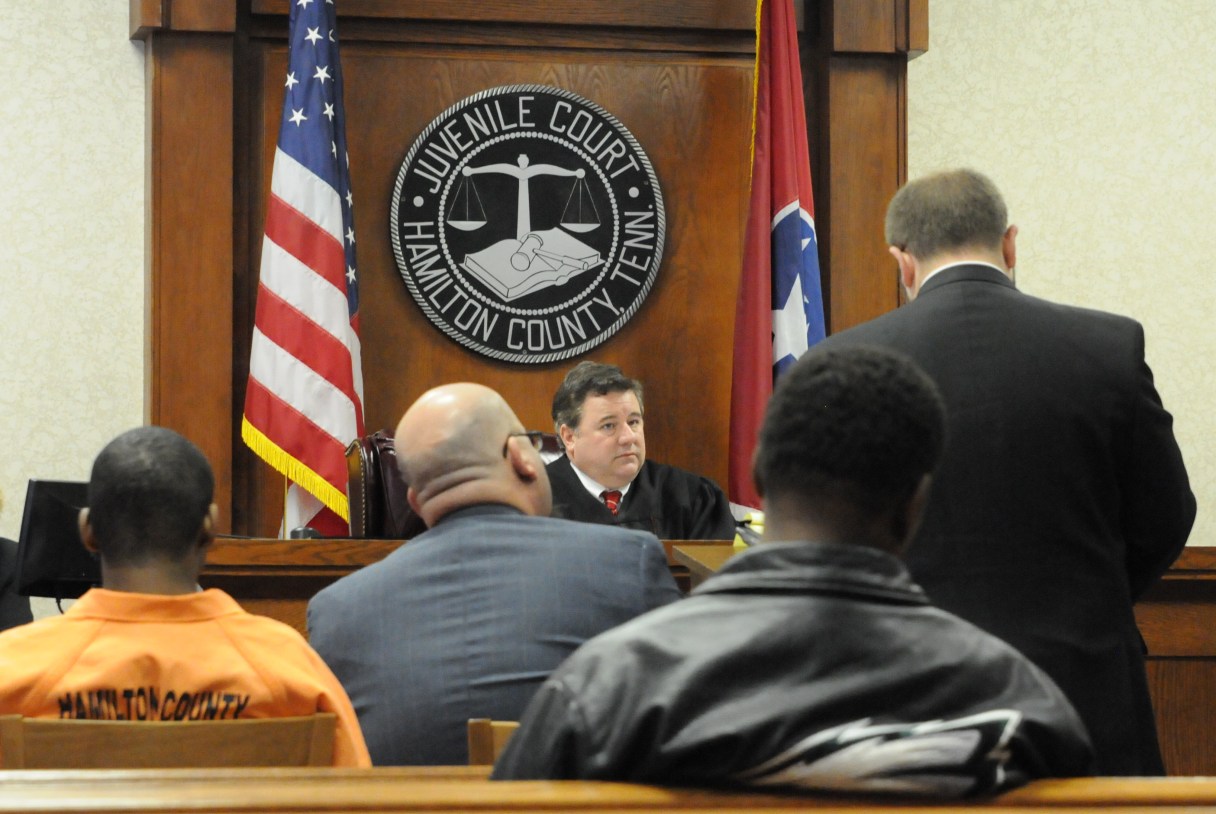
 Hamilton County Juvenile Court Judge Robert D. Philyaw listens to testimony in the case of Deonte Smart, charged with the rape of an elderly male jogger, before ruling that the 17-year-old will be tried as an adult in this file photo.
Since Hamilton County Juvenile Court began a massive effort to scan its entire repository of files, nearly 4 million pages have been converted to digital format. It’s a process that health care professionals have been struggling with for years, and one that smaller businesses may have undertaken decades ago.
It’s only been up and fully running in the court since December. But those who work within the system say the switch from the old paper files to the digital age is already making a world of difference.
“It’s really something that I’ve been excited to see in the courtroom,” Magistrate Kathy Clark said.
From her bench in the East Main Street child support courtroom, she can quickly pull up case files and see scanned documents that used to rise in stacks on her desk. In the past, she sometimes felt she was drowning in documents.
“You’re just keeping your head above water,” Clark said. “That paper is consuming.”
Where there once were five files on her desk, there are now five windows on her screen with information on current cases. That transition didn’t come without a vast amount of work, Juvenile Court Clerk Gary D. Behler said.
Behler outsourced the project to vendor DigiPoint Solutions Inc., which scanned files both from the child support division and the main division. Two clerks oversaw the process, which took from August 2013 to October 2014.
“It was a huge project,” Behler said. “It was a monster.”
Along with converting to a digital filing system, the court has added email capabilities, developed electronic calendaring and hooked up a telecommunications system between courtrooms and local jails. It’s much easier and more efficient for everyone involved in the court system to access files and communicate about cases.
The scanning project has cost taxpayers $149,157.50 so far. Behler said courts in particular are resistant to change — the cassette recorder and typewriter that sit in his office and were used in court until 2010 are prime examples of that resistance.
Before the project was completed, walls full of case files, which range in thickness from half an inch to nearly a foot, had to be separated and scanned one page at a time. Behler and his staff are still clearing out those shelves and determining what they’ll do with the old paper. Old files are sent to county storage after a juvenile defendant turns 18 or after child support fees are paid in full.
After the scanning was finished in late October, county information technology specialists built a system that will allow digital access to court files. Since the vendor finished the stacks of back files, clerks now are able to scan in any new files using an in-office system. Dockets and other scheduling information were digitized as well, eliminating the huge hard-copy books once used to handle scheduling.
Behler said he isn’t afraid of data breaches because the information is stored on a separate server and closely monitored for unauthorized access.
Since juvenile records are tightly controlled, those files still won’t be emailed out or widely available to the public, as many county and federal court files are. But in the main division, they will be available to attorneys at digital kiosks. That shift to digital case management is next on Behler’s list after the full migration in the child support division.
Contact staff writer Claire Wiseman atcwiseman@timesfreepress.com or 423-757-6347. Follow her on Twitter@clairelwiseman.