
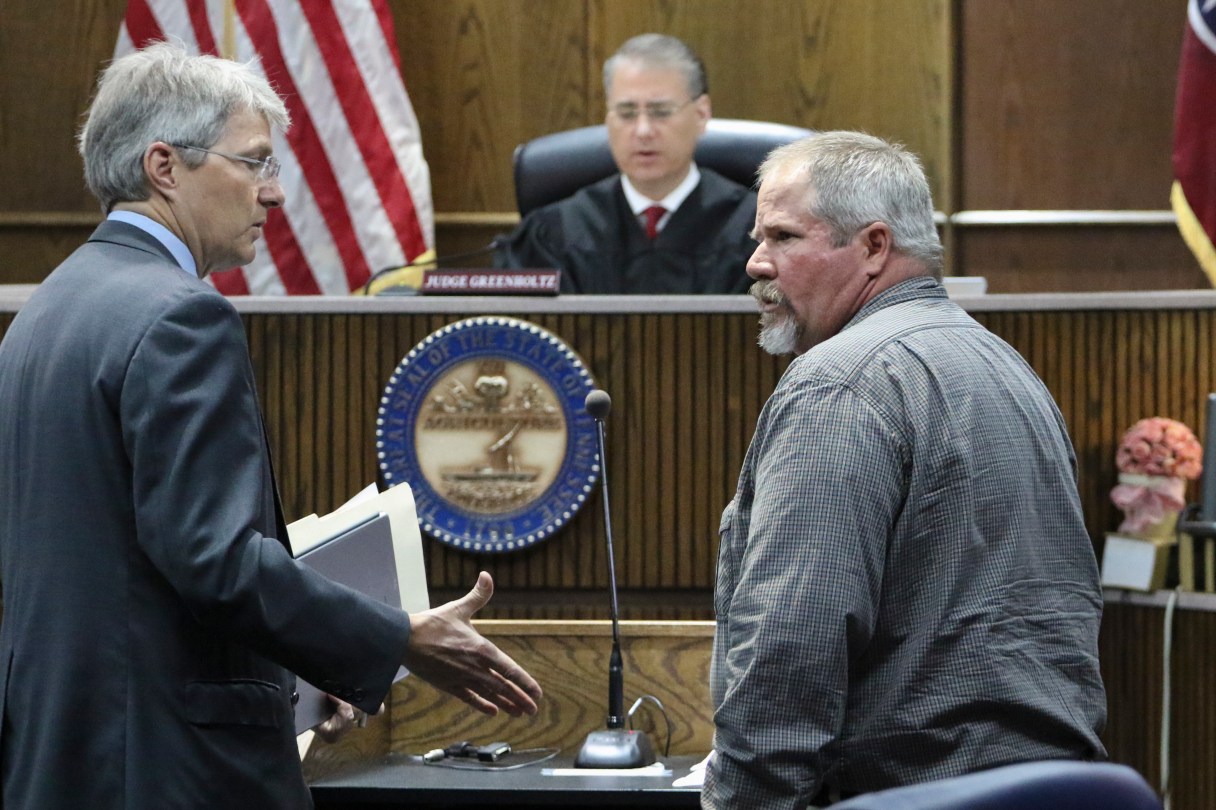

An Alabama man pleaded guilty this morning to voluntary manslaughter in a 28-year-old cold case.
Samuel Edward Reeves, 49, of Bryant, Ala., admitted to killing James “Richard” Layne in the La Plaza motel off Cummings Highway on Feb. 20, 1989, prosecutors said.
“I’m sorry for what happened,” Reeves said to a row of Layne’s family members.
Reeves will spend a year in Silverdale Correctional Facility before going on probation in Alabama. He faced three to six years for the charge, which is a class C felony.
Layne checked into the motel that afternoon to meet Reeves for sex, Hamilton County District Attorney General Neal Pinkston said. “And then, consent was violated.”
Prosecutors believe Reeves stabbed Layne 32 times, with wounds to the head, neck, chest, back, abdomen and arms, after he was provoked into violence.
The next morning, when Layne did not check out as scheduled, motel staff entered his room and found the 47-year-old Ringgold, Ga., man’s naked and bloody body on the floor, prosecutors said.
Investigators collected fingerprints from beer cans in the room, which were inconclusive.
Detectives continued to interview suspects, but Reeves’ name never came up, and the case quickly went cold.
Then, in summer 2016, the FBI said a fingerprint on one of the beer cans matched Reeves, who had recently been booked on a driving under the influence charge.
That revelation was key for Bill Phillips, who had been piecing together clues for the Chattanooga Police Department since 2004.
Phillips knew Layne told a friend that he met a young man from north Alabama. He also knew Layne never completed a check-in card at La Plaza in February 1989, “which probably left the suspect fillings it out.”
One card had an address in Chattanooga that was “nowhere near correct” with an Alabama zip code, Phillips said.
Encouraged, he sent the information to the Regional Organized Crime Information Center, which helps thousands of law enforcement agencies build cases by cross referencing records.
“After getting information from them in 2007, I saw from 1986 to 1988 he was at Auburn University with two addresses at that zipcode,” Phillips said. The FBI started feeding cold cases again through its updated systems in 2013, Phillips said.
When a match returned on Reeves in the summer of 2016, he refused to speak with investigators and hired defense attorney Lee Davis, prosecutors said.
Davis, a former prosecutor with the Hamilton County District Attorney’s Office, said detectives could have filed a first-degree murder or felony murder charge against Reeves.
There is no statute of limitations for murder, meaning the state can file those charges whenever it wants.
But prosecutors needed to file voluntary manslaughter cases within six years in this case, Davis said. They missed it by 22 years but agreed to the charge after several conversations because the evidence supported it, he said.
“Here the legal question is, do you insist on the statute of limitations and take your chance at trial on first-degree murder?” Davis said.
He and Pinkston agreed not to send the case to the grand jury, meaning Reeves was never formally arrested or indicted on the charges.
A courtroom officer took Reeves into custody at the end of the hearing and his wife and mother walked out alone.