
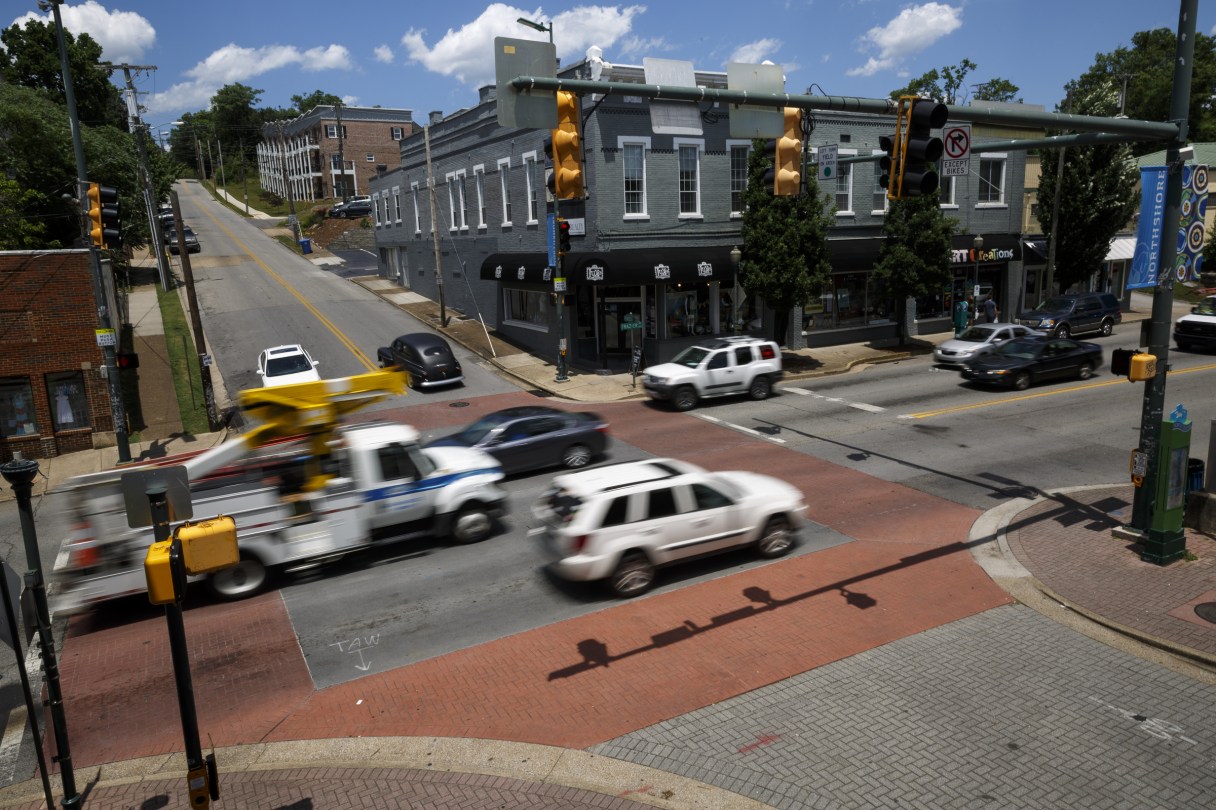

Now an iconic destination, the North Shore’s renaissance began in the early 1990s, when the reopening of the Walnut Street Bridge as a linear park brought a resurgence in interest – and businesses – to the Frazier Avenue corridor.
The North Shore Design Review Committee, which was established by the city of Chattanooga in the late ’90s, played a large role in that. The seven-person committee, recommended by the North Shore City Council representatives, appointed by the mayor and approved by the full City Council, needed to include an architect approved by American Institute of Architects Chattanooga; two members who could be either architects or landscape, interior or urban designers; a contractor or developer; a Realtor or engineer; a business representative recommended by the North Chattanooga Chamber Council; and a property owner, resident, or business operator in the North Shore zone. The group reviewed site and building proposals in the North Shore zone based on the North Shore Guidelines and other adopted land-use plans.
With the area transitioning to the new model of form-based codes approved by the City Council June 21, 2016, the group recently held its final meeting.
Form-based code has specific, measurable standards, and the results are more predictable and easier to enforce than the more subjective North Shore Guidelines, said Karen Hundt, executive director of the Chattanooga-Hamilton County Regional Planning Agency Community Design Group. Still, she feels the guidelines the Design Review Committee were responsible for upholding were successful in achieving their goals, but, like many of the former members, believes the changeover will further benefit the area.
“I’m quite sure we would have lost more of the existing commercial buildings had it not been for the guidelines,” she said. “Without the guidelines, new development would likely have been very suburban-looking, one-story, single-use buildings set back from the street, with parking in front.”
The guidelines called for multi-story, mixed-use buildings, built up to the sidewalk with shared parking. This type of development, which is predominantly what Frazier Avenue consists of now, helps to keep urban areas vibrant and to promote pedestrian activity, said Hundt.
But guidelines, unlike a formal code, are inherently flexible and open to interpretation, she added, and as a result, they were not always applied consistently across projects.
“The subjective nature of design guidelines do leave them open to some interpretation, and because they are not ‘code,’ they were sometimes difficult to enforce,” said Hundt.
Bill Wilkerson, an architect and member of the North Shore Design Review Committee during its first four years, said he regrets allowing the Walgreens at Frazier Avenue and Market Street to set its building away from the street with parking in front, not keeping with the character of the rest of the area. But he felt pressure to approve the project from area residents who wanted the Walgreens, which threatened to drop the project if the current design was not approved, he said.
Such digressions are not as likely with the new FBC, which have specific, measurable standards, making them easier to enforce. Ranges within the standards provide some flexibility, as does the Form Based Code Committee established by the city, which Chattanooga Historic Planning and Design Review administrative assistant Angela Wallace said has the same makeup and appointment process as the North Shore Design Review Committe. It is basically a variance board that considers projects that may not meet the specific standards, but do meet the intent of the FBC.
John Straussburger, a general contractor whose company developed Two North Shore and The Block and Jack’s Alley downtown, was a member of the NSDRC for the past two years and is chairman of the new FBCC. He said he saw a lot of frustration with the previous process and feels FBC are a more customer-friendly process.
FBC make the approval process quicker, because if a project meets all the applicable standards set forth, the developer does not have to go before a committee for approval, said Hundt. Developers for most projects do have to meet with the local neighborhood association to inform them of the project and what to expect, she added.
Straussburger said it’s a good sign that of the 37 site or building proposals received for the district as of last week, only five didn’t meet the standards of FBC and need to go before the board.
As a strong believer in property rights, Straussburger said he prefers FBC.
“It gives the applicant a lot more freedom as to the aesthetic of the building,” he said. “I think taste is very subjective, and if someone wants to paint their building pink, they can paint their building pink.”
Straussburger said the areas of focus for upcoming developments include Cherokee Boulevard and the west side of North Market Street. The next big project in the district is a $15 million to $20 million apartment complex at Cherokee and Manning streets.
Email Emily Crisman at ecrisman@timesfreepress.com.