
Thursday, October 29, 2026Oct 29

This story is free to read.

How one Hamilton County high school course focuses on forensic science

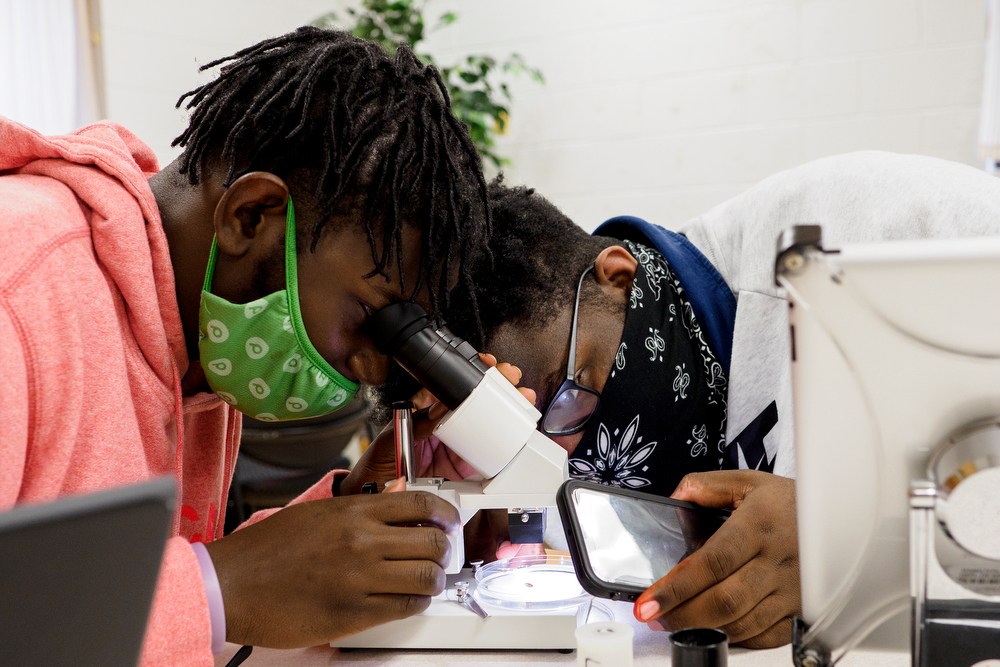
Staff photo by C.B. Schmelter / Senior Taylon Harris, left, looks through a microscope as fellow senior Richard Jones holds a light at the Harrison Bay Future Ready Center on Thursday, Sept. 24, 2020 in Ooltewah, Tenn. Inspired by the University of Tennessee at Knoxville's Forensic Anthropology Center, Justin Walley teaches a forensic science class where students study the decomposition of bodies by studying entomology.
Staff photo by C.B. Schmelter / Senior Taylon Harris, left, looks through a microscope as fellow senior Richard Jones holds a light at the Harrison Bay Future Ready Center on Thursday, Sept. 24, 2020 in Ooltewah, Tenn. Inspired by the University of Tennessee at Knoxville's Forensic Anthropology Center, Justin Walley teaches a forensic science class where students study the decomposition of bodies by studying entomology. Staff photo by C.B. Schmelter / Senior Taylon Harris, left, looks through a microscope as fellow senior Richard Jones holds a light at the Harrison Bay Future Ready Center on Thursday, Sept. 24, 2020 in Ooltewah, Tenn. Inspired by the University of Tennessee at Knoxville's Forensic Anthropology Center, Justin Walley teaches a forensic science class where students study the decomposition of bodies by studying entomology.

On a cold, dark and rainy Thursday afternoon, two high schoolers – 16-year-old Ozzy Paulus and 17-year-old Jacob Nation – walked on a path behind the Harrison Bay Future Ready Center.

There, they were greeted with the slight smell of animal remains.

As they continued along their way, they pointed out seven dead caged animals: a pigeon, a squirrel, an armadillo, a cat, a deer and two doves. The area was similar to a body farm.

“It smelled worse when we first came out here. That was about two weeks ago,” Paulus said. “You can see the deer’s insides are quite liquidated. That’s how we found it a few days ago.”

The boys then went back to their classroom. Along with their classmates, they examined insects that they took off the carcasses, using a mobile app to help identify the species.