
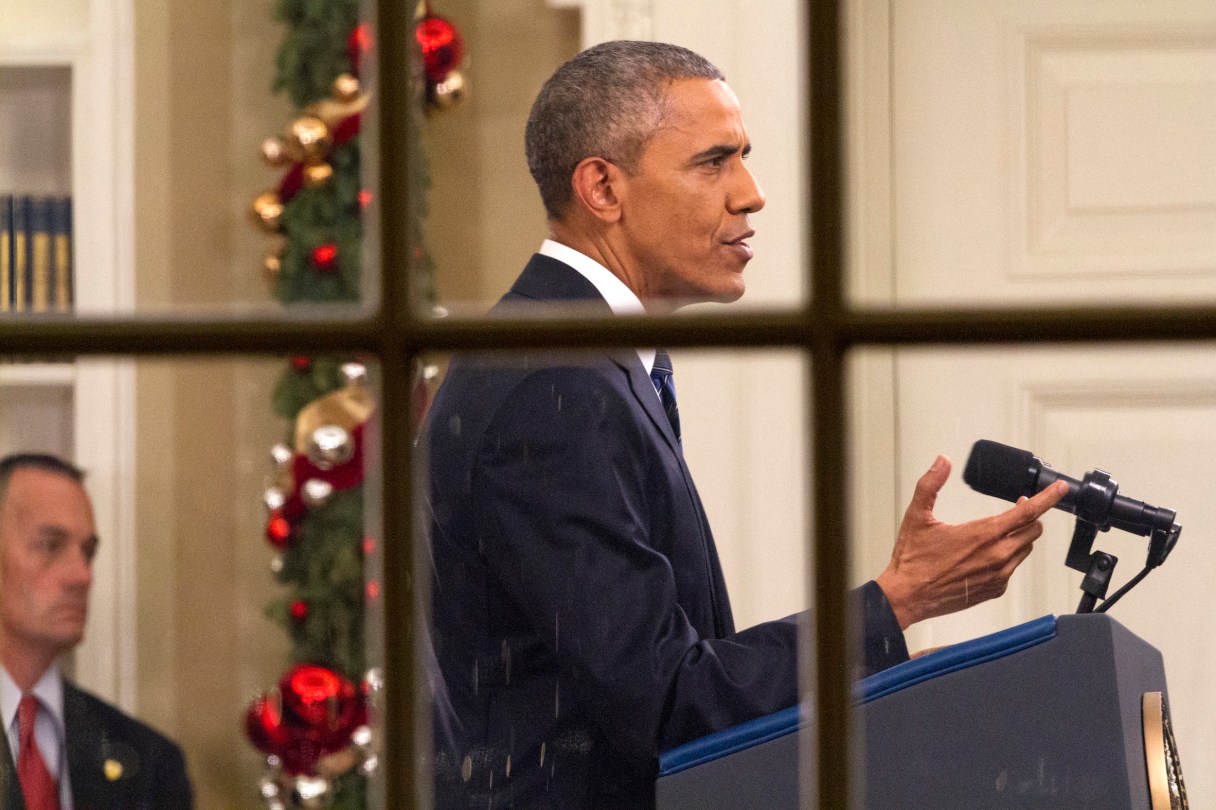
WASHINGTON – In his address to the nation on terrorism, President Obama warned against “tough talk.” On this, at least, no one can accuse him of hypocrisy.
In the aftermath of recent attacks, Obama perfunctorily ticked off a series of inputs: air strikes, arming and training Iraqi and Syrian forces, cooperating with allies on counterterrorism and pursuing a cease-fire in the Syrian conflict. And then he issued this directive: “I’ve ordered the Departments of State and Homeland Security to review the visa-waiver program.” Who at the White House thought it would be helpful for the commander in chief, after a terrorist attack on the American homeland, to order an interdepartmental review process?
 Michael Gerson
Obama gave a speech of reassurance for a policy that appears to be collapsing. The Islamic State has solidified control of vast territory and is displaying many of the characteristics of an actual nation. It has attracted jihadists from around the world to the conflict in Syria and Iraq, many of whom will return home with deadly skills. With the Paris attacks, the Islamic State has demonstrated the strategic capacity to strike in Western capitals. It counts affiliates in about a dozen nations, including a particularly successful Libyan branch operation.
Before the events of the last few weeks, it might have been possible to argue that Obama’s anaconda plan of slow strangulation could work in, say, five years. But is the threat revealed in Paris and elsewhere acceptable for five years? In this case, patience is a dangerous course.
Obama’s strategy has many elements that any future president, Republican or Democrat, would adopt. The only things missing are urgency and leadership. The president should convene his security team and ask: What would it take to degrade the Islamic State’s capabilities to strike in the west within one year? And to defeat it completely in two? Then the president should assemble a coalition sufficient to that task, comprised of forces from European allies, boots on the ground from Sunni nations and a more aggressive U.S. support role (much larger special forces to assist on the front lines, forward air controllers, relaxed rules of engagement).
Obama is correct that a parallel political track is essential. Syria will require a Lebanon-like peace, in which minorities are granted protection and power. It will be necessary to somehow re-convince the Sunni tribal leaders in Iraq that, if they fight the Islamic State, they will find protection and fair treatment in a unified country, instead of living under Shiite despotism.
The complexity of this military and diplomatic task would challenge any president. It is pretty much inconceivable that the “ender of wars” would suddenly assume this role in his seventh year in office. Obama has consistently done the minimal amount necessary to avoid the charge of fecklessness.
Obama’s call for tolerance of the Islamic faith is more than minimal; it is essential. But even this is put at risk by the broader crisis. “A continued failure to recognize the scale of the challenge and to construct the means necessary to meet it,” says Britain’s former Prime Minister Tony Blair, “will result in terrorist attacks potentially worse than those in Paris, producing a backlash which then stigmatizes the majority of decent, law-abiding Muslims and puts the very alliance so necessary at risk, creating a further cycle of chaos and violence.”
This is the challenge of America’s involvement in the Middle East. Because it is politically unpopular, there is a natural temptation to disengage. But after attacks, engagement will come – with more anger, on worse terms.
Washington Post Writers Group