
Friday, November 13, 2026Nov 13

‘Innovation Center’ tries to reinvent Medicare

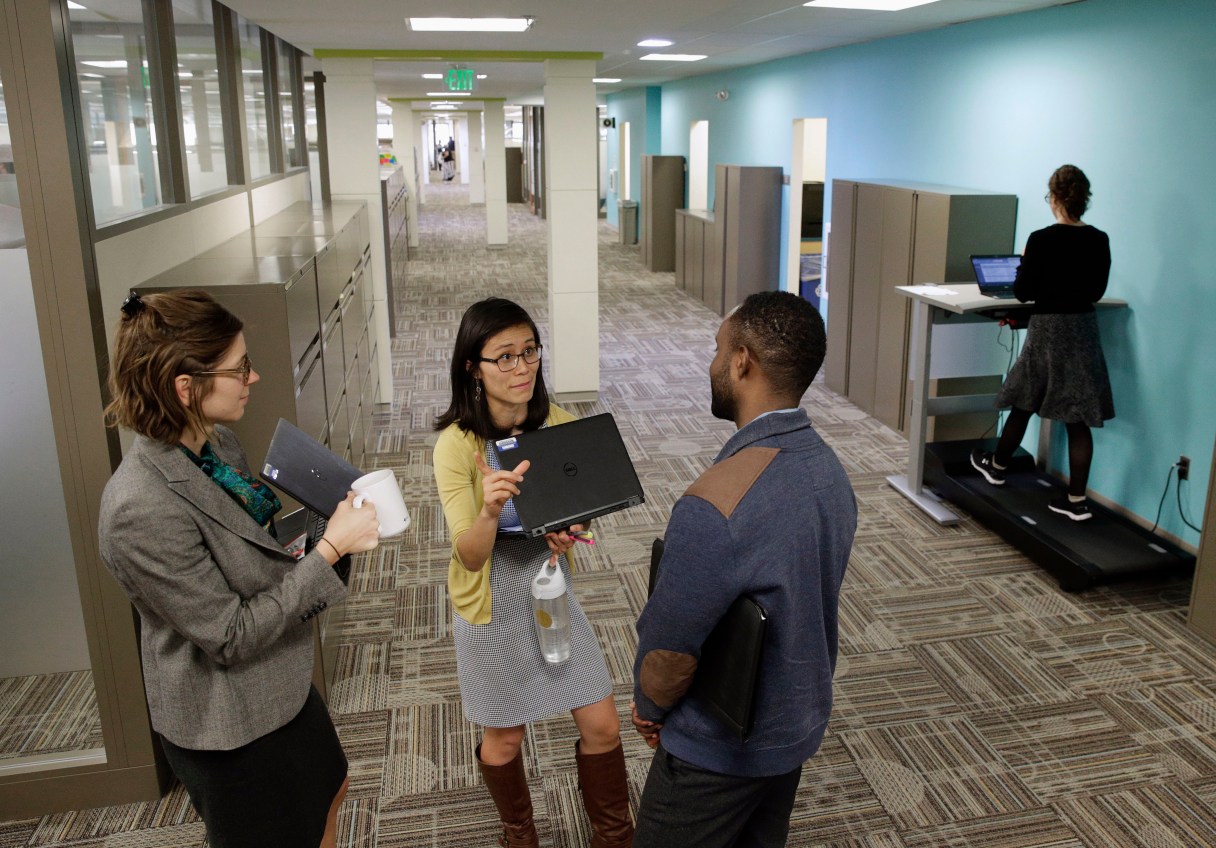
In this photo taken April 12, 2016, from left, Carlye Burd, Jen Zhu and Simeon Niles chat as Audrey Mitchell works on her laptop while using a treadmill at far right, at the Center for Medicare & Medicaid Innovation in Baltimore County, Md. In a sprawling, nondescript office park near Baltimore, some 360 people at the Center for Medicare & Medicaid Innovation are trying to change the health care system, using the government's premier insurance program as leverage. If they prevail, the U.S. may no longer have the worst of both worlds: unsustainable spending and unenviable results.  (AP Photo/Patrick Semansky)
In this photo taken April 12, 2016, from left, Carlye Burd, Jen Zhu and Simeon Niles chat as Audrey Mitchell works on her laptop while using a treadmill at far right, at the Center for Medicare & Medicaid Innovation in Baltimore County, Md. In a sprawling, nondescript office park near Baltimore, some 360 people at the Center for Medicare & Medicaid Innovation are trying to change the health care system, using the government's premier insurance program as leverage. If they prevail, the U.S. may no longer have the worst of both worlds: unsustainable spending and unenviable results. (AP Photo/Patrick Semansky) In this photo taken April 12, 2016, from left, Carlye Burd, Jen Zhu and Simeon Niles chat as Audrey Mitchell works on her laptop while using a treadmill at far right, at the Center for Medicare & Medicaid Innovation in Baltimore County, Md. In a sprawling, nondescript office park near Baltimore, some 360 people at the Center for Medicare & Medicaid Innovation are trying to change the health care system, using the government's premier insurance program as leverage. If they prevail, the U.S. may no longer have the worst of both worlds: unsustainable spending and unenviable results. (AP Photo/Patrick Semansky)

WASHINGTON (AP) – They work for the government and even their closest relatives have no idea what they do. It’s not because they’re spies or nuclear scientists, but because their jobs are so arcane: trying to reinvent Medicare to improve it, and maybe save taxpayers money.

In a sprawling, nondescript office park near Baltimore, some 360 people at the Center for Medicare & Medicaid Innovation are trying to change the health care system, using the government’s premier insurance program as leverage. If they prevail, the U.S. may no longer have the worst of both worlds: unsustainable spending and unenviable results.

“I want Medicare to exist not just for my mother, but for me and my kids,” said the director, Patrick Conway, 41, a pediatrician who also serves as Medicare’s chief medical officer.

At the center are doctors, lawyers, health policy experts, and career Medicare employees. Many came from outside government. They’re somewhat younger than Medicare’s core staff. Some have seen how parents and grandparents can be harmed in the nation’s disjointed health care system.

The center’s physical layout is meant to encourage discussion and debate. Meeting rooms have walls you can write on to diagram ideas. Laptops are at every meeting, but for thinkers who like to have a toy in their hands to play with, there’s a cigar box with colorful dinosaurs in one conference room.