
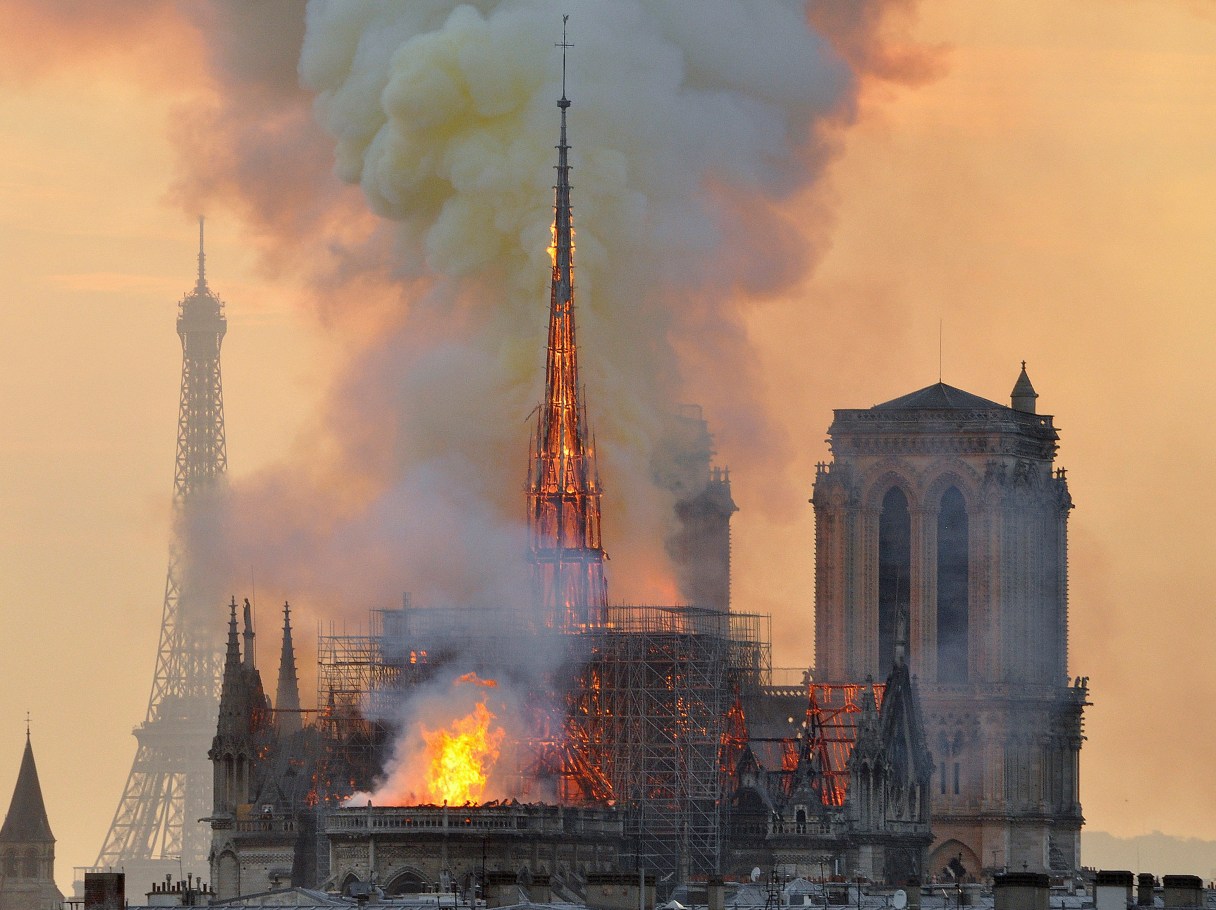
BORDEAUX, FRANCE – This recent Easter weekend, France was still reeling from the burning of the 800-year-old Notre Dame Cathedral in Paris. Its destruction is an apt metaphor for the devastation of Christianity across Europe – and a warning for us in the United States.
At Notre Dame’s much younger sister church in Bordeaux (construction began in 1684), Easter Mass was well attended. But in his homily the priest noted that the church now has only two Sunday masses; he could remember when there were seven. And for the first time in 15 years, there was not one new priest ordained in the diocese. Bordeaux, he said, was lucky; some French dioceses have not seen any ordinations in 20 years.
France was once one of the most Catholic countries in Europe. Today, while 64% of French people still identify as Christian, only 5% attend church regularly and just one in 10 pray daily. The younger generation is even less attached to the faith of their fathers. According to a study by the Benedict XVI Center for Religion and Society, only 26% of French young adults consider themselves Christians, and 65% say they never pray. The same sad story is playing out across the rest of Europe. The study found only three countries – Poland, Portugal and Ireland – where more than one in 10 young people said they attend a religious service weekly.
The situation in the United States is somewhat better: 39% of Catholics and 58% of evangelicals attend church services once a week, and even more say they go a few times a month. But the numbers are in decline among the young as well. Only 11% of younger millennials are weekly churchgoers, while 16% more go either once or twice a month, or a few times a year. The secular tsunami that has swept Europe is making its way across the Atlantic.
Elsewhere, in Asia and Africa, Christianity is growing – and, as we saw in Sri Lanka, is increasingly under attack. But in the West, modern secularism is slowly accomplishing what the totalitarian ideologies of the 20th century tried and failed to do: eradicate God from society. We are seeing the triumph of what Cardinal Joseph Ratzinger, in a homily a day before becoming Pope Benedict XVI, called the “dictatorship of relativism that does not recognize anything as definitive and whose ultimate goal consists solely of one’s own ego and desires.” On both continents, young people are putting off or forgoing marriage, and having fewer children – because a culture of self runs counter to the sacrificial love at the core of marriage and family.