
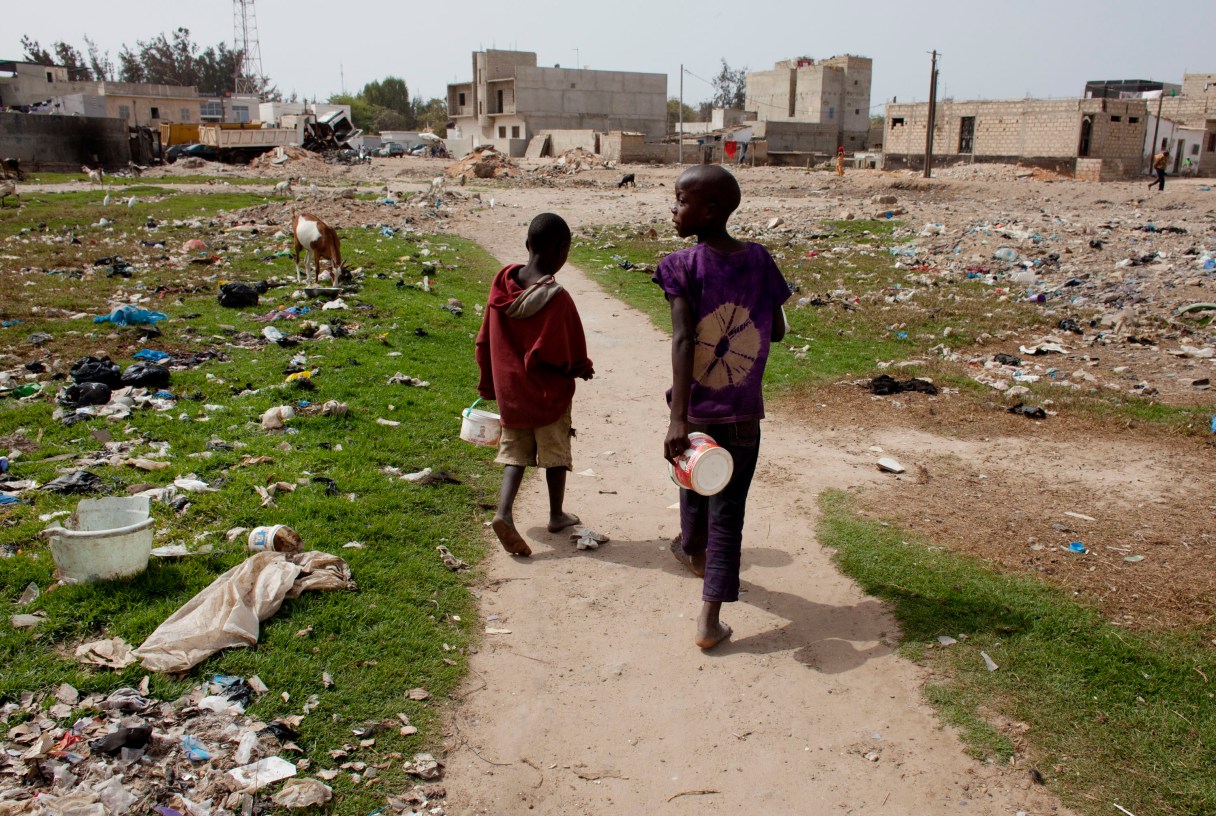
NDIAMAGUENE, Senegal – I am visiting Ndiamaguene village in the far northwest of Senegal. If I were giving you directions I’d tell you that it’s the last stop after the last stop.
It’s worth the trek, though, if you’re looking for the headwaters of the immigration flood now flowing from Africa to Europe via Libya. It starts here.
It begins with a trickle of migrants from a thousand little villages and towns across West Africa like Ndiamaguene, a five-hour drive from the capital, Dakar. I visited with a team working on the documentary “Years of Living Dangerously,” about the connection between climate change and human migration, which will appear this fall on the National Geographic Channel. The day we came, April 14, it was 113 degrees – far above the historical average for the day, a crazy level of extreme weather.
But there is an even bigger abnormality in Ndiamaguene, a farming village of mud-brick homes and thatch-roof huts. The village chief gathered virtually everyone in his community to receive us, and they formed a welcoming circle of women in colorful prints and cheerful boys and girls with incandescent smiles, home from school for lunch. But the second you sit down with them you realize that something is wrong with this picture.
There are almost no young or middle-aged men in this village of 300. They’re gone.
It wasn’t disease. They’ve all hit the road. The village’s climate-hammered farmlands can no longer sustain them, and with so many kids – 42 percent of Senegal’s population is under 14 years old – there are too many mouths to feed from the declining yields. So the men have scattered to the four winds in search of any job that will pay them enough to live on and send some money back to their wives or parents.
This trend is repeating itself all across West Africa, which is why every month thousands of men try to migrate to Europe by boat, bus, foot or plane. Meanwhile, refugees fleeing wars in Syria, Iraq and Afghanistan are doing the same. Together, these two flows pose a huge challenge for the future of Europe.
Tell these young African men that their odds of getting to Europe are tiny and they will tell you, as one did me, that when you don’t have enough money to buy even an aspirin for your sick mother, you don’t calculate the odds. You just go.
“We are mostly farmers, and we depend on farming, but it is not working now,” the village chief, Ndiougua Ndiaye, explained to me through a translator. After a series of on/off droughts in the 1970s and 1980s, the weather patterns stabilized a bit, “until about 10 years ago,” the chief added. Then, the weather got really weird.
The rainy season used to always begin in June and run to October. Now the first rains might not start until August, then they stop for a while, leaving fields to dry out, and then they begin again. But they come back as torrential downpours that create floods. “
When he was young, the chief said he could walk out to his fields any time during the planting season “and your feet would sink into” the moist earth. Now, he said, picking up a fistful of hot sand, the soil “is like a powder – it is not living anymore.”
Has he ever heard of something called “climate change”? I asked. “We heard about it on the radio, and we have seen it with our own eyes,” he answered. The temperature is different. The winds are different. They’re hot when they should be cold.
The chief’s impressions are not wrong. Senegal’s national weather bureau says that from 1950 to 2015, the average temperature in the country rose 2 degrees Celsius, much faster than anticipated, and since 1950, the average annual rainfall has declined by about 50 millimeters (about 2 inches). So the men of Ndiamaguene have no choice but to migrate to bigger towns or out of the country.
Which means they are losing the only thing they were rich in: a deep sense of community. With the land no longer producing enough, “everyone has a [male] family member who has had to leave,” said the chief. “I am afraid of losing my community, because my people can’t live here anymore.”
Africa has always had migrants, but this time is different. There are so many more people and so much less natural capital – Lake Chad alone has lost 90 percent of its water – and with cellphones everyone can see a better world in Europe.
Gardens or walls? It’s really not a choice. We have to help them fix their gardens because no walls will keep them home.