
Monday, November 16, 2026Nov 16

Summer camp helps kids with Tourette’s syndrome

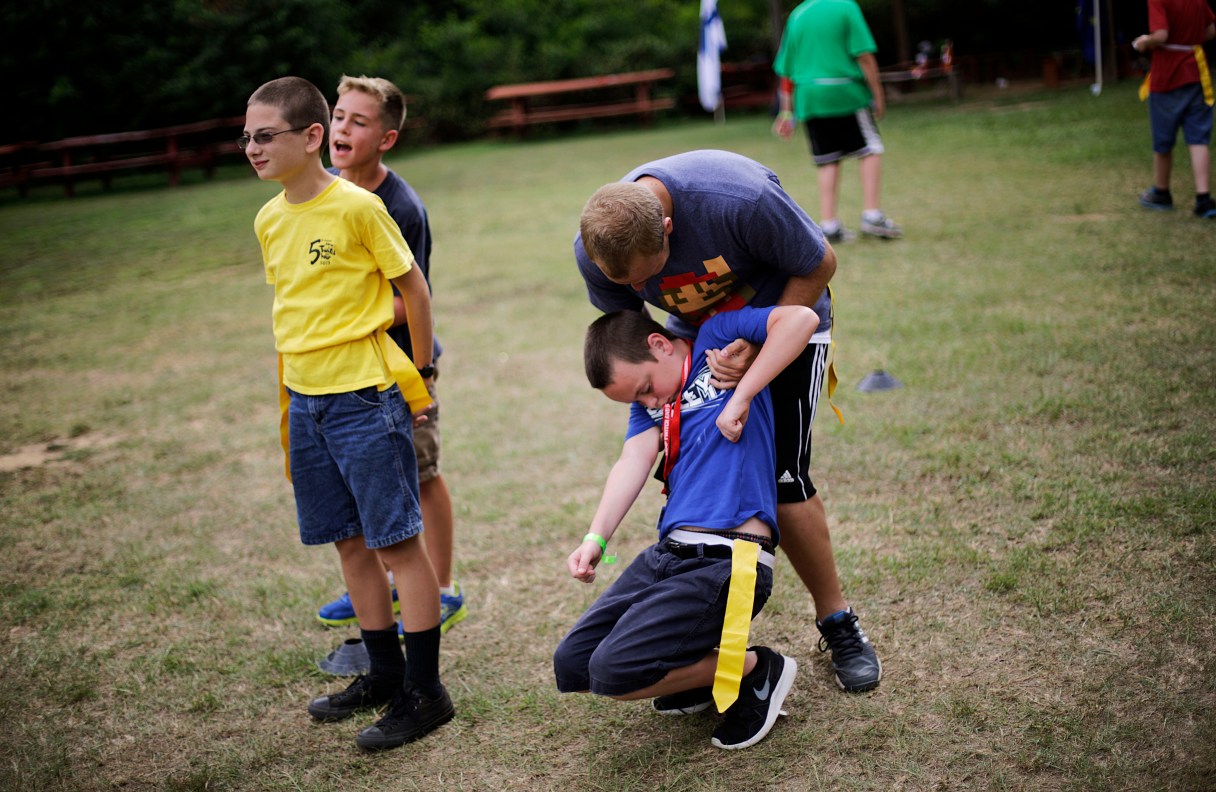
In this July 15, 2014 photo, counselor Paul Luongo, 24, right, catches camper Colton Semonasky, 12, of Leesburg, Fla., as he experiences a tic where he suddenly falls to the ground while running during a game of "capture the flag" with fellow campers at Camp Twitch and Shout, a camp for children with Tourette Syndrome in Winder, Ga. The children’s tics range from mild to severe. One child spits in someone’s face and apologizes. Others fall unexpectedly, so camp counselors always have an eye on them. (AP Photo/David Goldman)

WINDER, Ga. (AP) – Eleven-year-old Blake Desadier thought his mom was lying when she told him there were other kids like him with Tourette’s syndrome.

Then he went to “Camp Twitch and Shout,” a weeklong summer camp for children with Tourette’s, a neurological disorder that makes people have different types of involuntary muscle movements or speech. The camp helps children embrace the disorder. Many of the counselors also have Tourette’s.

“My mom wasn’t lying to me about how many people have Tourette’s,” said Blake, who is from New Orleans. His face twitches and he clears his throat uncontrollably.

Blake is one of about 170 kids who attend the camp each year. It ended Friday.

The National Institute of Neurological Disorders and Stroke estimates 200,000 Americans have the most severe form of Tourette’ syndrome. Symptoms are often worse in the early teens but improve into adulthood. Boys are affected more often than girls.