
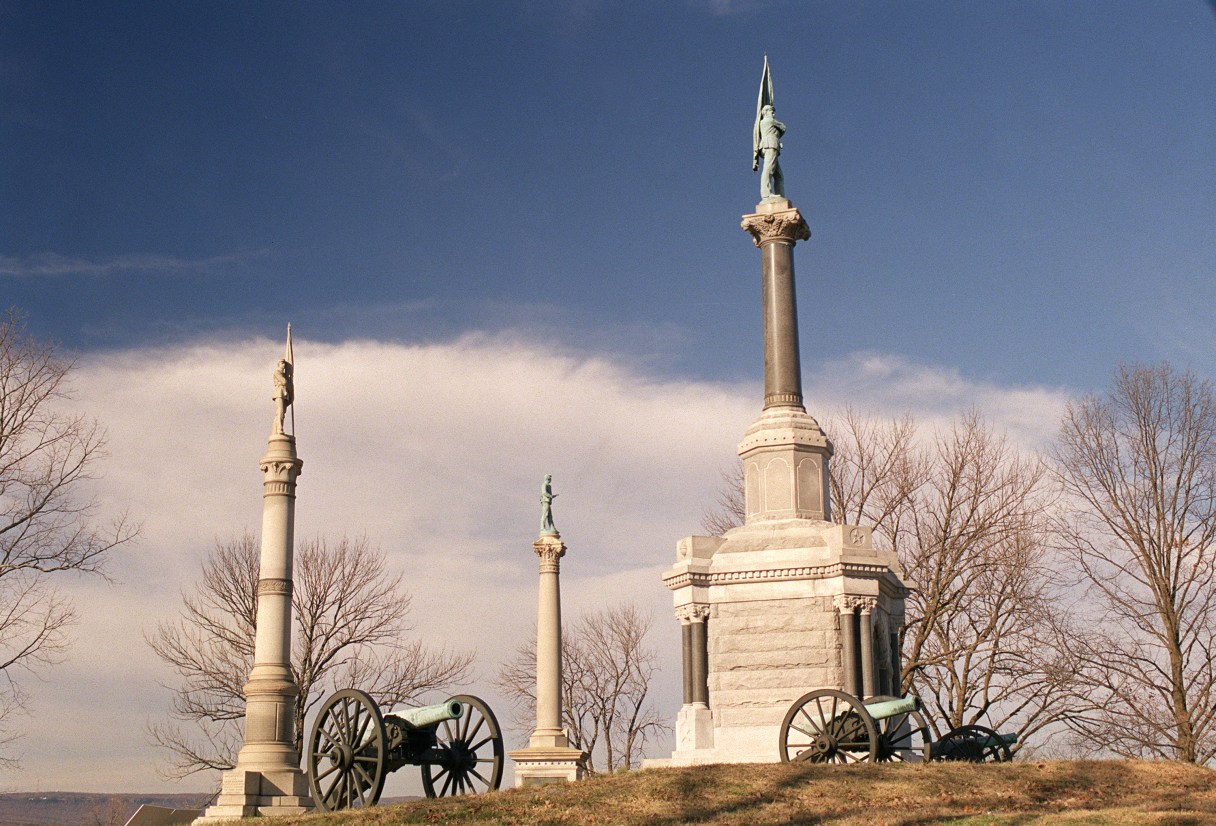
Bradford Torrey, a Boston journalist, wrote about his visit to Orchard Knob in “1895 Spring Notes from Tennessee.” Below are excerpts:
“The street cars that run through the open valley country from Chattanooga to Missionary Ridge, pass between two places of peculiar interest to Northern visitors – Orchard Knob on the left, and the national cemetery on the right.
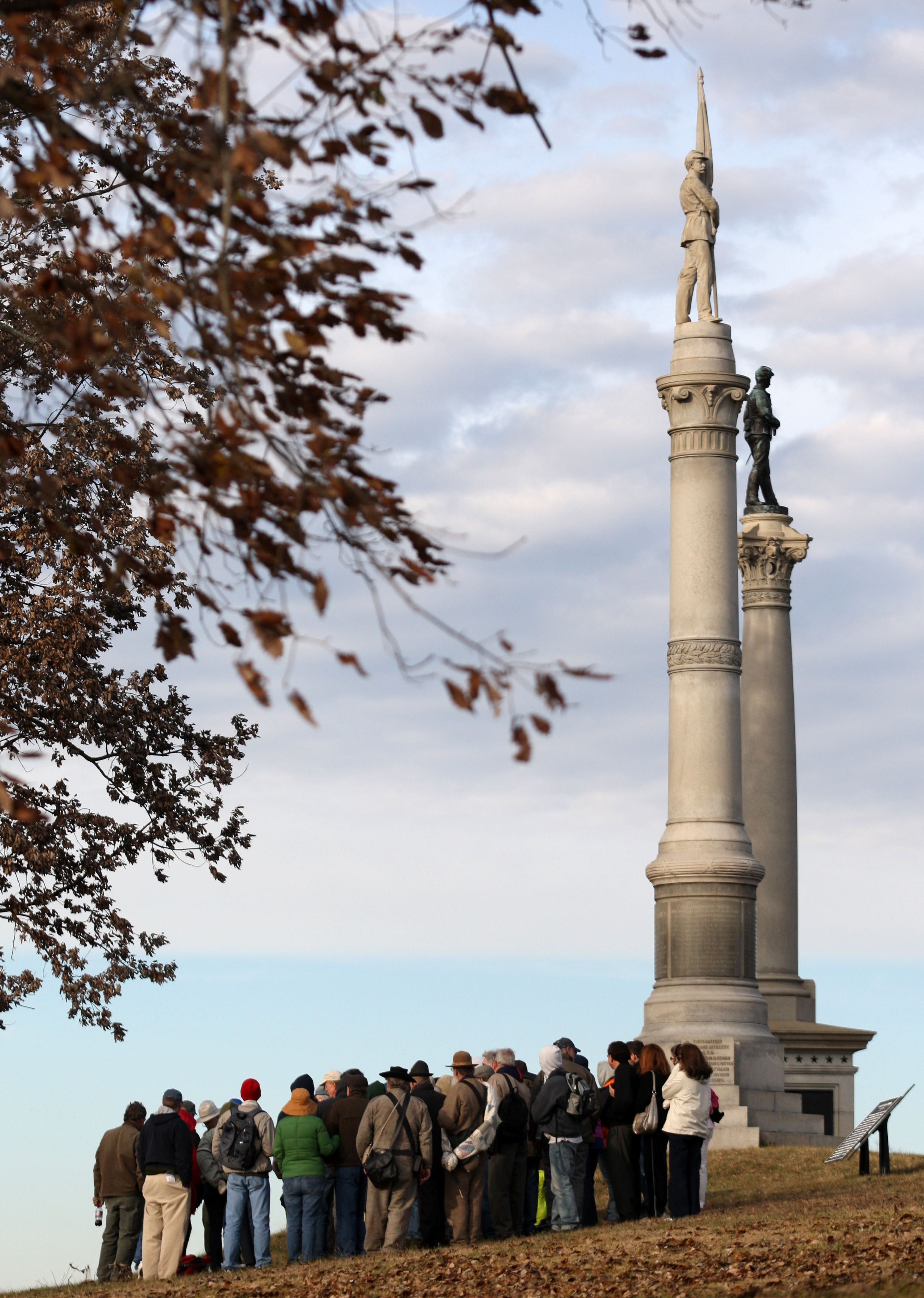 A crowd listens to Park Historian Jim Ogden during a tour at the Orchard Knob National Military Reservation on Saturday.
“Of these, the Knob remains in all the desolation of war-time; unfenced, and without so much as a tablet to inform the stranger where he is and what was done here; a low, round-topped hill, dry, stony, thin-soiled, with out-cropping ledges and a sprinkling of stunted cedars and pines. Some remains of rifle-pits are its only monument, unless we reckon as such a cedar rather larger than its fellows, which must have been of some size thirty years ago, and now bears the marks of abundant hard usage.
“The hill was taken by the Federal troops on the 23rd of November, 1863, by way of ‘overture to the battle of Chattanooga,’ [Gen. Ulysses S.] Grant, [Maj. Gen. George Henry] Thomas, [Maj. Gen. Joseph] Hooker, [Maj. Gen. Gordon] Granger, [Maj. Gen. Oliver Otis] Howard, and others overlooking the engagement from the ramparts of Fort Wood. The next day Hooker’s men carried Lookout Mountain, while the multitude below, hearing the commotion, wondered what could be going on above them, till suddenly the clouds lifted, and behold, the Confederates were in full flight. Then, says an eyewitness, there “went up a mighty cheer from the thirty thousand in the valley, that was heard above the battle by their comrades on the mountain.” On the day following, for events followed each other fast in that spectacular campaign, Grant and Thomas had established themselves on Orchard Knob, and late in the afternoon the Union army, exceeding its orders, stormed Missionary Ridge, put the army of Bragg to sudden rout, and completed one of the really decisive victories of the war.
 This photo from around 1900 shows the corner of Ivy Street and Orchard Knob Avenue with view of Orchard Knob Reservation gate. (Photo courtesy of Chattanooga Public Library)
“For a man who wishes to feel the memory of that stirring time there is no better place than Orchard Knob, where Grant stood and anxiously watched the course of the battle, a battle of which he declared that it was won ‘under the most trying circumstances presented during the war.’ For my own part, I can see the man himself as I read the words of one who was there with him. The stormers of Missionary Ridge, after making the demonstrations they had been ordered to make, kept on up the slope, thinking ‘the time had come to finish the Battle of Chickamauga. As soon as this movement was seen from Orchard Knob,’ writes Gen. Fullerton, ‘Grant turned quickly to Thomas, who stood by his side, and I heard him say angrily, “Thomas, who ordered those men up the ridge?” Thomas replied in his usual slow, quiet, manner, “I don’t know; I did not.” Then, addressing General Gordon Granger, he said, “Did you order them up, Granger?” “No,” said Granger, “they started up without orders. When those fellows get started all hell can’t stop them.”‘