
Sunday, November 15, 2026Nov 15

Trump administration strikes tougher stance before China talks

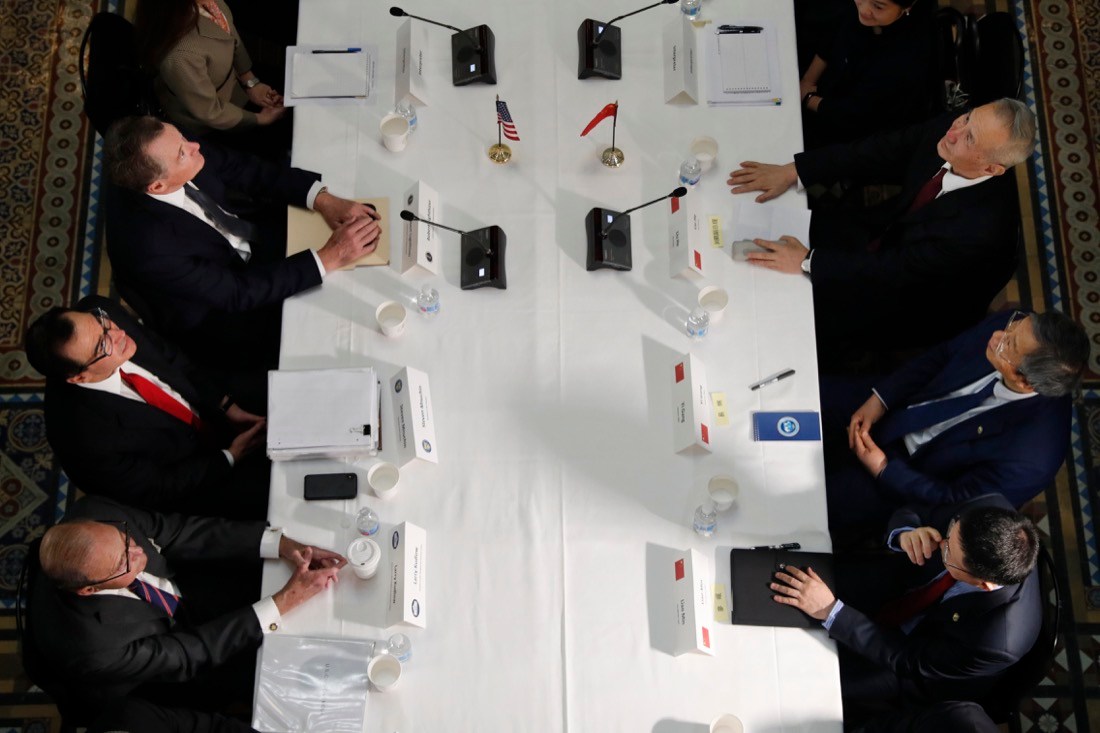
In this Feb. 21, 2019, file photo senior US-Chinese officials resume trade negotiations as they meet during continuing meetings on U.S.-China trade in Washington. With the U.S. delegation are U.S. Trade Representative Robert Lighthizer, top left, Treasury Secretary Steve Mnuchin, center left, and White House economic adviser Larry Kudlow, bottom left. At right from top are Chinese Vice Premier Liu He, and Chinese officials Yi Gang, and Liao Min. Top U.S. trade and economic officials will visit China late next week for another round of negotiations, a White House official says. (AP Photo/Jacquelyn Martin, File)

President Donald Trump said the United States would keep tariffs on $50 billion worth of Chinese goods in place even if the two sides reached a trade deal, channeling a tougher approach as his negotiators head to Beijing this weekend for a crucial round of talks.

Trump’s remarks, made in a television interview that aired Friday, are likely to unsettle Chinese negotiators, whose main goal in the talks is to convince the United States to remove as many of the $250 billion worth of tariffs that have been imposed.

While Trump had agreed late last month not to raise tariffs on Chinese goods, the administration is coalescing around the need to retain at least some of the tariffs as it looks for a way to ensure that China keeps whatever promises it makes in a trade agreement.

Robert Lighthizer, Trump’s top trade adviser, prefers to phase out many of the tariffs over time as China proves its willingness to follow through with economic changes sought by the Trump administration, people familiar with his thinking say. But it is unclear whether China will make enough concessions to satisfy the United States if the tariffs remain in effect.

The two sides are now pushing for a summit in late April to sign a trade deal.