
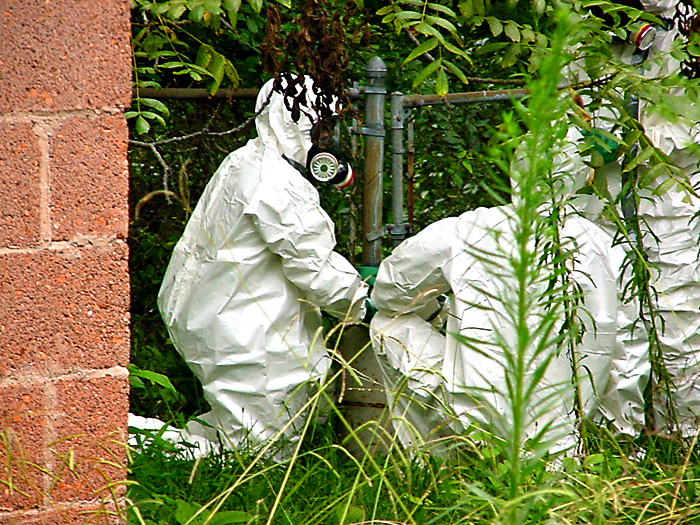
 PHOTO BY TENNESSEE METHAMPHETAMINE TASK FORCE – Three lab technicians assess the contents taken from a house in Soddy-Daisy where a meth lab was discovered.
As debate continues over how to tackle the Southeast’s increasing number of meth labs, authorities agree on one thing — the drug is depleting Tennessee’s financial resources.
Officials estimate that one man cost the state $1.5 million after a meth lab he is charged with operating exploded.
Mark Buckner was airlifted to the Vanderbilt University Regional Burn Center for four months of treatment after a meth explosion in October 2009, said Tommy Farmer, director of the Tennessee Methamphetamine Task Force.
The uninsured McMinn County man’s bill went up at the rate of $10,000 a day — it cost $1 million to heal the burns covering his face and body, Farmer said.
Almost a year later, police found Buckner making meth again, Farmer said. Buckner was indicted and, if convicted, faces a 10-year prison sentence. The cost for prosecution and imprisonment could add up to about $500,000, he said.
Local police estimate there are hundreds of similar cases.
A Rand Corp. study released in 2009 estimated that the overall cost of meth to the nation was $23 billion in 2005.
When police discover a meth lab, it takes at least four hours to clean it up, said Lt. Van Hinton with the Hamilton County Sheriff’s Office. Investigators have to secure an area, book suspects in jail and wait for a clean-up crew to take care of the lab, he said.
“It can be overwhelming for any department,” Hinton said.
Farmer said each meth lab costs the state between $2,000 and $3,500 to clean.
Also, meth cases are among the most expensive to prosecute, said Scott Burns, National District Attorneys Association executive director.
“It’s a lot more complicated, time-consuming and expensive,” he said. “You have to deal with toxic and dangerous chemicals.”
CONTINUE READING Cold war cooking: Battle lines being drawn to limit access to meth ingredients
In other criminal cases the evidence may be a gun or a knife, but with meth cases all the contents seized at a lab scene have to be documented and then properly destroyed, Burns said.
Aside from the monetary cost, the drug also affects families, said Catherine Schueman, site manager for Highland Rivers Treatment Services in Calhoun, Ga.
Georgia Division of Family and Children Services records showed 484 children were taken into protective custody in meth-related cases in 2010, The Associated Press reported.
Schueman said she sees children forced from homes where parents have been caught cooking meth. And she works with young teenagers who became addicted to meth after their parents became users, she said.
“I get to see the children going from foster home to foster home,” Schueman said. “Kids end up living with grandmother if they’re lucky.”
Contact Joy Lukachick at jlukachick@timesfreepress.com or 423-757-6659.