
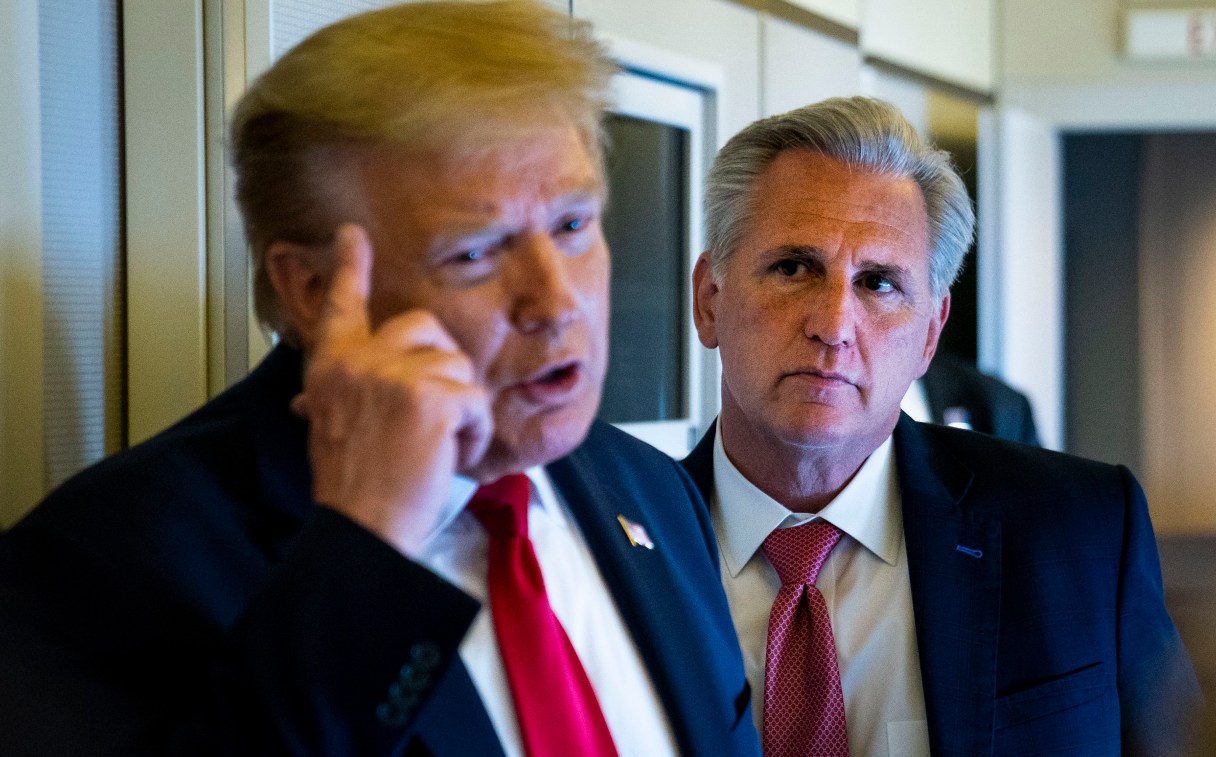
When I first heard the rumblings that Donald Trump could become the next speaker of the House, I rolled my eyes.
What fresh insanity, right? Like most people, I believed the speaker of the House had to be an elected member of Congress.
Think back to the speakers you’ve heard of. Not just the most recent ones, but also Sam Rayburn of Texas. Tip O’Neill, the Boston pol who dominated the House of Representatives when I was coming of age. Newt Gingrich, who changed the course of conservative American politics. James K. Polk! Henry Clay!
Every single one of them was a member of the House. So pardon my ignorance for thinking it was a requirement.
In fact, there is no law or constitutional mandate that limits the speakership to an elected representative. There isn’t even a House rule about it. It’s just a norm, and we know what those are worth these days.
To become speaker, all a person needs to do is win an absolute majority of votes cast by the elected members of the House. That person could be the D.C. dog catcher. Or, worse, it could be Donald Trump.
The first I heard of this awful idea was back in June, when it was floated by Trump sycophant Rep. Matt Gaetz (R-Fla.).
“Can you just imagine Nancy Pelosi having to hand that gavel to Donald J. Trump?” Gaetz crowed in a speech.
A Trump spokesman said the former president had “zero desire” to be speaker.
In November, former Trump Chief of Staff Mark Meadows suggested it again on Stephen K. Bannon’s “War Room” podcast. Bannon chimed in, suggesting the ex-president could “come in [as speaker] for 100 days to sort things out” and then go back to running for president in 2024. By “sort things out,” he apparently meant beginning impeachment proceedings against President Biden.
These guys are provocateurs. But given the state of politics in the U.S. right now, can even lunatic propositions be ruled out?
Some experts have opined that the speaker rumors were just a way of trolling House Minority Leader Kevin McCarthy, who is in line to become speaker if the GOP takes control. They suggest the idea is a ultraconservative Freedom Caucus push because of dissatisfaction with McCarthy, a reliable Trump bootlicker but apparently not enough of a wacko for Reps. Gaetz and Marjorie Taylor Greene and their ilk.
Trump, unsurprisingly, has failed to rule out taking charge of the House. “Well, I’ve heard the talk and it’s getting more and more,” he said. He added that he had “a good relationship with Kevin and hopefully we will do everything traditionally.”
I’d consider that weak reassurance if I were McCarthy.
What’s in it for Trump? He’d get some headlines, yeah. And some more disruption.
But it’s hardly his sort of job. “Effective speakers do a lot of glad-handing, do favors, deal with minor issues like ‘Fix the carpet in my office’ – and other grunt work,” says Matthew Green, a professor of political science at Catholic University who studies Congress.
Not that the job isn’t powerful. Speakers have a role in appointing committee members and chairs, decide points of order, recognize who gets to speak on the floor and control what measures move forward. They can dole out or withhold favors. They play a leading role in negotiations with the president and they’re usually leader of the majority party caucus. They’re also third in line of presidential succession, after the vice president.
It would be a disaster if Trump were given the gavel. He shouldn’t be in any position of power whatsoever. Also Congress should be overseen by an elected official, accountable to voters – not by an unelected, irresponsible demagogue with only his own interests at heart.
Should we prepare ourselves for Speaker Trump? Probably not, but when it comes to our ex-president, you can’t rule out any bit of chicanery or malevolence. Trump and his acolytes could be trolling for the heck of it, or it could be a sinister plot, like the equally unimaginable but all too real effort to delegitimize and reverse the 2020 election.
I didn’t take that too seriously either at first, and boy was I wrong.
Los Angeles Times