
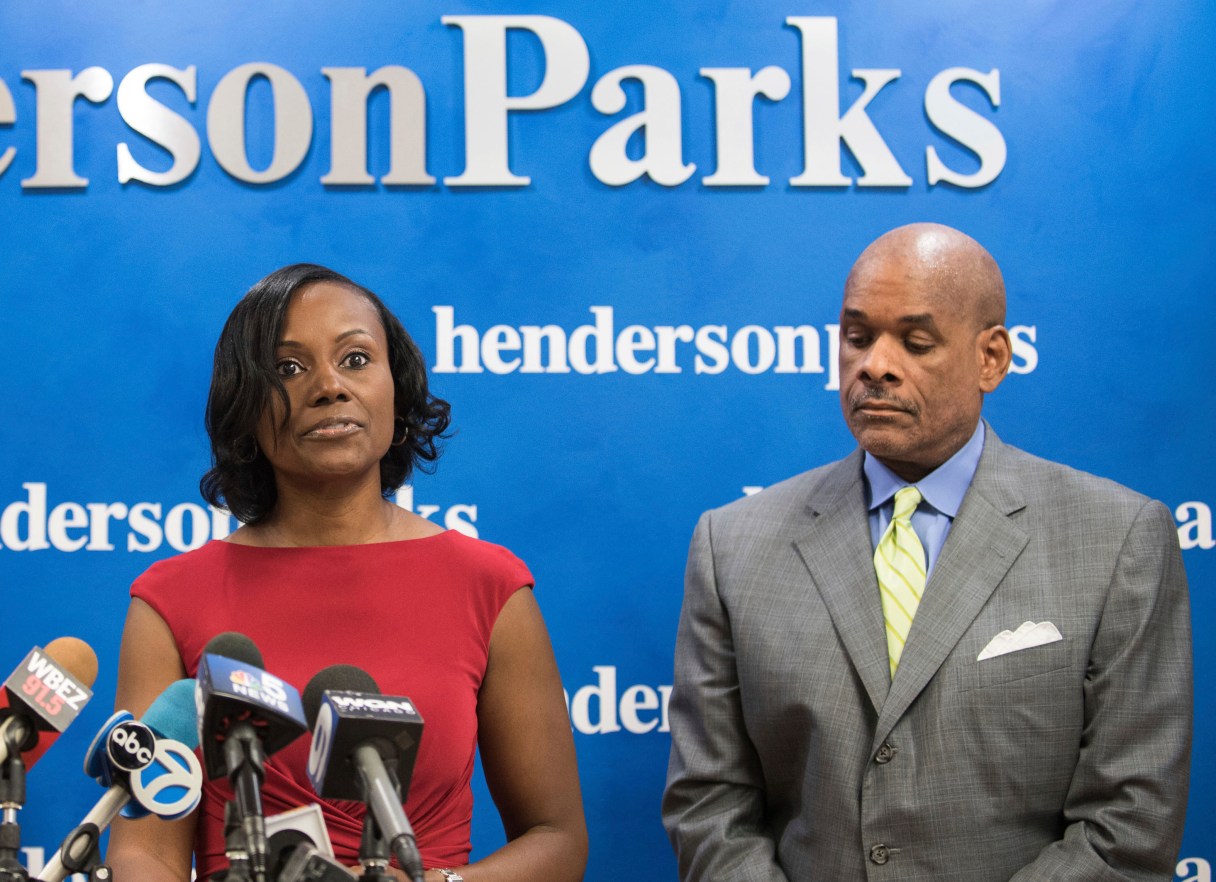
CHICAGO (AP) – A nurse-turned-law clerk is the only candidate listed on next week’s general election ballot for an open Chicago-area judgeship, even after she was fired from her courthouse job and criminally charged for donning a robe and presiding over traffic cases that should have been heard by a real judge.
Legal observers say there’s no obvious reason Rhonda Crawford was able to easily win the Democratic primary in March over two more experienced jurists who received good reviews by legal associations.
Illinois is one of several states where party-affiliated candidates run for vacant judicial seats. Critics say the system often renders candidate records irrelevant and often means races are decided more by clout, identity politics and sheer luck. More superficial factors, like the sound of a candidate’s last name or ballot position, can end up swinging the outcome.
Some 30,000 judges across the U.S. hear millions of cases each year ranging from traffic to murder, there is no commonly accepted best practice for how to select these public officials. Reformers say imperfect systems sometimes provide openings for substandard judicial candidates to sneak through.
Critics say Crawford is a case in point.
The 45-year-old heard several actual traffic cases on Aug. 11 after her Democratic primary victory in March, telling reporters later that she saw it as part of her preparation for becoming a judge. When word spread about what she’d done, she was fired from her $57,000-a-year position and was recently charged with official misconduct.
The Illinois Supreme Court this week temporarily suspended her law license during civil disciplinary proceedings. That means even if she wins Tuesday’s election as expected over a write-in opponent, she would have to be cleared of wrongdoing before she could be sworn-in to the $180,000-a-year job that’s seen as a gateway to higher court posts.
With no consensus on judicial selection , systems vary by state and sometimes even by county within the same state. Most states have ended up mixing aspects of several different systems that have fallen in and out of favor every couple decades, said William Raftery, an analyst at the National Center for State Courts.
“You still have that (1800s) Jacksonian idea that every official should be elected – from dog catcher and coroner,” he said. “But people also think judges shouldn’t be thrown off the bench just for making an unpopular ruling … that judges are supposed to be experts in law, not really good politicians.”
Four other states – Texas, Louisiana, Alabama and Pennsylvania – largely use partisan elections with features similar to Illinois, according to the Brennan Center for Justice at NYU School of Law; 16 hold non-partisan elections, 14 use strict merit selection and a few depend on gubernatorial or legislative appointments. Many states use one system is used for lower-court judges and another for appellate judges.
Bar associations have periodically led drives – with limited success – to overhaul a state’s judicial selection system. A 2016 Brennan Center for Justice report says South Dakota in 1980 was the last state to move from electing judges to a system based primarily on merit.
Illinois is strewn with failed bids for change.
Voters were asked in 1970 whether they wanted to switch to a merit system, where aspiring judges would be vetted by committees, then appointed. Cook County voters backed the idea, though much of the rest of Illinois didn’t – so the partisan-voting method remained.
A retention-vote provision adopted by Illinois in 1964 was hailed by anti-corruption activists as a mechanism for voters after each judge’s term ends to periodically give bad ones the boot. But in practice, it hasn’t worked. Out of hundreds of judges up for retention in Cook County over the last 25 years , not one has fallen below a 60 percent approval threshold that would force them off the bench.
A dizzying number of judicial races on Cook County ballots make it that much harder for voters to make informed decisions. Around 70-some judicial retention votes and judicial races, including Crawford’s, are on the more than-a-dozen page Cook County ballot for next week, making them among the longest in the nation. Democrats dominate the county’s politics, and Republicans frequently don’t even put candidates on the ballot.
Crawford worked as law clerk and staff attorney for the chief judge of the Circuit Court of Cook County, Timothy Evans, from 2011 until Evans fired her in August after it became known that she had played a judge.
Burt Odelson, an attorney for the write-in candidate against Crawford, says he assumes that because Evans hired Crawford, he may have backed her behind the scenes leading up to the primary. But no public records indicate he did anything at all to help her. A spokesman for Evans’ office declined immediate comment.
Crawford’s attorney, Victor Henderson, said Democratic powerbrokers are seeking to undermine her candidacy by blowing out of proportion the judge impersonation charges.
“It’s machine politics as usual,” he said.