
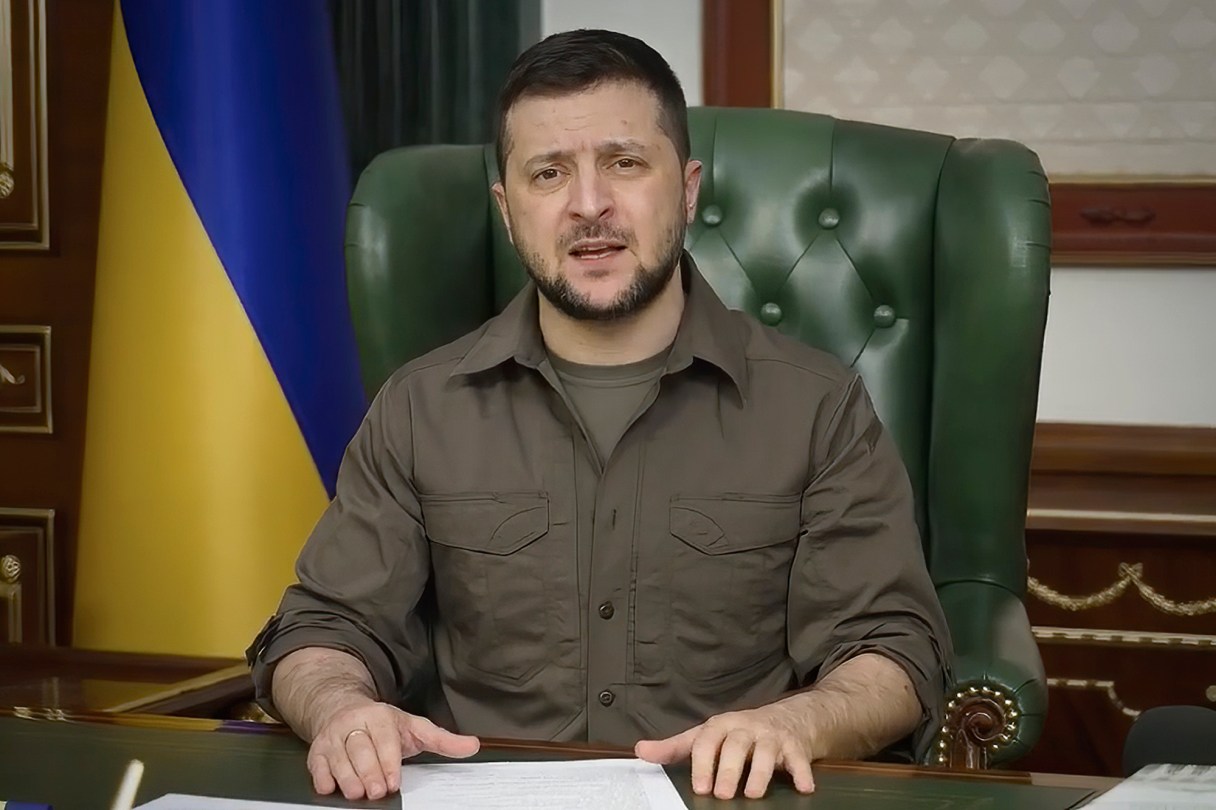
Not in a generation, maybe several generations, have we seen a political leader as adept as Ukraine’s Volodymyr Zelenskyy at matching his soaring emotional rhetoric to his audience.
When he talked to the British parliament to argue for the no-fly zone his nation desperately wants, he quoted Winston Churchill. When he spoke to the Canadian parliament, he asked his listeners to imagine their feelings if Toronto or Vancouver were attacked.
When he spoke to the joint session of the Congress on Wednesday, he came armed with a skillfully produced and emotionally powerful video, referenced Pearl Harbor and quoted Martin Luther King Jr.
And when Zelenskyy spoke to Germany’s Bundestag Thursday, he centered his remarks around Ronald Reagan’s famous demand of Mikhail Gorbachev that he remove the Berlin Wall.
“Tear down this wall,” Zelenskyy said Thursday. “Give Germany the leadership that Germany deserves, so that your descendants will be proud of you.”
Zelenskyy also clearly knows that there is another audience member watching from the metaphorical balcony: Vladimir Putin.
And he’s gambling that he’s a charmless man stuck in an increasingly unpopular war at home and looking for a way out.
There was a subtext to all three of those speeches, and it involved Zelenskyy shrewdly distancing himself from NATO.
In the speech to Congress, Zelenskyy made mention of a new idea: the creation of something he called “U-24,” or “United for Peace,” seemingly a nimble third alliance that might co-exist with NATO and the oppositional axis of China and Russia (and their allies), with “U-24 keeping the peace, coming immediately to the aid of countries under attack and even acting as a clearinghouse for humanitarian aid following disasters other than warfare.
Zelenskkyy described this aspiration as “a union of responsible states with the strength and conscience to stop conflicts. Immediately. Provide all necessary assistance within 24 hours. If necessary, with weapons. If necessary, with sanctions, humanitarian support, political support, money. Everything we need to keep the peace.”
He added that his new multinational organization could assist “those who are experiencing natural disasters, man-made disasters, who have become victims of a humanitarian crisis or an epidemic.” He even included improving the delivery of COVID-19 vaccines to needy nations.
Generally speaking, the reaction to “U-24 from those in the foreign policy establishment to whom we spoke last week was that the idea was idealistic, for sure, but also impractical and expensive. It’s not a solution to the immediate crisis, as Zelenskyy surely is well aware.
But this was an effective way of Zelenskyy signaling to Putin that he was casting around for an alternative to his nation’s NATO membership.
Maybe the Zelenskyy subtext goes even deeper than that. For example, the BBC’s John Simpson, choosing to be optimistic about the emergence of a back-door way for Putin to save face at home and declare victory even as he loses, argued that Zelenskyy was, in fact, asking NATO for something (a no-fly zone) that he well knew it could not and arguably should not deliver. That would allow Zelenskyy to save face at home by declaring the alliance not worth joining anyway (hence U-24) and subtly telling Putin that he will get something that will in turn let him save face, too.
Perhaps that’s too far down the subtextual rabbit hole.
Still, Zelenskyy is delivering a succession of stunning international performances. Putin is being reduced to rhetorical rubble, and we could not be more impressed with the Ukrainian leader, nor more anxious that the killing of innocents soon will cease.
The Chicago Tribune