
ATLANTA – The trajectory of opioid deaths in the United States is trending in the wrong direction and has to be moved to the top of the federal government’s radar screen along with the threat of terrorism and promoting a strong economy, President Barack Obama said Tuesday.
Obama said more people are being killed from opioid overdoses than from traffic accidents. “I think the public doesn’t fully appreciate yet the scope of the problem,” Obama told about 2,000 people attending the National Rx Drug Abuse & Heroin Summit.
Obama’s appearance at the conference came as his administration issued proposed regulations and announced new funding for states to purchase and distribute the opioid overdose reversal drug, naloxone, and to train first responders and others on its use. The actions also coincide with a commitment from 60 medical schools to heighten training for prescribing opioids.
Opioids are highly addictive drugs that include both prescription painkillers like codeine and morphine, as well as illegal narcotics, primarily heroin. Deaths linked to opioids soared to more than 29,000 in 2014, the highest number on record.
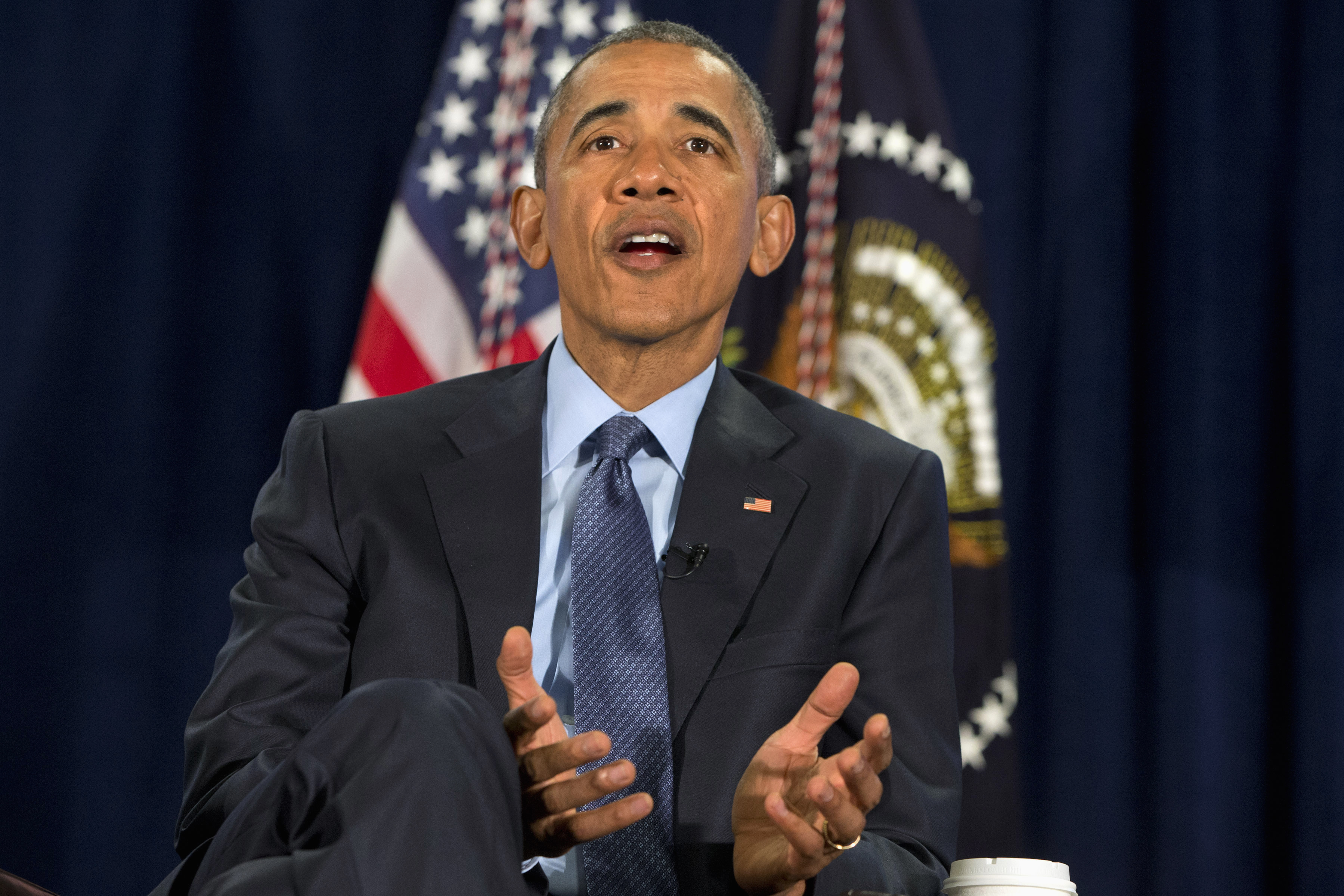 President Barack Obama speaks at the National Rx Drug Abuse & Heroin Summit, Tuesday, March 29, 2016, at AmericasMart in Atlanta. The panel is moderated by Sanjay Gupta, also on the panel are Justin Riley, President and CEO of Young People in Recovery, Crystal Oertle of Ohio, and Dr. Leana Wen, the Baltimore City Health Commissioner. (AP Photo/Jacquelyn Martin)
“There are not enough of us to provide the care needed,” said Dr. Daniel Sumrok, director of the Center for Addiction Sciences at the University of Tennessee Health Science Center College of Medicine. “Over half of the people with opiate abuse problems right now can’t get access to treatment.”
Sumrok also praised the increased emphasis on training medical students. The U.S. Centers for Disease Control and Prevention last week announced new guidelines for prescribing opioids to be taught to medical students.
“They give us a uniform set of guidelines so when these issues are discussed in medical school, we’re all on the same page,” Sumrok said.
Congress is attempting to allocate more resources to confront the problem, one of few areas where bipartisan agreement may be reached during the election year. But the White House is critical of a Senate bill it says lacks critical funding. Obama is seeking $1.1 billion in new money to expand treatment for opioid addiction, which is about triple current levels.
“The problem we have right now is treatment is underfunded,” Obama said.
Republican senators note that the authorization bill, along with $400 million appropriated a few months earlier for opioid-specific programs, would still make important strides.
Obama spoke during a panel discussion with doctors and recovered drug addicts. He said drug addiction in the past has been treated as a law enforcement problem, while the public viewed it as a character flaw. Obama said the opioid epidemic shows that addiction can reach everybody.
Obama alluded to his drug use as a youth and said he was in many ways lucky that addiction “didn’t get its claws in me.” An ex-smoker, he noted the exception was nicotine.
Obama said the U.S. can cut opioid abuse in the same way it has lowered tobacco use and traffic fatalities.
White House officials said most of the additional $1.1 billion that Obama seeks to battle opioid addiction would fund agreements with states to expand medication-assisted treatment.
Along those lines, the Department of Health and Human Services issued a proposed rule allowing physicians who prescribe Buprenorphine to give it to more patients to help them reduce or quit their use of heroin or other opiates. The proposed rule would expand the limit from 100 patients to 200.
While local pain treatment specialists praised the new rule raising the number of prescriptions doctors can write for Buprenorphine, they also emphasized that just providing greater access to the drug won’t solve the problems of painkiller addiction unless counseling is provided as well.
“Treating Buprenorphine as though it is a panacea without being able to have proper consultations with various counselors won’t serve anything,” said Dr. Thomas Miller, a longtime pain management specialist who is chairman of the addictions and dependency subcommittee of Chattanooga’s Regional Health Council. “Giving another drug without counseling services won’t solve things.”
Miller praised another change mentioned by the White House, the announcement by Walgreens that 500 of its pharmacies will take back unused medications, including opioids.
“We have a big problem with children when they experiment with their parents’ and grandparents’ drugs – they know where to find old medicine in the medicine cabinet,” he said.
The department also is issuing guidance to programs that allow intravenous drug addicts to trade dirty syringes for clean ones. Congress recently allowed federal money to be used for certain expenses, such as staff and equipment, but not for syringes themselves.
Officials also are focused on better educating prescribers. The Centers for Disease Control and Prevention recently issued new guidelines stating that physical therapy, exercise and over-the-counter pain medication should be used before turning to painkillers like morphine and oxycodone. Sixty universities will announce that their students will have to learn prescriber information in line with the new guidelines in order to graduate.
Health officials who addressed the conference earlier Tuesday said doctor training will be key.
“Changes must start with us,” said Dr. Patrice Harris, chairman of an American Medical Association task force on the crisis.
She said there have been some signs of progress. For the past two years, the total number of prescriptions for opioids has decreased.
“Physicians have changed their prescribing practices for many reasons, which is a good sign, a sign of progress, but I think we all can agree that there is more work to do,” Harris said.