
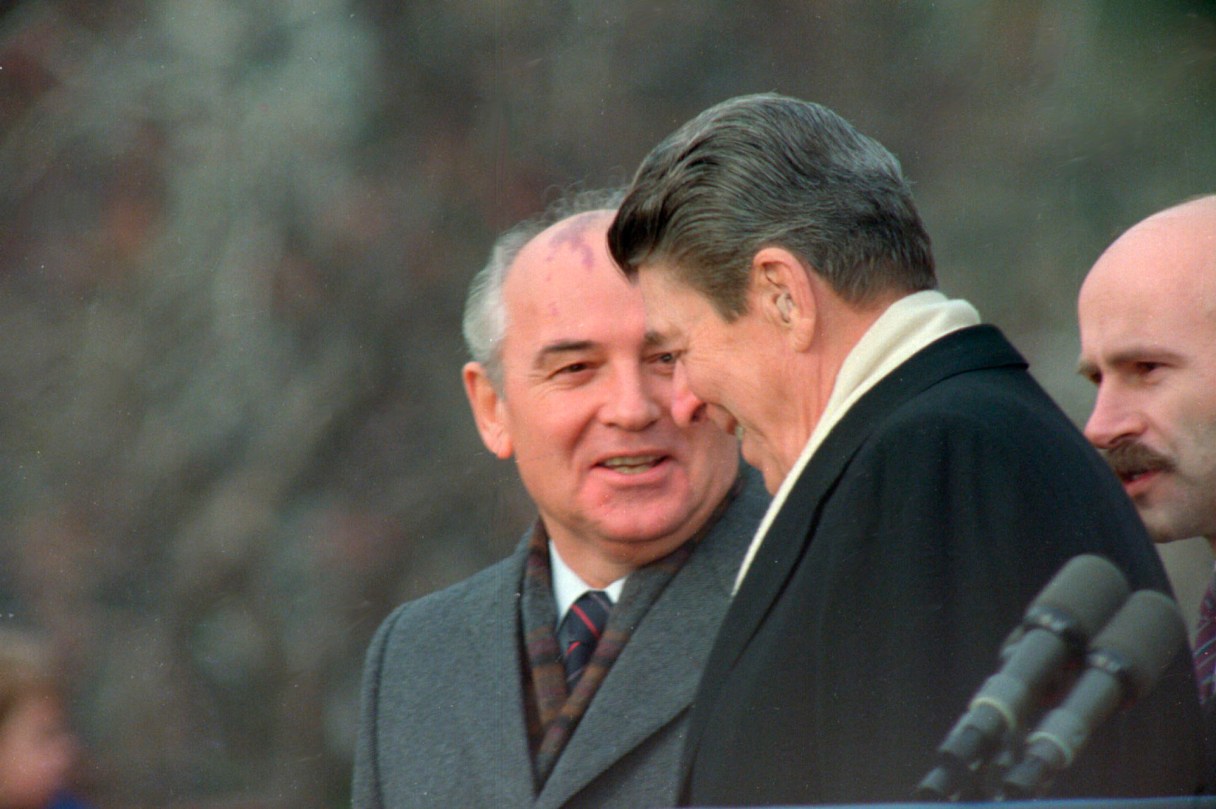
WASHINGTON – When President Ronald Reagan met Mikhail Gorbachev in Geneva in November 1985, he whispered to the Soviet leader: “I bet the hard-liners in both our countries are bleeding when we shake hands.”
Reagan had a point. His inclination to negotiate with the Evil Empire left many of his conservative friends aghast. In an otherwise touchingly affectionate assessment of the 40th president’s tenure, my Washington Post colleague George Will said that Reagan had “accelerated the moral disarmament of the West by elevating wishful thinking to the status of political philosophy.”
Further right, the conservative activist Howard Phillips accused Reagan of being “a very weak man with a very strong wife and a strong staff” who had become “a useful idiot for Kremlin propaganda.” Wow!
Few metaphors are perfect; Iran is not the Soviet Union. But the Reagan legacy is worth pondering to understand why, barely hours after the nuclear deal with Iran was announced, so many of President Obama’s critics leapt to conclude that the accord would only embolden Iran.
No doubt the instant responses can be explained partly by partisanship and by whether the responder has faith in Obama. But these reactions also had much to do with attitudes toward the proper approach to an adversary.
Are negotiated deals ever to be trusted? Should the United States be influenced by its allies’ wishes? Are imperfect compromises ever acceptable? Is hope that a hostile regime might gradually transform itself always wishful thinking? Is avoiding war a legitimate goal?
Those of us inclined to support what Obama and Secretary of State John Kerry have achieved answer these questions with a combination of Reaganite practicality and Reaganite hopefulness.
Of course negotiations can work. John F. Kennedy, no softie, got the balance right when he declared: “Let us never negotiate out of fear, but let us never fear to negotiate.”
It’s worth remembering that Reagan’s willingness to bargain with Gorbachev weakened the hard-liners in the Soviet Union, creating the opening for its collapse. And there are parallels between the two-step approaches that both Reagan and Obama took to a problematic foe. The Gipper was very tough at the outset of his presidency, and the Soviet Union realized it could not keep up with American defense spending. Gorbachev came to the table. Obama got our allies to impose much tougher sanctions, and Iran came to the table.
There is no way of knowing if this deal will lead to a dramatic transformation inside Iran, and there are some legitimate doubts that it will. But then, Reagan’s conservative skeptics were also insistent that the Soviet Union could never change, and surely never fall. They were wrong and Reagan’s bet paid off. Obama is now making a comparable wager.
If the administration had torpedoed these talks, our partners would have been hard-pressed to maintain the current sanctions, let alone toughen them. The United States will now need to be vigilant in containing Iran. But, again, Reagan – like every president from 1945 forward – successfully contained the Soviet Union.
Three days after the Senate approved the Intermediate-Range Nuclear Forces Treaty in May 1988 (Democrats sped it through even as some Republicans tried to drag out the process), Reagan was his classic optimistic self at Moscow University. “We may be allowed to hope,” he declared, “that the marvelous sound of a new openness will keep rising through, ringing through, leading to a new world of reconciliation, friendship and peace.”
Obama was a long way from being as ebullient about Iran at his news conference Wednesday. He was all about verify, not trust. But like Reagan, he’s willing to take a chance on the idea that reaching our goals through negotiation can be wiser than the alternatives.
Washington Post Writers Group