
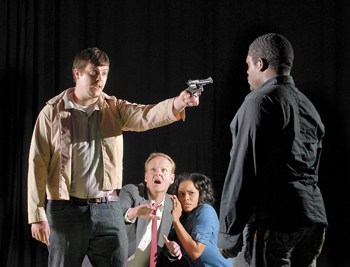
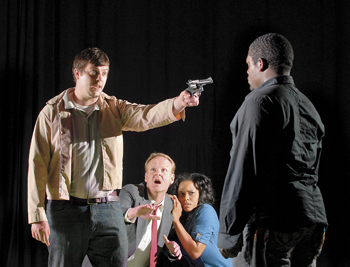
IF YOU GOWhat: “Blues for Mister Charlie.”When: 8 p.m. Fridays and Saturdays through April 30.Where: Circle Stage, Chattanooga Theatre Centre, 400 River St.Admission: $18 adult, $15 students.Phone: 267-8534.Website: www.theatrecentre.com
In 1964, when James Baldwin’s “Blues for Mister Charlie” debuted, then-16-year-old Hope Alexander became involved in the civil-rights movement, joining picket lines and nonviolent protests.
A relative newcomer to the Scenic City – she moved here a year and a half ago to be closer to her 4-year-old grandson – Alexander said she tried to get the play produced on her native West Coast, to no avail, but realized the work would have far more impact in the South, where the story takes place.
“To do it here was so much deeper and richer than it would have been doing it in L.A.,” she said.
So she fostered a collaboration between the Chattanooga Theatre Centre and the Destiny Theatre Company to bring Baldwin’s work to the local stage. “Blues for Mister Charlie” opens tonight at the Theatre Centre.
The play is loosely based on the 1955 murder of Emmett Till, a black 14-year-old in Money, Miss. Till was brutally beaten, tortured, shot and his body drowned by two white men, J.W. Milam and Roy Bryant, after Till reportedly whistled at Bryant’s wife, Carolyn. The men were acquitted. One hundred days after Till was murdered, Rosa Parks refused to give up her seat on a Montgomery, Ala. bus.
“One of the reasons this play resonates for me is that Baldwin, who was a gay black man in the early ’60s, managed to write a play that is fairly balanced between the black and the white community,” she said. “Everybody’s human. Everybody has foibles. Everybody loves their children, and everybody has problems.”
Part of her goal, she said, was bringing Baldwin’s work to light.
“I love James Baldwin as a writer, and I don’t think a lot of people know who he is anymore, which is horrendous.”
Alexander spent time educating or re-educating her cast members about the civil-rights movement as a part of rehearsing “Blues for Mister Charlie.”
“We kept a very open dialogue all the way through,” she said.