
Your First Flyght
Trekka Outfitters offers monthly meet-ups for beginner and veteran fly fishermen alike, usually on the third Saturday of each month. The shop also offers $25 rod rentals. After evaluating what the water is like in other areas, everyone carpools to the chosen location that month to fly fish for about four hours. Loizeaux says it’s a great opportunity to not only be introduced to the sport, but also to the local fly fishing community. Check Trekka Outfitters’ social media profiles on Facebook and Instagram for details.
Some may wonder at the allure of fly fishing versus traditional baitcasting, and anglers already versed in the traditional style may ask themselves why they’d want to consider it. Chris Loizeaux of Trekka Outfitters here in Chattanooga says that although the end result is similar, the experience is fundamentally different, and you would be remiss if you didn’t at least see what fly fishing has to offer.
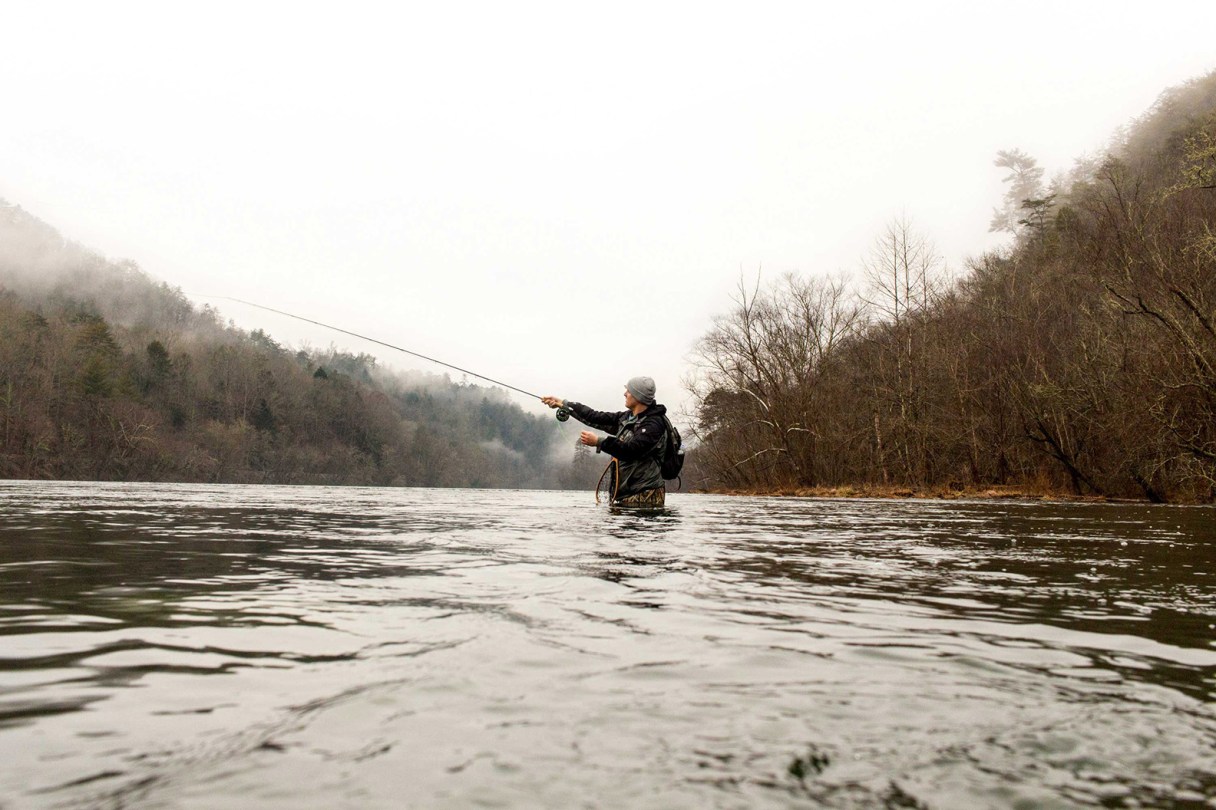
“A lot of people have complaints of boredom out on a lake, and I think they’d have a good shot at gravitating toward fly fishing,” he says. “It’s far more immersive as an activity. You’ve got the sun on your back and the water at your waist. You’re constantly aware of the current. You feel the fish on your line with your whole body. It’s a much more tactile experience.”
Loizeaux, who is an avid backpacker and hiker, also says the journey, not necessarily the destination, is a big draw with fly fishing. Some of the best fly fishing spots around are in beautiful streams and brooks hidden away in the Smoky Mountains.
“Very often, people can walk away from a fly fishing trip feeling great even if they didn’t catch anything,” says Loizeaux. “It’s still a spectacular experience.”
More than anything, though, people who already do – or would like to try -fishing as a hobby should give fly fishing a shot because it’s something new that they just might love. You’re denying yourself a great new experience if you shrug off fly fishing just because it’s different, Loizeaux says. Sure, it may not be for you, but if you haven’t tried it, you could be seriously missing out.
More Info
RODSSimilar to the specific flies used in fly fishing, the reel you pick doesn’t define what you can do. On the contrary, your rod and line determine what reel you should be looking for.Fly rods are categorized by their action — that is, how flexible they are. Fast-action rods won’t flex too much during casting, leading to sharp, long and powerful casts which make the lure dance on the water. Slow-action rods flex much more, lending to gentler casts and a smoother motion, making this type of rod simpler to use on short casts. Rods can be anywhere between fast- and slow-action. Moderate-action rods are considered the most versatile, featuring the best of both worlds. Loizeaux recommends a medium-fast rod for beginners, but really, you can’t go wrong with whatever rod feels most natural when you’re casting.Rods are also categorized by weight. Lighter weights are used to catch small panfish and small trout. The heavier the rod, the larger the fish you should be aiming to catch, up to massive saltwater catches like marlin or bluefin.The heft of the reel you select as well as the weight of the line should match your rod choice. Here in Tennessee, you won’t be battling anything too massive, so Loizeaux says reel selection should be last on your list of priorities when getting started, behind your rod, line and lure, or fly,TASTY-LOOKING LURES (TO A FISH)With fly fishing, the type of lure you pick is all about your surroundings — you’re trying to create the illusion of naturally moving prey the fish you’re after would be looking for. There are thousands of different variations of flies mimicking different types of prey.Dry flies are the lightest and float on top of the water like an adult fly would, meaning you’ll get a graceful show of a fish arcing out of the water, or at least the satisfying smacking sound as they surface for your bait. Nymph flies aim to mimic the pre-adult stage of local insect life. Since aquatic nymphs usually rest under rocks or in other secluded parts of the water and are only active if jostled from their hiding place or if they’re hatching, if you opt for a nymph fly, you should cast it as low as you can get it under the water’s surface. As such, nymph flies can be difficult to use since you won’t be able to see when a fish takes your line. Streamer flies are supposed to act like larger, more active prey, such as bait fish or leeches, leading to a bigger bout of action since they’re more likely to attract bigger fish.For more advanced anglers, the differences may improve their chances, but for all intents and purposes, a new fly fisherman shouldn’t stress too heavily about them. Loizeaux says beginners can stick with streamer flies and the occasional dry fly as they get more comfortable with their rod and casting. More than anything, he says, matching the fly you’re using with what is native to the region and active at the moment is key. When you go to your local fly fishing shop, ask for flies that are viable in different seasons and in different areas. The more versatile, the better. Observation of your surroundings, he says, is the single most critical component to being a good fly fisherman.