
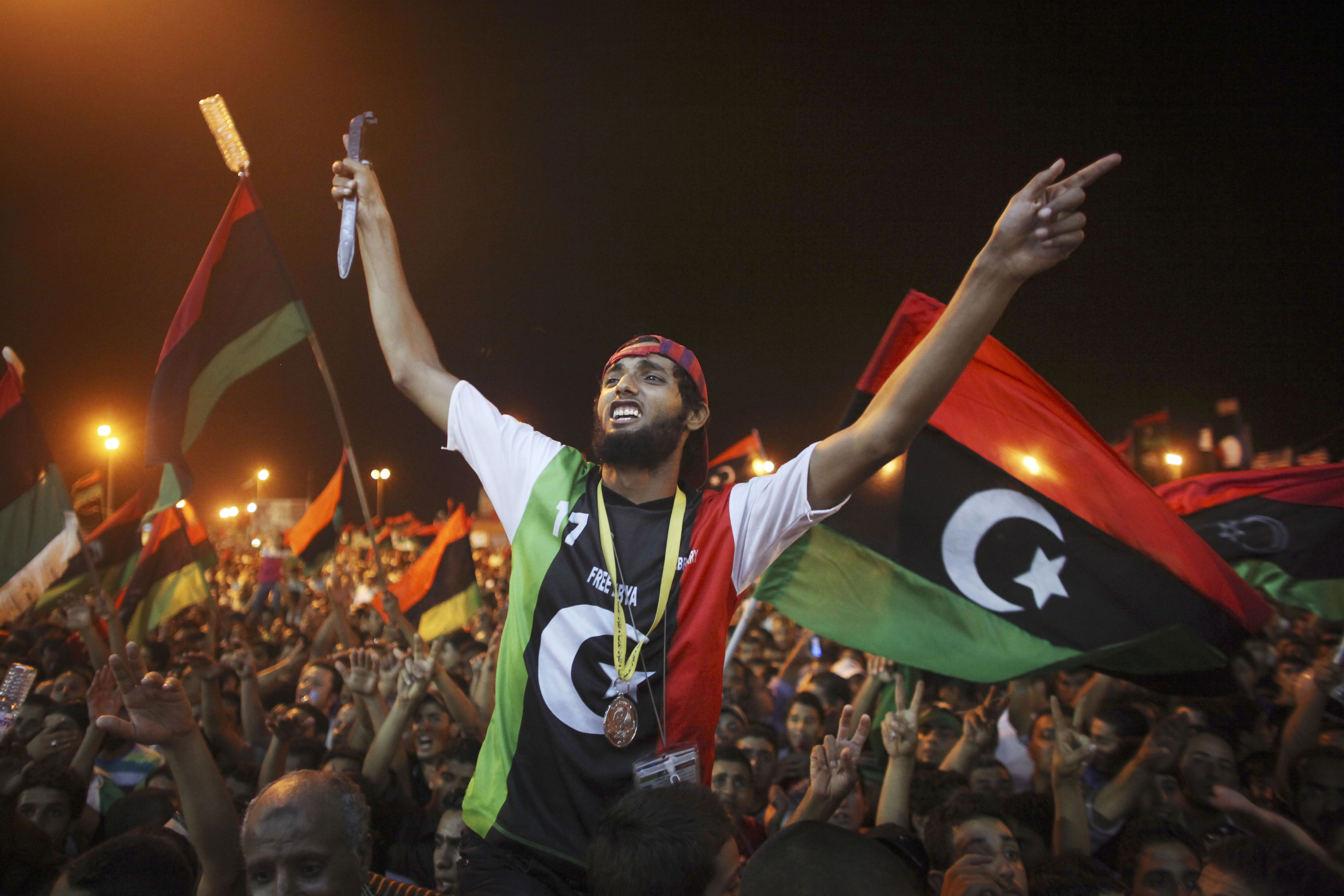
 People celebrate the capture in Tripoli of Moammar Gadhafi’s son and one-time heir apparent, Seif al-Islam, at the rebel-held town of Benghazi, Libya, early Monday, Aug. 22, 2011. Libyan rebels raced into Tripoli in a lightning advance Sunday that met little resistance as Moammar Gadhafi’s defenders melted away and his 40-year rule appeared to rapidly crumble. The euphoric fighters celebrated with residents of the capital in the city’s main square, the symbolic heart of the regime. (AP Photo/Alexandre Meneghini)
The Libyan rebels’ six-month-campaign to overthrow their nation’s murderous tyrant of 42 years, Col. Muammar Gadhafi, may have appeared stalled or shaky at points, but that changed dramatically in a surprisingly fast push over the weekend to take Tripoli. By Monday afternoon, the intensified urban fighting in the capital to subdue the last of Gadhafi’s defenders, like the search to find the dictator himself, could hardly dispel the sudden sense of an epic national victory — nor the looming questions that surround the pending transition to Libya’s unknown future.
The moment begs as much praise as it does questions.
It was a seemingly rag-tag band of idealistic but largely untrained rebels — inspired by freedom movements in Tunisia and Egypt that bookend Libya on the North African Mediterranean — who mounted the uprising against Gadhafi and the superior armor and fire power of his military forces.
Their courage and resilience sustained them while NATO’s air campaign, initially led by the United States until Britain and France took the lead, gradually reduced and isolated Gadhafi’s armed might, giving allies from western and other nations time to train and supply the rebels enough to carry the fight. The two curves crossed in the past few weeks, spawning the mission to capture Tripoli, home to Gadhafi’s power base and his own defensive compound.
Both the rebels and the nations that supported them merit praise for the course they took. But while victory required both, it was the Libyan rebels who carried the fight on the ground. They earned their freedom from Gadhafi, who had promised to attack their cities and homes and kill them “like rats.” The 7,459 air strikes executed by NATO and its allies by Saturday clearly degraded the operational ability of Gadhafi’s armed forces to achieve that threat. But it was the rebels who stubbornly marched and drove into the firepower leveled against them.