
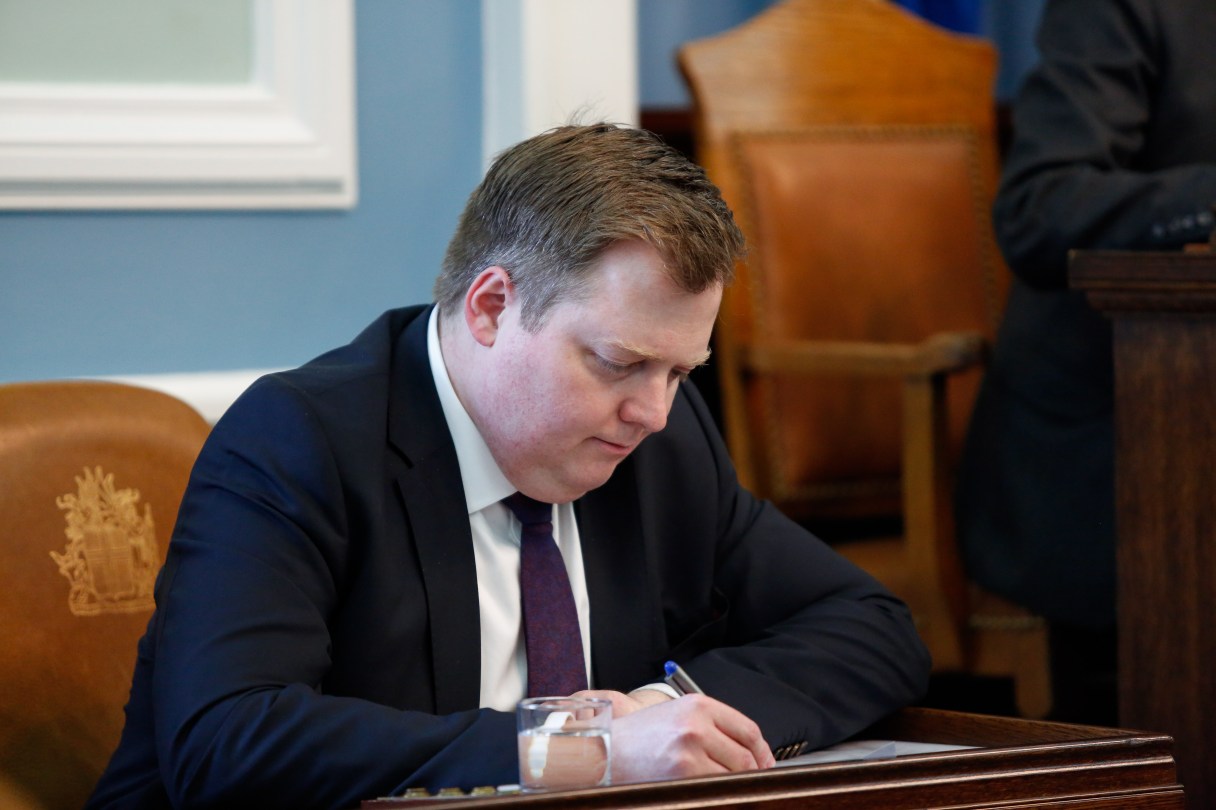
REYKJAVIK, Iceland – Iceland’s prime minister insisted Monday he would not resign after documents leaked in a media investigation linked him to an offshore company that would represent a serious conflict of interest.
News reports have alleged that Prime Minister Sigmundur David Gunnlaugsson and his wife set up a company in the British Virgin Islands with the help of a Panamanian law firm at the center of a massive tax evasion leak. The reports have prompted calls for a no-confidence vote in parliament against him.
Going on Icelandic television Monday afternoon, Gunnlaugsson said he would not resign and added there was nothing new in the information contained in the Panama Papers data leak.
Iceland’s foreign minister also said on a trip to India that the prime minister had not done anything illegal.
“There is nothing strange there,” said Gunnar Bragi Sveinsson, the minister for foreign affairs and external trade.
The revelation concerns the company Wintris Inc., which Gunnlaugsson allegedly created in 2007 along with his partner at the time, Anna Sigurlaug Palsdottir, who is now his wife.
He allegedly sold his half of the company to Palsdottir for $1 on Dec. 31, 2009, the day before a new Icelandic law took effect that would have required him to declare the ownership of Wintris as a conflict of interest.
Wintris lost money as a result of the 2008 financial crash that crippled Iceland, and is claiming a total of 515 million Icelandic kronur ($4.2 million) from the three failed Icelandic banks: Landsbanki, Glitnir, and Kaupthing.
Gunnlaugsson has been accused of a serious conflict of interest. As prime minister, he was involved in reaching a deal for the banks’ claimants.
Published reports about the prime minister’s financial matters have brought quick condemnation from prominent Icelandic politicians. Former Prime Minister Johanna Sigurdardottir called for Gunnlaugsson’s resignation, as did Birgitta Jonsdottir, the popular head of the Pirate Party.
The opposition has called for a vote against the center-right government. Protests are scheduled in Reykjavik outside parliament.
“Information on the involvement of current ministers in companies in tax havens was hidden from the Icelandic people before the last elections, and it is only right that they get to appraise the situation again,” Arni Pall Arnason, leader of the center-left Social Democratic Alliance, told the Morgunbladid newspaper.
Gunnlaugsson, the head of the center-right Progressive Party, began his four-year term in 2013, five years after Iceland’s financial collapse.
Iceland, a volcano-dotted North Atlantic nation with a population of just 330,000, went from economic superstar to financial basket case almost overnight when its main commercial banks collapsed within a week of one another in 2008.
BERLIN (AP) – The release of a vast trove of documents and other data on offshore financial dealings of wealthy, famous and powerful people around the world is raising questions over the widespread use of such tactics to avoid taxes and skirt financial oversight.
Reports by an international coalition of media outlets on an investigation with the Washington-based International Consortium of Investigative Journalists brought to light details of offshore assets and services of politicians, businesses and celebrities, based on a cache of 11.5 million records.
Among the countries with past or present political figures named in the reports are Iceland, Ukraine, Pakistan, Saudi Arabia, Russia and Argentina.
Australia’s tax agency said Monday it was investigating more than 800 wealthy people for possible tax evasion linked to their alleged dealings with Mossack Fonseca, a Panamanian law firm with international offices that provide offshore financial services.
The Australian Tax Office said in a statement that it had linked more than 120 of those people to an offshore services provider in Hong Kong, but did not name the company.
In New Zealand, Prime Minister John Key rejected ICIJ’s characterization of his country as among 21 tax havens used by Mossack Fonseca.
“Tax havens are where there is nondisclosure of information,” Key said. “New Zealand has full disclosure of information.”
Ramon Fonseca, a co-founder of Mossack Fonseca – one of the world’s largest creators of shell companies – confirmed to Panama’s Channel 2 television network that documents investigated by the ICIJ were authentic and had been obtained illegally by hackers.
But he said most people named in the reports were not his firm’s direct clients but were accounts set up by intermediaries. He said the firm did not engage in any wrongdoing.
Businessmen, criminals, celebrities and sports stars – the ICIJ said the documents involve 214,488 companies and 14,153 clients of Mossack Fonseca. The nonprofit group said it would release the full list of companies and people linked to them early next month.
The Munich-based German newspaper Sueddeutsche Zeitung said it was offered the data more than a year ago through an encrypted channel by an anonymous source. The source sought unspecified security measures but no compensation, said Bastian Obermayer, a reporter for the paper.
The documents provided to Suddeutsche Zeitung, amounting to about 2.6 terabytes of data, included emails, financial spreadsheets, passports and corporate records detailing how powerful figures used banks, law firms and offshore shell companies to hide their assets. The data dated from 1977 through the end of 2015, it said.
The newspaper and its partners verified the authenticity of the data by comparing it to public registers, witness testimony and court rulings, he told the AP. A previous cache of Mossack Fonseca documents obtained by German authorities was also used to verify the new material, Obermayer added.
“It allows a never-before-seen view inside the offshore world – providing a day-to-day, decade-by-decade look at how dark money flows through the global financial system, breeding crime and stripping national treasuries of tax revenues,” the ICIJ said.
Panamanian President Juan Carlos Varela issued a statement saying his government had “zero tolerance” for illicit financial activities and would cooperate “vigorously” with any judicial investigation arising from the leak of the law firm’s documents.
The Guardian newspaper, which participated in the investigation, published a video on its website late Sunday of an interview with Iceland’s Prime Minister Sigmundur David Gunnlaugsson. During the interview with Sweden’s SVT television, the prime minister is asked about a company called Wintris. He responds by insisting that its affairs are above board and calling the question “completely inappropriate,” before breaking off the interview.
In Russia, the Kremlin last week said it was anticipating what it called an upcoming “information attack.”
Russian President Vladimir Putin’s spokesman, Dmitry Peskov, told reporters that the Kremlin had received “a series of questions in a rude manner” from an organization that he said was trying to smear Putin.
“Journalists and members of other organizations have been actively trying to discredit Putin and this country’s leadership,” Peskov said.
The office of Argentine President Mauricio Macri confirmed a report by La Nacion newspaper that a business group owned by Macri’s family had set up Fleg Trading Ltd. in the Bahamas. But it said Macri himself had no shares in Fleg and never received income from it.
Mexico’s tax office said it would check on any Mexican resident or company mentioned in reports on the leaked documents.
According to the ICIJ’s website, banks including HSBC, UBS, Credit Suisse, Deutsche Bank have worked with Mossack Fonseca to create offshore accounts.
“The allegations are historical, in some cases dating back 20 years, predating our significant, well-publicized reforms implemented over the last few years,” HSBC spokesman Rob Sherman said in an emailed response to an AP request for comment.
UBS, Credit Suisse and Deutsche Bank did not immediately respond to a request for comment.