
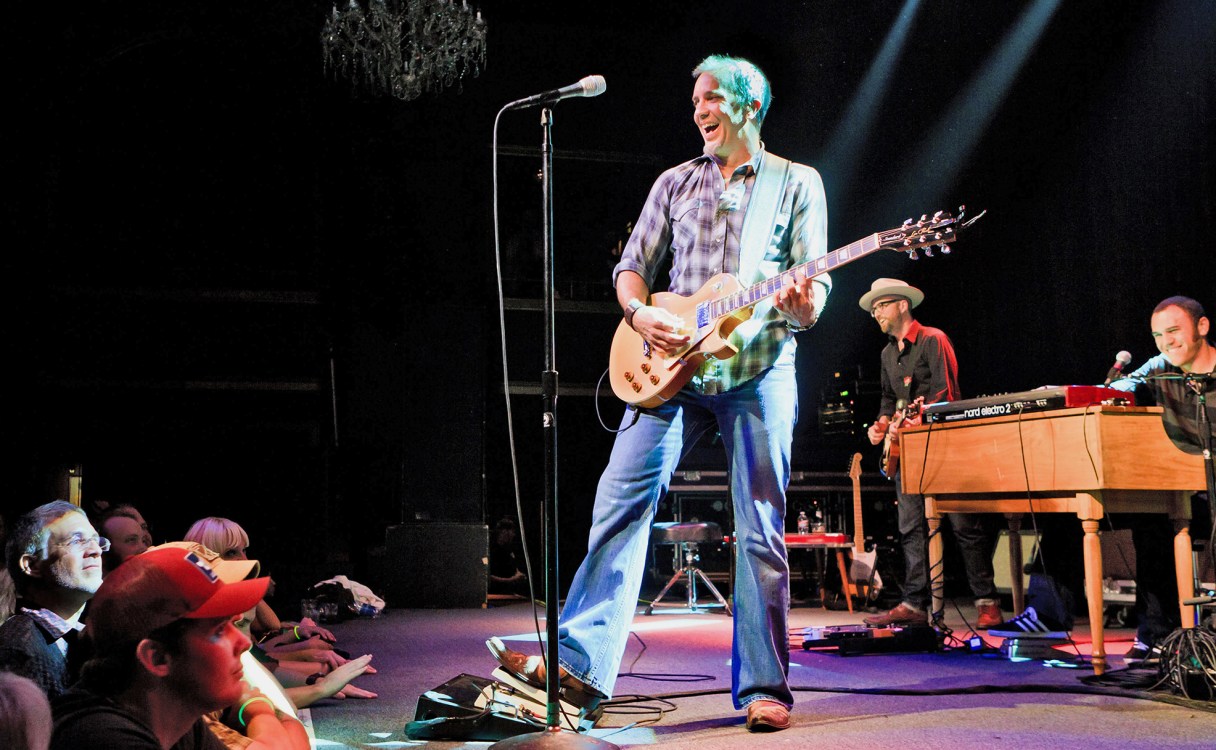
The rumble of a gasoline-powered generator thumps through the dome of the Chattanooga Choo Choo as workers pound away at a new 500-seat music venue. The four-stroke engine may be noisy, but it’s got rhythm, much like the Glenn Miller song that inspired the name of the famous train station-turned hotel.
The Choo Choo’s newest musical attraction is poised to douse the Scenic City’s smoldering entertainment scene with a big can of jet fuel, igniting the afterburners that may propel Chattanooga toward the musical future it has always coveted. Music and entertainment may be the next big thing in Chattanooga.
To be sure, that’s been said before. Chattanooga’s music scene has teetered on the verge of something great for years now, always poised to break through but never able to hang on to the next rung of the ladder. But thanks to waves of young people moving downtown to live, work and play, developers can’t seem to build new apartments fast enough, and the accompanying restaurants, venues and bars – complete with live bands and cover charges – aren’t far behind.
By some estimates, Chattanooga is already transforming into a destination city for live-music fans. As many as half of the paying customers at the city’s major music venues may already come from out-of-town. They come from Knoxville, Nashville, Memphis, Atlanta, Huntsville, Birmingham, and that’s just in the region. Others come from Chicago, Austin, Louisville, and Cincinnati.
They’re coming to places such as Track 29, Rhythm & Brews, Honest Pint and JJ’s Bohemia, Meanwhile, new venues are in the works and old venues going under the knife for a little reconstructive surgery.
“We view the Southside, Main Street, the Choo Choo as a portal, a gateway to an entertainment district or districts,” said Bob Doak, president and CEO of the Chattanooga Convention and Visitors Bureau. “It doesn’t have to be the Southside, or the Choo Choo or Main, but that’s where it’s happening. You fish where the fishing is good.”
This is a new thing. Ever since Bessie Smith died in the 1930s – and after the block of music venues on the Big Nine (now M.L. King Boulevards) shut down, Chattanooga’s music scene has been little more than a historical footnote.
In tune with a midsize market
The city is what’s known as a P3 market, meaning it’s in the third tier of cities considered by promoters to be profitable places to send their musicians. Cities such as New York and Atlanta are considered to be top-tier cities, while Charlotte and Nashville could be considered second-tier. Chattanooga is in the third tier, which means it typically gets fashion, music and entertainment last, said Richard Torregano, a local singer who goes by the initials CT.
“That pushes us into this crab bucket of everyone struggling to get to the top, and that’s why a lot of artists here go elsewhere,” he said. “Everybody always says the music scene here is ‘budding,’ but it’s been budding for a while now.”
Not that the city hasn’t spawned its share of great artists. Chattanooga-born singer Usher Raymond and actor Samuel L. Jackson got their big breaks after moving to Atlanta. More recently, rapper Isaiah Rashad moved to California to launch his rap career, though he filmed the music video “I Shot You Down” at the derelict, and now torn-down Harriet Tubman public housing complex.
But the city’s music scene is looking up for local artists and the tourists who come to see them, thanks in part to the construction of Track 29, which can hold 1,000 paying customers, as well as a handful of bars and music venues scattered around the city.
Bands like Strung Like a Horse, The Bohannons and Glass Hammer have remained in Chattanooga even as they’ve gained notoriety.
Clay Maselle, the lead singer of Strung Like a Horse, says he’s here to stay.
“I see a lot of artists moving out of Chattanooga and stuff because they’re tired of the scene and tired of ‘no one pays here’ and stuff, but as a touring band we work in every market. There would be absolutely no way to sustain ourselves if we just played in Chattanooga, so the Chattanooga market isn’t necessarily our focus,” Maselle says. “But we all love living here, and I’m not moving anywhere.”
City Hall spins off Tivoli, Memorial
City officials have taken note of the music scene’s recent transformation from distraction to attraction, moving to support its growth by spinning off the once city-owned Tivoli Theatre and Memorial Auditorium to live under a nonprofit umbrella, an arrangement that has worked in other cities.
Chattanooga’s former arrangement, under which those two venues combined 5,628 seats remained unfilled 70 percent of the time, simply wasn’t wasn’t cutting it, said Andy Berke, Chattanooga’s mayor.
“The Tivoli and Memorial together did about $750,000 of ticket sales last year,” Berke said. “[Knoxville’s] Tennessee Theatre, alone, which is about the same size as Tivoli, did $4.3 million in ticket sales last year. We have two venues basically doing about one-sixth of what one venue does in Knoxville, a very similarly-sized city.”
Doak, as part of his role on the mayor’s Entertainment and Attractions Task Force, quizzed the heads of those venues as to their priorities.
“I asked them, what are you doing to make yourself more profitable? The answer was, we’re changing light bulbs, we’re deferring maintenance, we’re cutting staff, we’re cutting back on marketing. My next question was, have you ever considered trying to grow revenue? The answer to that was no,” Doak said.
Doak says he isn’t slamming those venues’ former managers, rather their mindset was indicative of one of the problems of a risk-averse government-run entertainment business versus a private or non-profit management company, he says.
“In order to increase profitability, in order to increase the number of events and shows you’re doing, you have to take a calculated risk. Have to. Period. Nothing you can do, there’s risk involved. So I think that’s what’s really good about the spin off of Memorial and the Tivoli, the ability to take some chances.”
Broadening Chattanooga’s music venues
If the spin-off works, it will certainly increase activity at the higher-attendance venues. But a healthy entertainment sector requires plenty of opportunity at the lower end as well, specifically the 50- and 100-seat bars and restaurants, says Adam Kinsey, who co-owns Track 29 with his wife, Monica Kinsey.
“A local band can start out at the 50-, or 100-person venue, move up to Rhythm and Brews at 350, move up to our new venue with 500, then move up to Track 29 with 1,000, but right now we don’t have many venues at that 100-person venue,” Adam Kinsey says. “I’d say to really build the music scene, we need more venues.”
There are already some in the pipeline. Clyde’s, a new bar on the Southside operated by Mike and Taylor Monen, offers live music. Puckett’s Grocery, a new downtown restaurant featuring Nashville singer-songwriters, will open later this year. Other new venues will include The Feed Co. Table and Tavern, operated by the former owners of 1885, as well as Granfalloon, a new Southside venue that advertises itself as a place to eat, drink, listen and be heard. But the city needs more.
Selling the songs of Tennessee
An aspiring band or artist typically needs to sell out smaller venues before a promoter will be willing to take the risk putting them in the 12,000-seat McKenzie Arena or the 20,668-seat Finley Stadium. But that can’t happen in a vacuum. Artists, promoters and venue owners have to first figure out how to fill seats, and that requires building an audience locally. There has to be an awareness that there are actually bands to see, that venues actually exist, and they are places that are safe and fun to visit, says Monica Kinsey.
“I think we have to educate people locally, first of all we’re safe, but also about the activities people can engage in to support local,” she says. “You can’t expect local artists to reach tourists if they can’t reach their own.”
That’s why the Kinseys, along with a handful of other groups, are pushing to create a local campaign aimed at winning the hearts and minds of music lovers in the Chattanooga area.
“We need a campaign to our locals, a call to action,” she says.
In some ways, that’s already in the works. Early on in his term, Tennessee Gov. Bill Haslam assembled a Tennessee Tourism committee tasked with figuring out how to promote the state as a musical destination. That committee included Doak and others, who are now tasked with returning to their home cities and making things happen locally. Doak sees the next step for him and other officials as finding a music czar, a point person who will help develop, market and guide the city’s music scene as it expands.
“We’ve talked about this long enough, it’s time to move, to act upon it,” Doak says. “People want to be entertained and have fun, period. We need to position our city so there’s always something fun to do in Chattanooga.”
Still, Torregano, who works a day job as a barber at Klipz Hair Studio on Brainerd Road, is considering a move to Houston to be part of a musical group. He has performed in Atlanta, and taken trips to Los Angeles, though he’d prefer to make it in Chattanooga, his hometown. But like the city’s music scene itself, he’s still working to nail that big break.
“There’s a time and place for everything, and the time for Chattanooga is now,” Torregano says. “There’s a time and place for everything, and the time for Chattanooga is now. We have to embrace our own, we have to embrace home.”
– Times Free Press entertainment reporter Casey Phillips contributed to this report.
This article appears in Edge magazine, which may be read online at www.meetsforbusiness.com.