
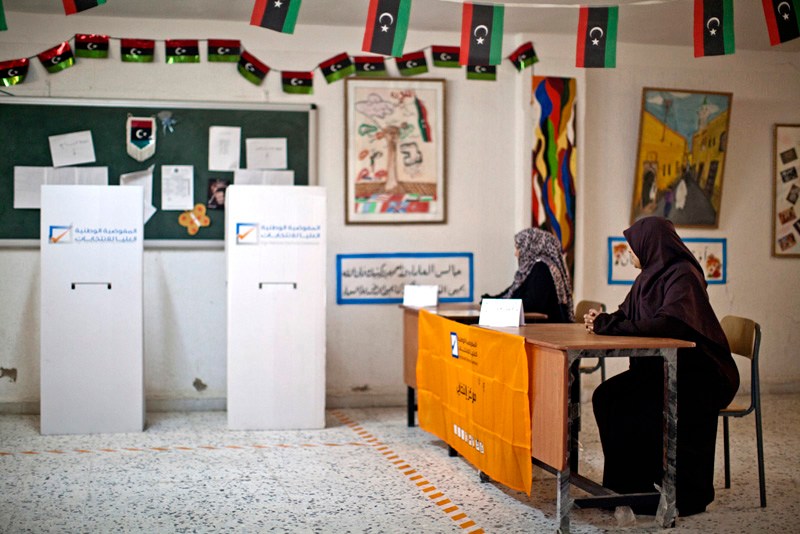
TRIPOLI, Libya (AP) – Libyans trickled to the polls Wednesday despite months-long violence that has roiled their nation to vote in parliament elections, the third nationwide balloting since the toppling of longtime dictator Moammar Gadhafi.
By midday about 13 percent of the 1.5 million registered voters had cast ballots for the 200-member parliament, according to Abdel-Hakim al-Shaab, a member of the country’s election commission.
The low turnout was in sharp contrast to the first parliamentary vote two years ago, when Libyans enthusiastically lined up outside polling centers in early morning hours, hoping to vote for a democracy after Gadhafi.
Al-Shaab said 1,626 polling centers were opened across the country. He said 17 polling centers in the eastern city of Darna, a stronghold of Islamic militias, did not open due to “security conditions.” He did not elaborate but said efforts were still underway to try to open those centers as well.
The outgoing Islamist-dominated parliament – the mandate of which expired in February – had largely failed to achieve its primary objective, overseeing the drafting of Libya’s first-ever constitution. The lawmakers also sacked a prime minister, appointed a caretaker Cabinet and tried to appoint a new premier but were overruled by the country’s Supreme Court.
The vote is crucial for the oil-rich Libya, embroiled in deep political chaos and instability mainly because of the absence of a strong military and police force. Successive transitional governments have depended on militias to achieve security. Yet the militias, empowered by support from members of the outgoing parliament, have put pressure on the government.
With all the turmoil, the Islamists have lost much of their popularity and the elections will be a key test of what is left of their support.
Since Gadhafi’s ouster, Libya held parliament elections in 2012 and last year elected a 60-member panel to draft the country’s new constitution.
But it’s unclear how balloting for parliament can take place in violence-stricken east. In the provincial council elections, voters in Darna came under attack when militants bombed polling centers in their city, a stronghold of Islamic militias.
Libya has sunk into chaos following the downfall and the killing Gadhafi in the country’s 2011 civil war. Heavily armed militias, born out of the rebel groups that toppled Gadhafi, now are the main power in the country.
Tensions were also high Wednesday in Libya’s second largest city, Benghazi, where a renegade general is waging an offensive against Islamist militias. There have been near-daily clashes there, with bombings of several neighborhoods and residential areas.
Over the past weeks, forces allied with Gen. Khalifa Hifter have bombed the camps of Islamist militias, which in turn attacked his forces, including an assassination attempt on Hifter that killed four people.
The general has warned he will detain Islamist lawmakers, accusing them of financing militias which he blames for much of Libya’s chaos. In turn, Islamist politicians and others have accused him of launching a “coup,” though many tired of the turmoil in Libya have backed him with mass rallies.