
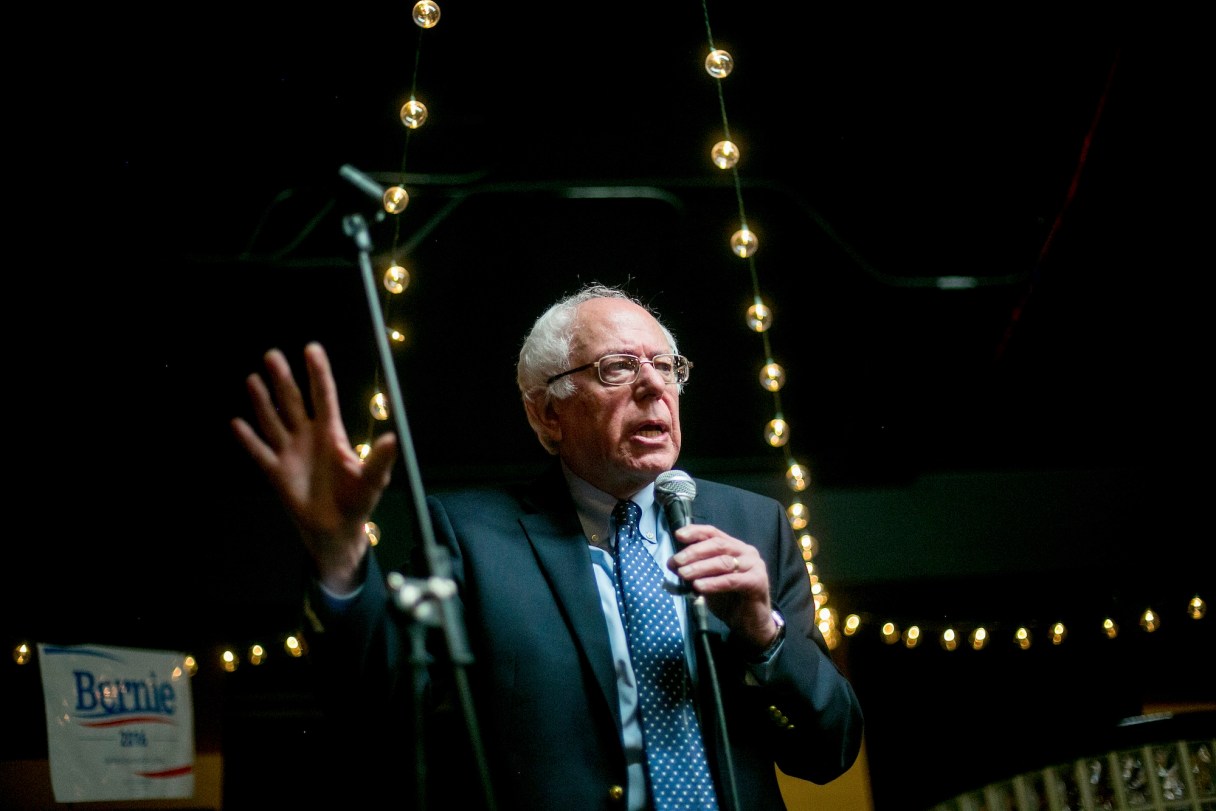
Bernie Sanders’ loss in the Nevada caucuses, 47 percent to 53 percent, reveals a very real weakness of his insurgent challenge to Hillary Clinton.
According to entrance polls, Sanders’ appeal is not broad enough among key groups that traditionally make up the base of the Democratic Party.
He lost among women, blacks, nonwhites and self-described Democrats. But the loss was even more troubling for his camp. He also lost highly educated caucusgoers with postgraduate degrees, both the poorest and wealthiest groups, and moderates. He lost those who saw health care and the economy as the most important issues of the election, even though those are key parts of Sanders’ platform and issues on which he is most eloquent and persuasive.
And perhaps most interestingly, he lost overwhelmingly among people who wanted a candidate who could win in November. Good for him though, only 18 percent of those polled thought electability was the top quality a candidate needed to possess. You only have to look at the Republican winner in South Carolina to understand that this is not an electability cycle, this is an anti-establishment, point-making cycle.
The map going forward has states that look a lot more like Nevada than those that look like Iowa and New Hampshire, where Sanders performed well. Indeed, there are many states like South Carolina, which will hold its Democratic primary Saturday, that look even worse for Sanders than Nevada.
That is because of the narrowness of Sanders’ winning demographics, as demonstrated in Nevada.
Let’s explore some of the positives for Sanders, the groups among which he won. He won liberals, of which there were many, and independents, of which there were few. He won people under 40, particularly those under 24, and whites with no college degree. He also won people who said their most important issue was income inequality and believed that the most important quality was having a candidate who cares about people like them or who was honest and trustworthy.
According to the entrance poll, Sanders also won the Hispanic vote, but this is where some prominent poll watchers took exception to the poll’s accuracy.
The New York Times’s Nate Cohn tweeted:
“Based on the results in Clark, the precincts in ELV, and the overall entrance poll error, I do not believe Sanders won the Hispanic vote.”
And young black voters are not yet “feeling the Bern” to the same degree that other millennials are, as a poll published last week in The Washington Post pointed out. According to the accompanying article:
The poll points out an even bigger problem for Sanders among black voters than millennials, and that’s his lack of support among black women who “comprise a disproportionate segment of the black electorate.”
As the Post pointed out in no uncertain terms:
“A Democratic victory in the general election requires enthusiastic support from black women, and black women are significantly more enthusiastic about Clinton than Sanders.”
It is very hard to see how Sanders wins the nomination without winning the black and Hispanic vote in the Southern and Western states, not to mention New York and Michigan.
Lastly, the political revolution on which Sanders has hinged his ability to accomplish his ambitious plan keeps failing to materialize. This year’s Democratic caucus participation was down nearly a third from 2008, and in Iowa and New Hampshire there were more voters – or caucusgoers – making choices in the Republican contest than in the Democratic one.
As Sanders told “Meet the Press” about the Nevada loss: “We did not do as good a job as I had wanted to bring out a large turnout.”
That doesn’t sound like a political revolution to me.
New York Times