
Monday, November 9, 2026Nov 9

New apps help Palestinians navigate Israeli checkpoints

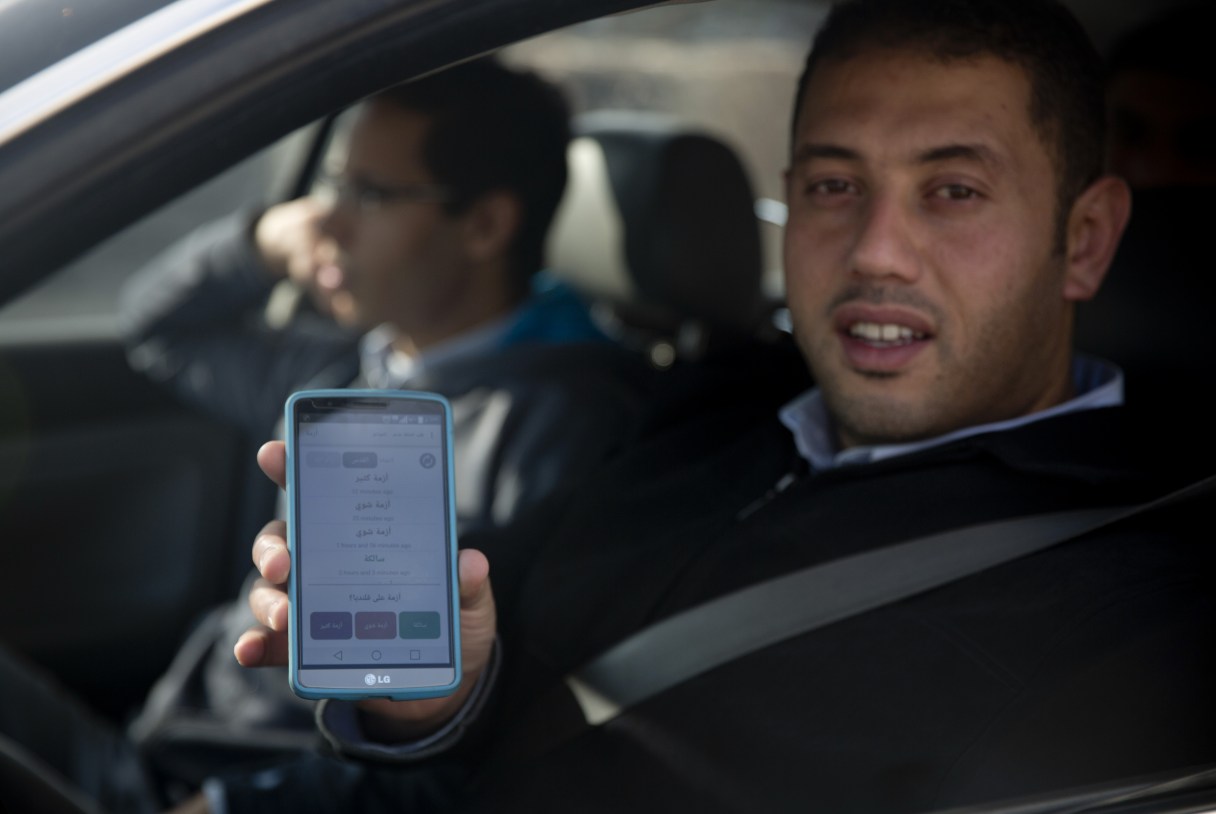
In this Tuesday, Nov. 10, 2015 photo, a Palestinian driver shows the “Azmeh” application, which means traffic jam in Arabic, on his mobile phone as he waits in traffic to enter Jerusalem at Qalandia checkpoint between Jerusalem and the West Bank city of Ramallah. A pair of new mobile apps hopes to help Palestinians navigate their way around snarled traffic at Israeli checkpoints in the West Bank, offering a high-tech response to an intractable problem: constant, burdensome and often seemingly random restrictions on movement. (AP Photo/Majdi Mohammed)
In this Tuesday, Nov. 10, 2015 photo, a Palestinian driver shows the “Azmeh” application, which means traffic jam in Arabic, on his mobile phone as he waits in traffic to enter Jerusalem at Qalandia checkpoint between Jerusalem and the West Bank city of Ramallah. A pair of new mobile apps hopes to help Palestinians navigate their way around snarled traffic at Israeli checkpoints in the West Bank, offering a high-tech response to an intractable problem: constant, burdensome and often seemingly random restrictions on movement. (AP Photo/Majdi Mohammed) In this Tuesday, Nov. 10, 2015 photo, a Palestinian driver shows the “Azmeh” application, which means traffic jam in Arabic, on his mobile phone as he waits in traffic to enter Jerusalem at Qalandia checkpoint between Jerusalem and the West Bank city of Ramallah. A pair of new mobile apps hopes to help Palestinians navigate their way around snarled traffic at Israeli checkpoints in the West Bank, offering a high-tech response to an intractable problem: constant, burdensome and often seemingly random restrictions on movement. (AP Photo/Majdi Mohammed)

QALANDIYA CHECKPOINT, West Bank (AP) – A pair of new mobile apps hopes to help Palestinians navigate their way around snarled traffic at Israeli checkpoints in the West Bank, offering a high-tech response to an intractable problem: constant, burdensome and often seemingly random restrictions on movement.

“Azmeh,” which means traffic jam in Arabic, and “Qalandiya,” the name of a major Israeli checkpoint on the outskirts of Jerusalem, join a slew of other global traffic apps, including the Israeli-developed Waze.

What sets the two Palestinian apps apart is how they go beyond daily rush hour traffic and touch at the heart of a central Palestinian criticism of Israeli occupation.

The free apps, launched over the last month, are still in their infancy, with only a few hundred downloads each. But as they grow in popularity, their developers say the crowdsourced apps present a partial solution to the jams that checkpoints cause, and they hope will catch on with drivers.

“The occupation affects the Palestinian people from all aspects, and takes from them lots of rights. One of those rights is the freedom of movement,” said Basel Sader, 20, a Palestinian resident of east Jerusalem and a law student at Jerusalem’s Hebrew University who developed Azmeh. “This application can’t give them the freedom of movement but it can make things easier for them.”