
SAN ANTONIO – Moon Ursin and DiJonai Carrington both had 21 points as reigning women’s national champion Baylor advanced to its 12th consecutive NCAA Sweet 16 with a 90-48 victory over Virginia Tech on Tuesday night.
Queen Egbo had a double-double with 12 points and 13 rebounds, along with seven blocked shots for the Lady Bears (27-2). DiDi Richards had nine assists.
All-America forward NaLyssa Smith finished with 15 points, all but two of those coming after halftime for Baylor. Smith got her second foul only seven minutes into the game, and didn’t return until getting two quick layups after the break.
The Hokies and their high-scoring duo of Aisha Sheppard and center Elizabeth Kitley – ranked second and third in the ACC, both averaging just over 18 points a game – struggled against the Lady Bears, the national leader in field goal percentage defense for the fourth season in a row.
Georgia Tech 73, West Virginia 56
Lotta-Maj Lahtinen scored 22 points, Lorela Cubaj had 21 points and 12 rebounds, and No. 5 seed Georgia Tech used a big third quarter to beat No. 4 West Virginia.
The Yellow Jackets needed a second-half rally in the opening round against Stephen F. Austin – the fourth-largest comeback in tournament history – but had this game well in control with a 17-point lead over the Mountaineers to start the fourth. Their European inside-outside combo of Cubaj, from Italy, and Lahtinen, of Finland, led the way.
Lahtinen was 9 of 16 from the field and struck for 17 points in the first half to dig the Yellow Jackets out of an early hole.
Georgia Tech (17-8) advanced to the Sweet 16 for the second time in program history and first since 2012.
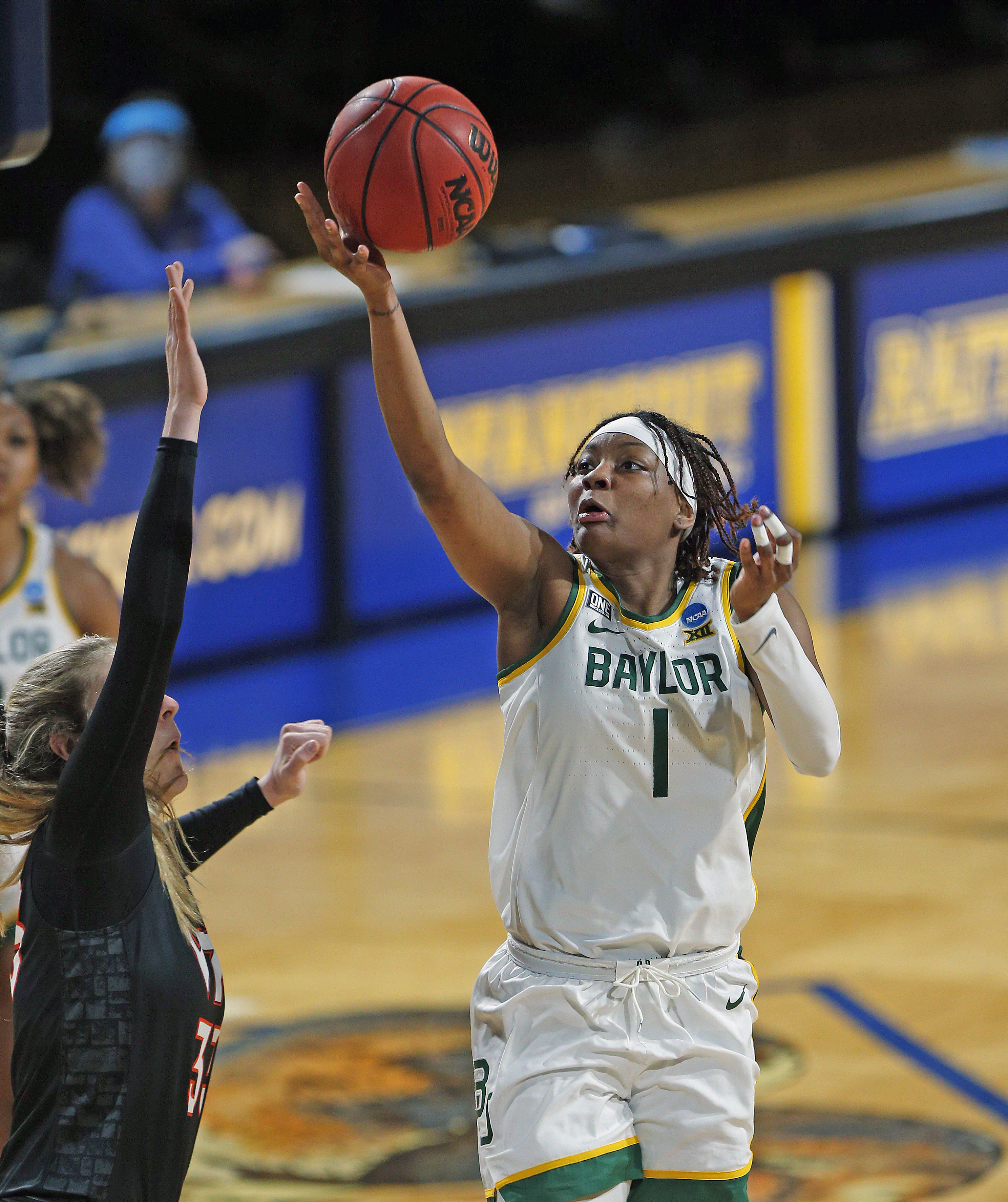 Baylor forward NaLyssa Smith (1) shoots during the first half of a college basketball game in the second round of the women’s NCAA tournament at the Greehey Arena in San Antonio, Tuesday, March 23, 2021. (AP Photo/Ronald Cortes)
South Carolina 59, Oregon State 42
Aliyah Boston scored 19 points and top seed South Carolina dominated after a close first quarter to beat eighth-seeded Oregon State, advancing to its seventh straight Sweet 16.
The Gamecocks (24-4) led by a point after one quarter but had built a 12-point lead by halftime and were up 53-29 by the start of the fourth.
South Carolina, which won a national title in 2017, improved to 8-1 in the second round under coach Dawn Staley and will appear in the regional semifinals for the 11th time overall. South Carolina made just 1 of 15 3-pointers, but was able to control the game by outscoring the Beavers 34-24 inside and winning big on the boards.
Iowa 86, Kentucky 72
Iowa freshman Caitlin Clark finished with 35 points after outscoring Kentucky on her own in the first half, and the fifth-seeded Hawkeyes advanced to the women’s NCAA Sweet 16.
The Hawkeyes (20-9) scored the game’s first 11 points and led throughout to advance past the second round for only the third time in their 14 NCAA appearances during coach Lisa Bluder’s 21 seasons. They went to the Elite Eight in the last tourney two years ago before losing to eventual champion Baylor.
Two-time AP All-American guard Rhyne Howard finished with 28 points to lead the Wildcats (18-9). She was 1 of 7 shooting in the first half, but finished 8 of 21 with five 3-pointers, along with eight assists.
A second-team AP All-American who entered the game as the national leader with 26.5 points per game, Clark finished 13 of 21 from the field with six 3-pointers, along with seven rebounds and six assists.
N.C. State 79, South Florida 67
Jakia Brown-Turner scored 19 points and top-seeded North Carolina State shrugged off a challenge from No. 8 South Florida with a big third quarter, advancing to the Sweet 16.
Jada Boyd added 18 points and 10 rebounds for the Wolfpack (22-2), who reached their third straight regional semifinal and 14th overall. USF (19-4) led by a point early in the third quarter before N.C. State used two big runs to pull away and take a 12-point lead into the fourth.
The Bulls pulled within eight points with 3 1/2 minutes to go. But the Wolfpack scored the next five points, capped by a 3 from Brown-Turner that made it 73-60 with 90 seconds to go.
The game was played at the Alamodome in front of a handful of people, including NCAA President Mark Emmert, who has been on the defensive since players took to social media to point out inequities in the NCAA’s treatment of women’s teams.