
Thursday, November 12, 2026Nov 12

S. Korea conducts cruise missile drill amid N. Korea threats

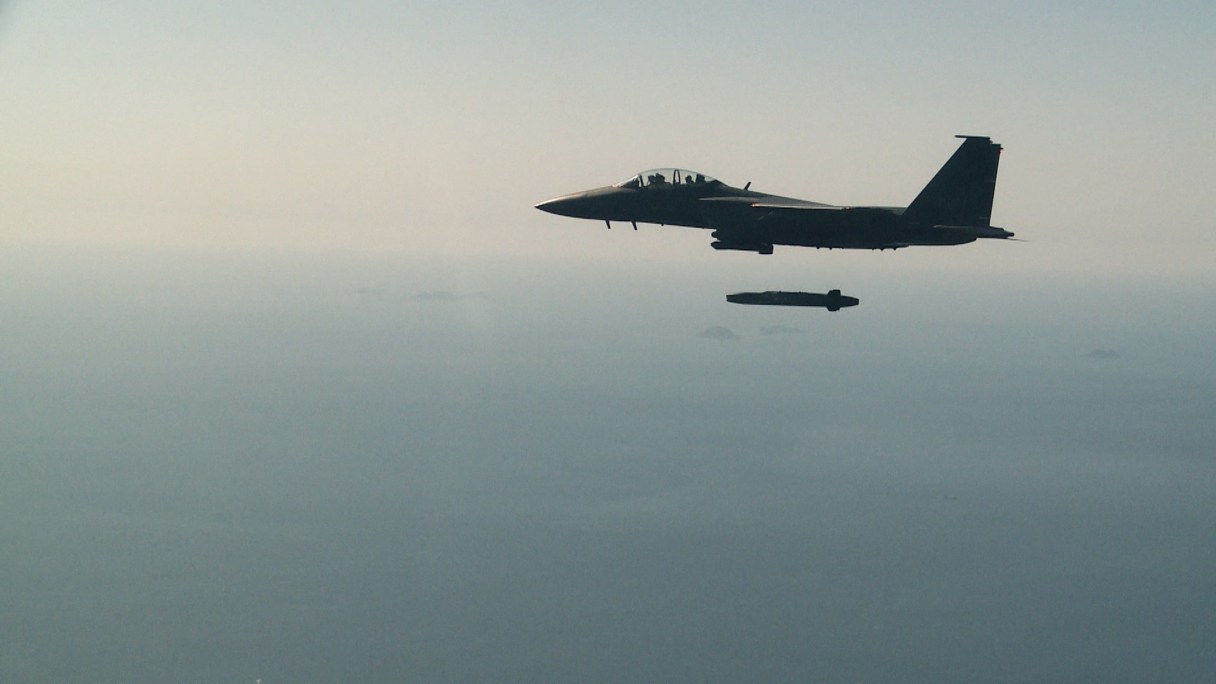
In this photo provided by South Korea Defense Ministry, a South Korean air force F-15K fighter jet releases a Taurus missile during a drill  off the country's western coast, South Korea, Wednesday, Sept. 13, 2017. South Korea says it conducted its first live-fire drill for an advanced air-launched cruise missile it says will strengthen its pre-emptive strike capability against North Korea in the event of crisis. (South Korea Defense Ministry via AP)
In this photo provided by South Korea Defense Ministry, a South Korean air force F-15K fighter jet releases a Taurus missile during a drill off the country's western coast, South Korea, Wednesday, Sept. 13, 2017. South Korea says it conducted its first live-fire drill for an advanced air-launched cruise missile it says will strengthen its pre-emptive strike capability against North Korea in the event of crisis. (South Korea Defense Ministry via AP) In this photo provided by South Korea Defense Ministry, a South Korean air force F-15K fighter jet releases a Taurus missile during a drill off the country's western coast, South Korea, Wednesday, Sept. 13, 2017. South Korea says it conducted its first live-fire drill for an advanced air-launched cruise missile it says will strengthen its pre-emptive strike capability against North Korea in the event of crisis. (South Korea Defense Ministry via AP)

SEOUL, South Korea (AP) – South Korea said Wednesday it had conducted its first live-fire drill for an advanced air-launched cruise missile that would strengthen its pre-emptive strike capability against North Korea in the event of crisis.

South Korea’s military said the Taurus missile fired from an F-15 fighter jet traveled through obstacles at low altitudes before hitting a target off the country’s western coast during drills Tuesday.

The missile, manufactured by Germany’s Taurus Systems, has a maximum range of 500 kilometers (310 miles) and is equipped with stealth characteristics that will allow it to avoid radar detection before hitting North Korean targets, according to Seoul’s Defense Ministry.

South Korea has been accelerating efforts to ramp up its military capabilities in face of a torrent of nuclear weapons tests by North Korea, which on Sept. 3 conducted its sixth and most powerful nuclear test to date.

Shortly after the nuke test, Seoul announced it reached an agreement with Washington to remove the warhead weight limits on South Korean ballistic missiles, which under a bilateral guideline could be built for a maximum range of 800 kilometers (497 miles).