
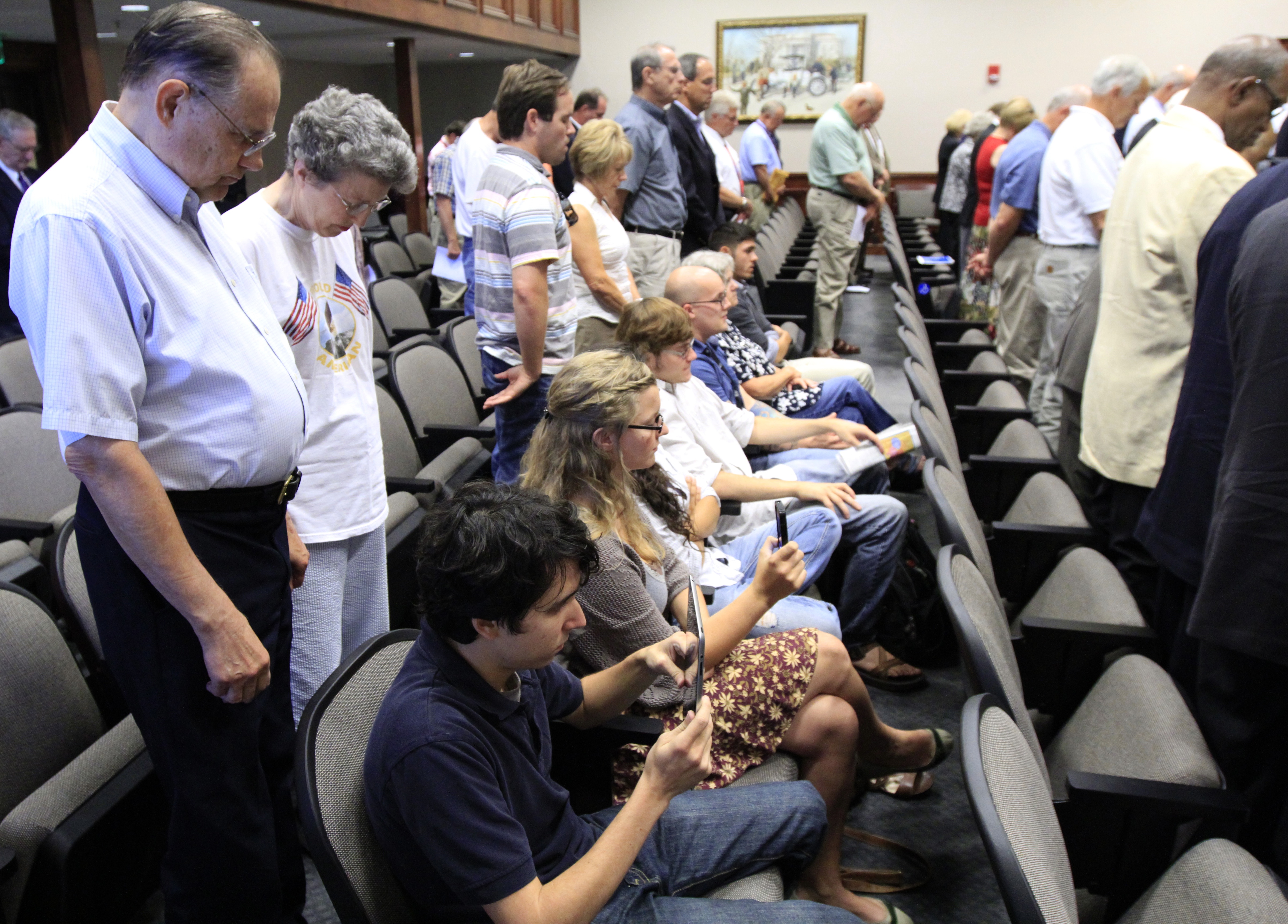
 Protesters remain seated during an opening prayer at a Hamilton County Commission meeting in June. The protesters addressed commissioners on their belief that government meetings should open with a moment of silence instead of prayer.
THE FIRST AMENDMENT”Congress shall make no law respecting an establishment of religion, or prohibiting the free exercise thereof; or abridging the freedom of speech, or of the press; or the right of the people peaceably to assemble, and to petition the Government for a redress of grievances.”WHY DOES IT APPLY HERE?The U.S. Supreme Court first decided in the 1925 case Gitlow v. New York that the First Amendment applies to the states and their subdivisions through the Fourteenth Amendment’s Due Process clause.THURSDAY’S HEARINGThough Thursday’s hearing is only preliminary, both sides likely will have to explain their Marsh arguments. A motion for preliminary injunction on a First Amendment issue requires plaintiffs to show, among other things, their likelihood of success on the merits of a case.
Both parties in a federal lawsuit over prayer at Hamilton County Commission meetings claim the First Amendment is on their side.
In the six weeks since Brandon Jones and Tommy Coleman sued Hamilton County over the commission’s regular Christian prayers during meetings, the county courthouse has drawn dozens of people expressing their thoughts and emotions through silent protest, prayer, public comment and, occasionally, verbal confrontation.
Still, at its core, the dispute is a legal struggle between two parties over two clauses in the first 16 of 45 words in an amendment to the U.S. Constitution passed by Congress in 1789 and ratified by the states in 1791.
“Congress shall make no law respecting an establishment of religion, or prohibiting the free exercise thereof …”