
Local reaction to the federal government’s newly released publication, “Dietary Guidelines for Americans 2015-2020,” has been surprising, says registered dietitian Allison Knott, president of the Chattanooga Academy of Nutrition and Dietetics.
Most people, she says, are surprised by the impact the guidelines make on food policies and programs that influence the American diet.
 Anne Braly
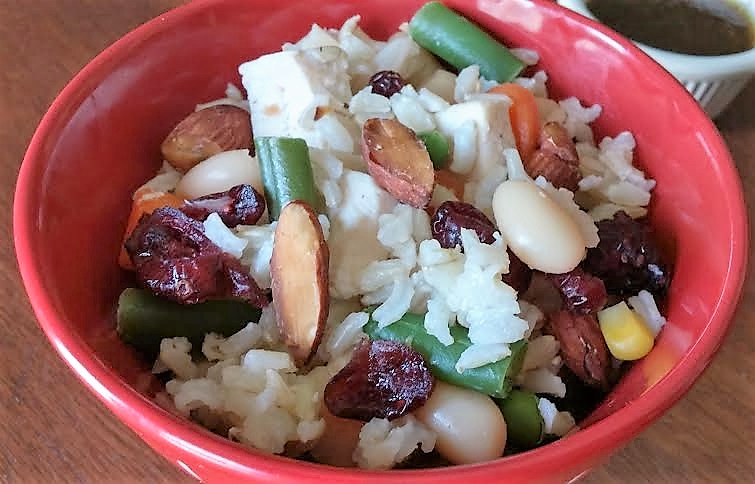
 The ingredients in this healthful whole-grain salad mirror the recommendations set forth in the federal government’s newly released Dietary Guidelines for Americans 2015-2020.
The publication is revised every five years and was first created in 1990 as a result of the newly created National Nutrition Monitoring and Related Research Act “to influence the way Americans eat by providing a framework for federal food programs and policies and by providing guidelines for health professionals to educate clients throughout the lifespan on eating for optimal health,” Knott says.
The latest guidelines are a mixed bag of recommendations, ranging from sugar intake for all Americans to a protein suggestion targeting men and teenage boys. Perhaps the most notable change, though, reveals a shift in thinking about cholesterol.
“Nutrition science is continually evolving so federal guidelines such as this must evolve as well in order to remain up to date on the latest scientific research,” Knott says. “Instead of focusing on single nutrients, the recommendation is to look at the diet as a whole,” thereby establishing a host of good eating habits to practice throughout life.
“However, the guidelines still include specific nutrient recommendations for protein, saturated fat and sodium,” Knott adds.
Here are some of the highlights of “Dietary Guidelines for Americans 2015-2020”:
* Limit added sugar: This is new recommendation states that no more than 10 percent of total calories should come from added sugars. The average American currently eats about 13 percent. This doesn’t include the sugar found naturally in foods, instead it’s the sugar added to foods during processing. Think sugar-sweetened beverages, desserts, baked products, condiments, candies, etc. What is confusing, though, are the labels found on food packaging.
“It’s nearly impossible to know how much added sugar is in a food without it being listed on the label. As the nutrition facts panel is currently formatted, total sugars are the only form listed, and you can only tell from the ingredients of the food if a product includes added sugar,” Knott says.
“For example, yogurt naturally contains sugar in the form of lactose, so even plain yogurt will have sugar listed on the label. Fruit syrup, granola or candied toppings included with the yogurt will increase that number in the form of added sugar. Hopefully, we will see that change to the nutrition facts panel in the coming months.”
* Dropping the dietary cholesterol recommendation: This is another first for the guidelines, and it de-emphasizes the importance of limiting dietary cholesterol. However, the lack of a recommendation has been met with controversy. Dropping the recommendation has led to a lawsuit against the U.S. Department of Agriculture, which funded the guidelines along with the U.S. Department of Health and Human Services, by the Physicians Committee for Responsible Medicine, a Washington, D.C.-based nonprofit that promotes a vegan diet. The committee claims that the egg industry heavily influenced the decision.
“Despite the controversy and lack of a specific recommendation, the guidelines still include a recommendation that dietary cholesterol should be limited and that individuals should eat as little as possible as a part of a healthy eating pattern,” Knott says.
* Protein intake for teenage boys and adult men: The guidelines call for teenage boys and adult men to eat less protein from animal sources. They recommend reducing the intake of meats, poultry and eggs and replacing them with vegetables and other underconsumed food groups, including fruits and whole grains.
Knott says research over the past few years supports all the recommendations, and she believes they are realistic.
“The key recommendations include focusing on variety and on a healthy eating pattern across the lifespan. Healthy eating doesn’t look the same for everyone and the dietary guidelines are just that – a guide to making healthy eating work for your lifestyle,” she says.
A good place to start is with the key recommendations:
* Focus on variety, nutrient density and serving size.
* Limit calories from added sugars, such as sugar-sweetened beverages.
* Limit calories from saturated fats, replacing saturated fats from meats with heart-healthy fats such as those found in nuts, seeds and fish.
* Reduce sodium intake.
* Shift to healthier food and beverage choices.
* Choose foods in their whole form such as whole fruits and vegetables and whole grains.
But most importantly, Knott stresses, look at the diet as a whole.
“If the majority of your diet is following the key principles laid out in ‘Dietary Guidelines 2015-2020,’ then you’re on the right path.”
The following salad mirrors the recommendations set forth in the new guidelines, making for an endless number of combinations that are excellent ways to add whole grains, lean protein and plenty of plants to your diet, Knott says. Use brown rice, quinoa, farro or barley as your base, then build the salad using your favorite dried fruits and vegetables.
Whole-Grain Salad
1 cup dry whole grains (brown rice, quinoa, farro or barley), cooked according to package directions
1 cup chopped vegetables
1/2 cup beans or legumes (low-sodium canned and rinsed, or dry and cooked)
2 tablespoons dried fruit (optional)
2 tablespoons nuts or seeds
2 tablespoons olive or canola oil
1 tablespoon red wine or balsamic vinegar
Dried herbs, salt and pepper, to taste
Combine cooked grains, vegetables, beans, fruit and nuts. Mix together olive oil, vinegar, herbs, salt and pepper. Toss with salad mixture and serve.
CORNBREAD COOKIN’
It’s time brush up on your creative cooking skills and come up with a winning recipe worthy of donning the cast-iron crown in the 20th Annual National Cornbread Cook-Off.
Now through March 11, consumers can submit an original main-dish recipe that uses at least one package of Martha White cornbread mix and cooked in a piece of Lodge cast-iron cookware. Five finalists will be selected to compete during the National Cornbread Festival on April 23 in South Pittsburg, Tenn.
In a press release, Martha White baking expert Linda Carmen said she gets intriguing recipes from cooks across the country. “They continue to impress me with the creative twists on classic recipes and trendy dishes reinvented with cornbread,” she said.
For complete details and to complete the entry form for the contest, visit www.nationalcornbread.com.
Contact Anne Braly at abraly@timesfreepress.com.
 The 20th Annual National Cornbread Cook-Off runs now through March 11.