
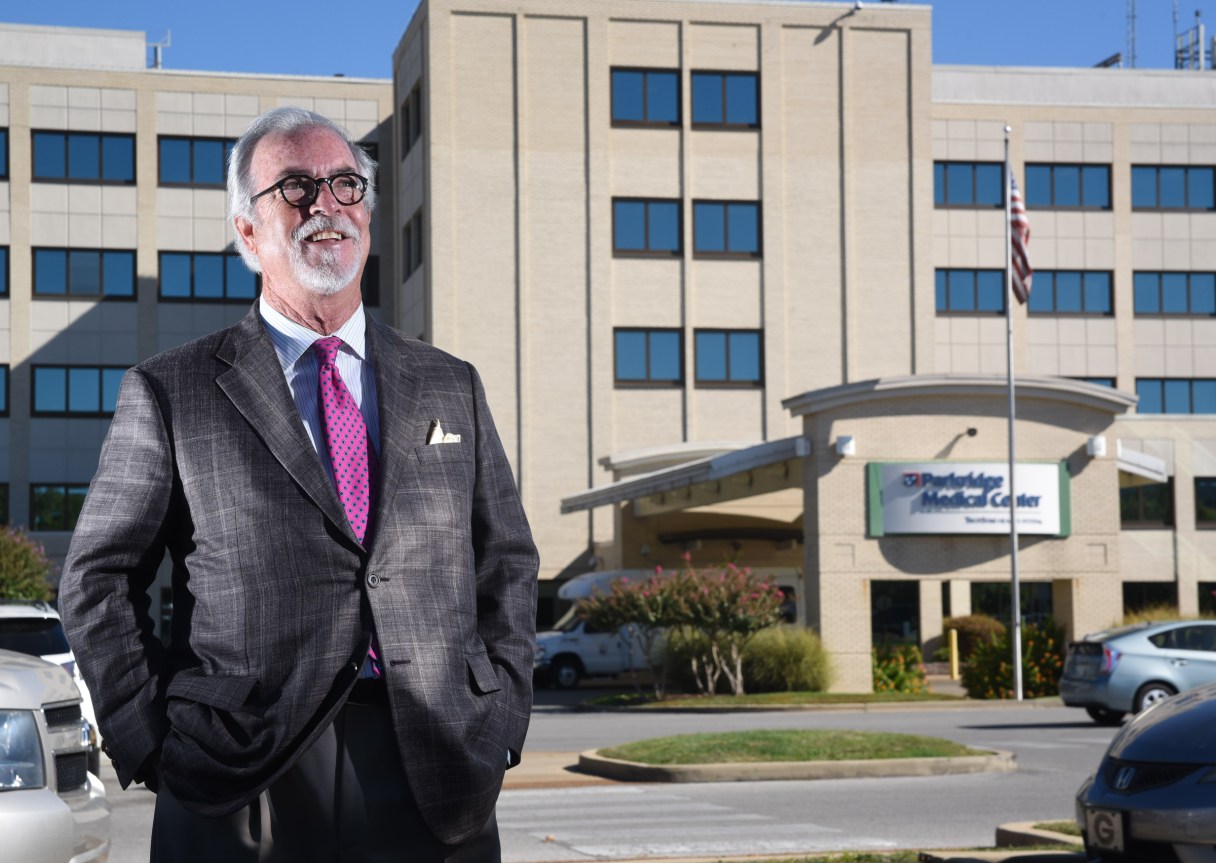
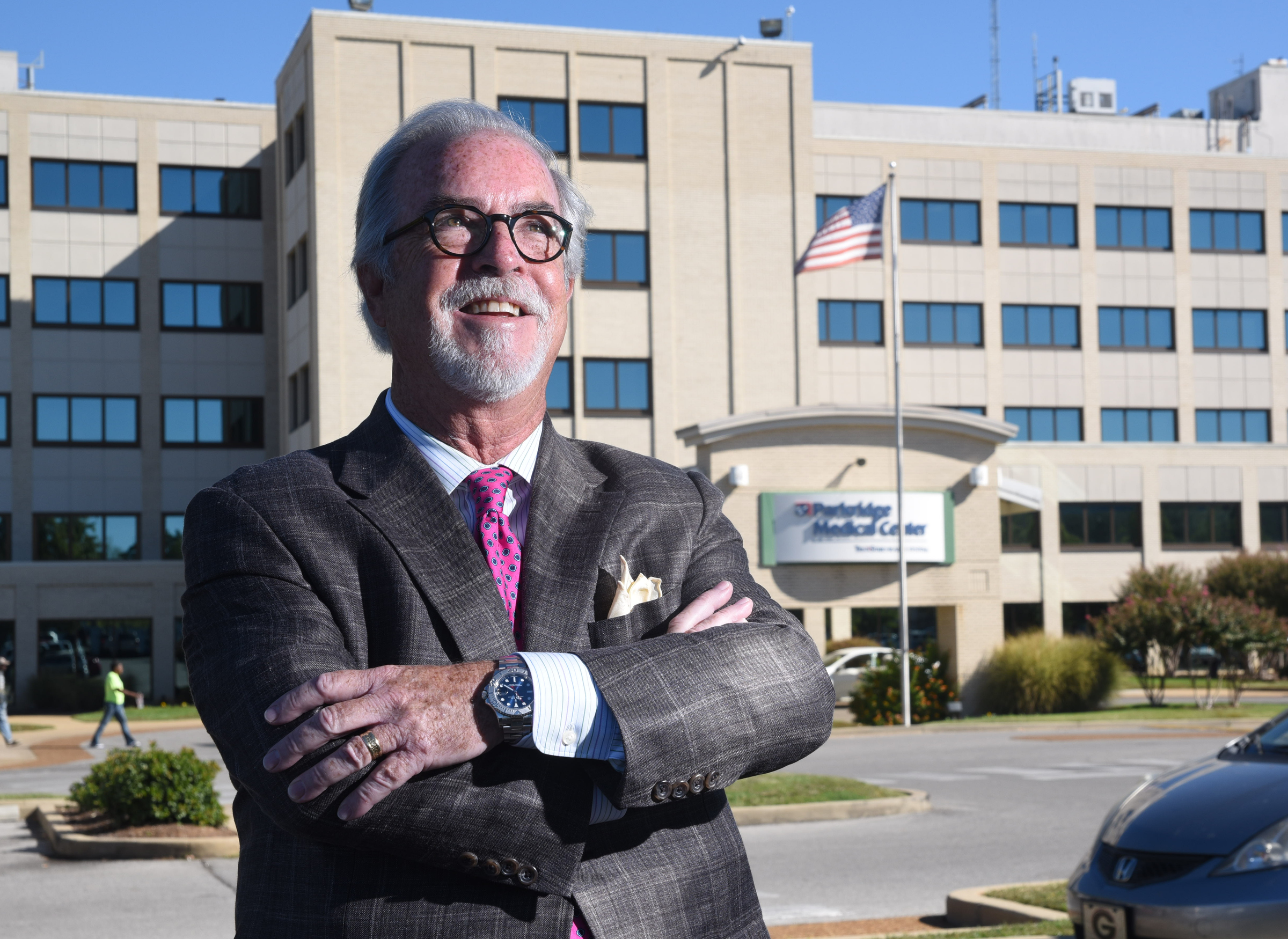
 Parkridge Health Systems President and CEO Darrell Moore, FACHE, is retiring in December.
Parkridge Medical System CEO Darrell Moore believes every hospital manager needs to be part chess player, part psychologist and part NBA referee.
Moore, who announced recently that he is retiring in December, should know. He has spent 40 years as a health care executive, the last decade managing Parkridge, the metro area’s third-largest hospital, through a period of major expansion during a time of constant change in the national health care scene.
“To be a good CEO, you need to be a good chess player so you can anticipate the next move of what’s happening in the community,” Moore said in a recent interview in his office at Parkridge’s main hospital on McCallie Avenue. “You have to be a psychologist so you can say, ‘How do you feel about this? Where are things going? Share with me your thoughts and ideas.
“And then you have to be an NBA referee so you can call a timeout or a foul and say, ‘No, this is where you need to go.'”
That’s become easier over time. “When I was 26 or 27 years old, trying to explain to a heart surgeon how things have to be was difficult,” he said. “But now with my gray hair, I can say I’ve seen a lot of different things in 40 years. You can sit down with physicians and ask, ‘Is that the right thing to do? What can we do to do something better together?'”
Moore insists that all of his efforts are ultimately focused around patient care. “There is somebody in our hospital today having the worst day of their life, and it is going to take the teamwork of the entire hospital – the physicians, our staff – to work with the patient and their families and coordinate that care for the best outcome that we can do.”
He quotes a former colleague, Norman Burkett, longtime CEO of Dalton’s Hamilton Medical Center, that “we do that with attention to detail and a sense of urgency.”
The attention to detail should start from the moment the patient enters the parking lot.
“It’s about cleanliness, friendliness, interaction, how to get patients registered and to their room, and to do so in the most smooth and effective manner, but to focus not only on the patient but also on the family,” he said. Hospitals are “an unusual environment that people are not accustomed to.”
Improving that first impression is one reason Parkridge is getting ready to start a major renovation of its main hospital.
“This hospital was built in the ’70s,” Moore said. “We look like a well-worn home, where you raised four children and had a lot of people over, but it is inefficient. We don’t want to be a showcase, but we want to be a comfortable, pleasant environment.”
Parkridge is owned by Nashville-based HCA (previously Hospital Corporation of America), one of the nation’s largest health care companies with some 177 hospitals in its network. That gives Parkridge an advantage, Moore believes, in that he has access to the experience of other hospitals in the chain in developing best practices for hospital management.
Parkridge shares a proprietary computer system with other HCA facilities for electronic health care records and other IT functions. Parkridge also can use the parent company’s clout when bargaining for expensive equipment such as MRI machines or CT scanners.
Parkridge is also unique in that it is the only major for-profit hospital in Chattanooga. Both Erlanger, which is public, and CHI Memorial, part of the Catholic Health Initiative, have different goals in terms of providing care for patients who can’t afford it. While Parkridge does provide charity care, Moore also has to be concerned with earning a profit.
“We select the service lines we can do and do well with good volume,” he said. “We don’t want to be everything for everybody.”
HCA requires its hospitals to prepare rolling three-year plans, with regular checks to see how well goals are being achieved and an understanding that adjustments are often needed.
“You can’t control the winds, but you can adjust your sails,” said Moore, a weekend sailor who took his wife of 38 years sailing on their first blind date.
For Parkridge, that has meant adding a behavioral health facility aimed at adults, Parkridge Valley and Senior Campus, and another similar facility, Parkridge Valley Child and Adolescent Campus, offering mental health care to younger patients.
Besides the 275-bed main hospital, Moore also oversees 128-bed Parkridge East, best known for its pediatric care; and Parkridge West, in Jasper, an emergency care and outreach facility serving Marion County.
Moore says he has a lot he is proud of.
“We have a very strong cancer and orthopedic program as well as our cardiac program that has really evolved as well as our high-risk delivery and mother-baby program over at East,” he said. “And we’ve been providing behavioral health services for over 40 years in this community and really have helped with inpatient and outpatient – that’s an area that has really changed and evolved.”
So what else has changed in Moore’s 40 years in health care?
First, most of what hospitals were doing in-house four decades ago is now handled on an outpatient basis, where patients never spend a night in the facility.
“The hospital of today is like an ICU unit with sub-specialties,” Moore said.
Major technologies such as MRIs and CT scanners that have given doctors much better diagnostic tools were still in their infancy when Moore began work. He has experienced firsthand the debates over whether and then how to use the expensive equipment.
“I like to be a pioneer, but I don’t want to be the first pioneer,” he quipped. “I want to be a settler.”
Now the issue is how best to use the gear. For example, the da Vinci robotic surgery device “is touted as doing all sorts of surgical procedures,” he said, noting that Parkridge owns three of the devices. “But for some you can say, ‘Gee we accomplished that by da Vinci,’ but it may have taken longer, and been more expensive, and you still have the same outcome. It’s using the right equipment for the right procedure, with the right outcome, with the right cost reimbursement efficiency.”
While the advances in technology and procedures have been significant, the way hospitals and doctors are paid has also changed dramatically. In the old days, doctors could just send patients or their insurers a bill for their services. But both insurance companies and the federal government began to insist that doctors agree on the best way to treat a patient, to make it easier to predict what that treatment would cost.
Many doctors condemned the idea as “cookbook medicine,” Moore said. “People were putting together these treatment protocols and folks reacted to them – ‘I’m a professional and a physician, and I really don’t need these guidelines.'” But over time, physicians and hospitals have come around, realizing that developing best practices improves patient care and safety, and makes treatment more efficient.
Now, both insurers and the federal Centers for Medicare and Medicaid Services (CMS) are taking things a step further. Instead of paying a set fee for a particular procedure, they are instead insisting that payment will depend on the quality of care. In practice, that means if the patient returns to the hospital for re-admission because his or her problem has not been fixed, Medicare may lower the hospital’s reimbursement.
For hospitals, that means they have to pay attention to what happens to a patient once he or she is discharged. Do they get their prescriptions filled? Do they take the prescriptions properly? Do they do followup visits with their family doctor or physical therapist? That is forcing hospitals to work with other medical providers such as physical therapists or family care doctors to keep patients healthy and out of the hospital.
“We have folks calling patients at home, to see how are you getting along; you were at our hospital, are you taking your medication; did you get your medication; how are you feeling?” Moore said.
Moore keeps coming back to the importance of collaboration and communication, and another sailing analogy.
“You can have the best boat, but if the crew is not coordinating, it’s just gonna sit there and the sails are going to flop and you won’t go anywhere,” he said. “When you start communicating, the helmsman gets the boat going great, but if the navigator says there is a reef ahead, you better change your course.”
Moore seems ready to stop worrying about the changing winds of health care.
When he retires, he plans on doing more hiking, biking and boating, but perhaps not as much sailing. “I like to call myself bi-nautical now,” Moore said. “I bought a trawler – I still do some sailing, but I have crossed over to the power side.”
Contact staff writer Steve Johnson at 423-757-6673, sjohnson@timesfreepress.com, on Twitter@stevejohnsonTFPhttp://twitter.com/stevejohnsonTFP, and on Facebook, www.facebook.com/noogahealth.