
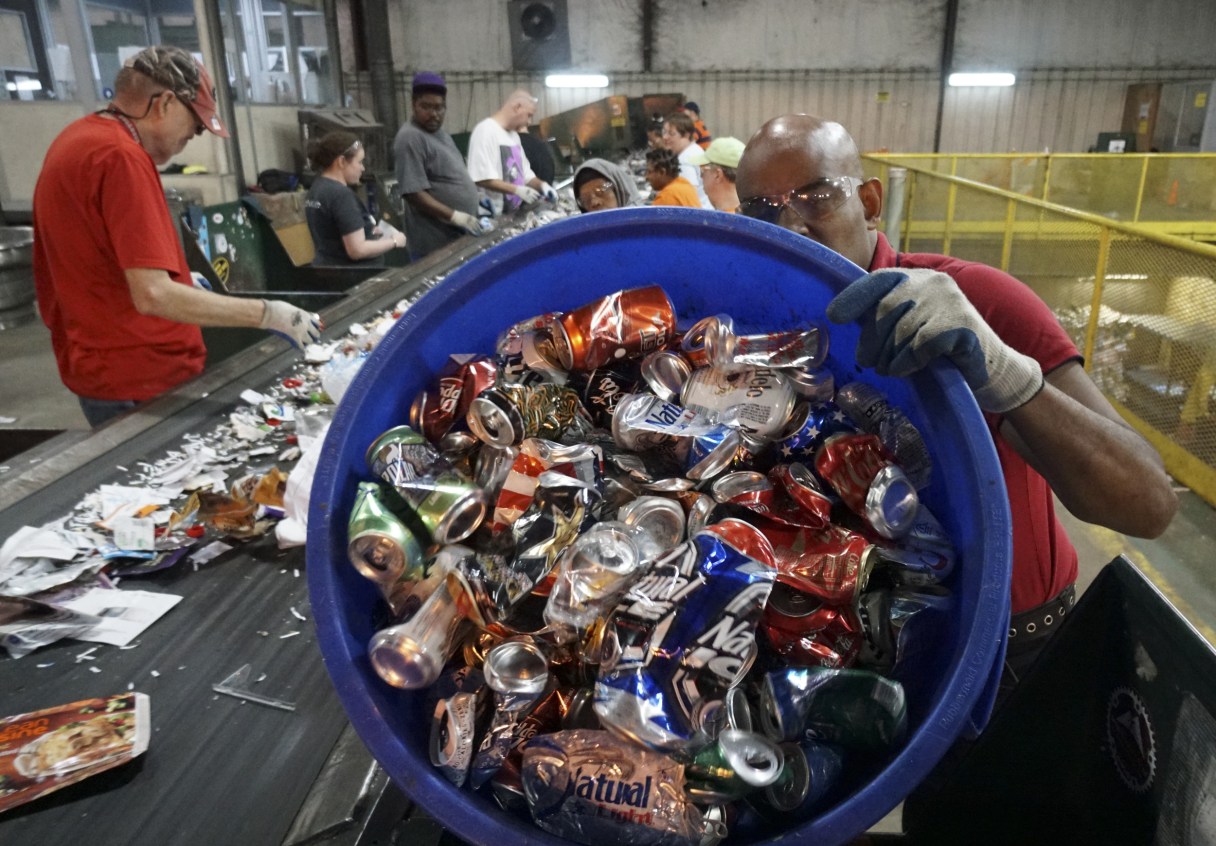
Over the last 28 years, hundreds of local adults with developmental or intellectual disabilities have found work in Orange Grove’s Dodson Avenue recycling facility. They have conducted intake, sorted items and repackaged them to be shipped to their next destination.
But later this month, the conveyor belt will stop, and the 45-50 individuals who work in the recycling center will take off their gloves for the last time.
The Orange Grove Center and the city of Chattanooga announced last week that, after 24 years partnering together, the center will no longer be able to conduct the core function of its recycling program due to a federal mandate requiring greater community engagement in the places where people with intellectual or developmental disabilities can work.
It’s a substantial change to a longstanding partnership regarded by most as a win-win: The city received a service at an affordable price while providing jobs to members of a historically marginalized population that might struggle to find work.
However, the Orange Grove Center’s state and federal funding hinges upon its compliance with regulations put forth by Centers for Medicare and Medicaid Services, and a 2014 final rule left the Orange Grove Center’s materials recovery facility out of compliance.
The rule requires that the settings for services like those provided by Orange Grove be “integrated” and support full access to the greater community.
The center attempted to bring its materials recovery facility into compliance by hiring outside workers to integrate the operation, but it became clear to leaders at the center that it would be implausible for the facility to continue operating within federal compliance.
Orange Grove is a nonprofit organization that receives about 85 percent of its funding from state and federal sources through Medicaid waiver programs. It serves close to 1,000 area individuals, offering academic programs to those who are school age, as well as job training, job placement, leisure and volunteer activities, health care and residential options, depending on the assessed need of each individual.
“Is it frustrating? Sure. It’s frustrating to have to take a program that we think was working, that our individuals enjoyed and thought was a good program, and have to dismantle it,” Orange Grove Development Director Heidi Hoffecker said. “But the end goal is not a bad one.
“The end goal is that we don’t have pockets of people and, practically, that means that our community and our businesses and our employers, and society in general, really needs to expand their understanding of what it means to have a diverse society.”
While the center’s materials recovery facility – where the bulk of the program’s workers have been employed – will shut down, Orange Grove will continue operating its six drop-off convenience centers and three refuse collection centers. Those facilities provide work in a more integrated setting to about 25 people with disabilities.
The center will also remain responsible for managing the sale and marketing of materials collected through the curbside recycling program, meaning Orange Grove – not the city – will find a new facility where items collected through the curbside program can be managed.
“Our partnership with Orange Grove is going to continue,” city Public Works Administrator Justin Holland said. “They will still continue to operate those facilities with their clients in a community atmosphere where they are out working and interacting with people.”
Hoffecker said the center will continue with “person-centered planning” for each individual as it always has. Individuals served by Orange Grove who worked in the recycling facility have always chosen to do so, she said.
The recycling facility workers have been paid hourly, working approximately seven hours per day, depending on capability and generally earning wages slightly above, at or slightly below minimum wage.
“The picture of success for each of these individuals may change,” she said. “It may not just be work, it may be some combination of work and volunteering and community-based activities. The No. 1 inquiry will be, ‘Hey, what do you want to do?'”
When workers at the Dodson Avenue facility were told about the looming change, several expressed mixed feelings about what is to come.
The Times Free Press agreed to identify the individuals served by Orange Grove by only their first names.
“I like my job,” said a man named Charles who has been working at the facility for “a long time.”
Charles said he wasn’t sure how he felt about the possibility of getting another job.
“It ain’t up to me,” added Diane. “I don’t know what to do about it. It’s up to somebody else for outside jobs.”
Orange Grove does partner with local businesses and nonprofits to place individuals in jobs, and Hoffecker said the center will need workplaces to think of how to be more accessible, to the extent that it would be mutually beneficial.
“If it doesn’t make sense for the employer to hire Judy, Johnny, Joey or Beth and it doesn’t make sense for them to be employed there, then that’s not going to work,” she said. “We want it to be successful for all parties. Really, this gives everybody a push toward broadening our definitions of what our society needs to look like.”
Contact David Cobb at dcobb@timesfreepress.com or 757-6249