
The revitalization of two Chattanooga buildings has drawn praise not only from the people who occupy the revamped spaces but from the American Institute of Architects, Tennessee.
The professional organization’s annual Design Awards are meant to honor “built works of distinction” designed by any of the 1,400-plus AIA Tennessee members and bring “public attention to their outstanding architectural accomplishments,” said Molly Craig, director of member services, in a news release.
The 2021 awards, announced in December, recognized six projects in Knoxville, Memphis and Nashville for Awards of Excellence.
The 14 Merit Award winners included two Chattanooga firms, both in the Restoration/Renovation category. Elemi Architects’ Stove Works project hearkens to a century-old family connection as the space finds new life as a gallery space. Franklin Architects’ designs for Conversant Group help the secrecy-minded information technology company telegraph success.
“The 20 projects were unanimously chosen from a field of 98 submittals, all of which received thoughtful consideration,” Craig said. “The jurors noted the diverse range of work and elegant solutions to challenges presented.”
Here’s a look at the Chattanooga award recipients. The juror comments were provided by Craig.
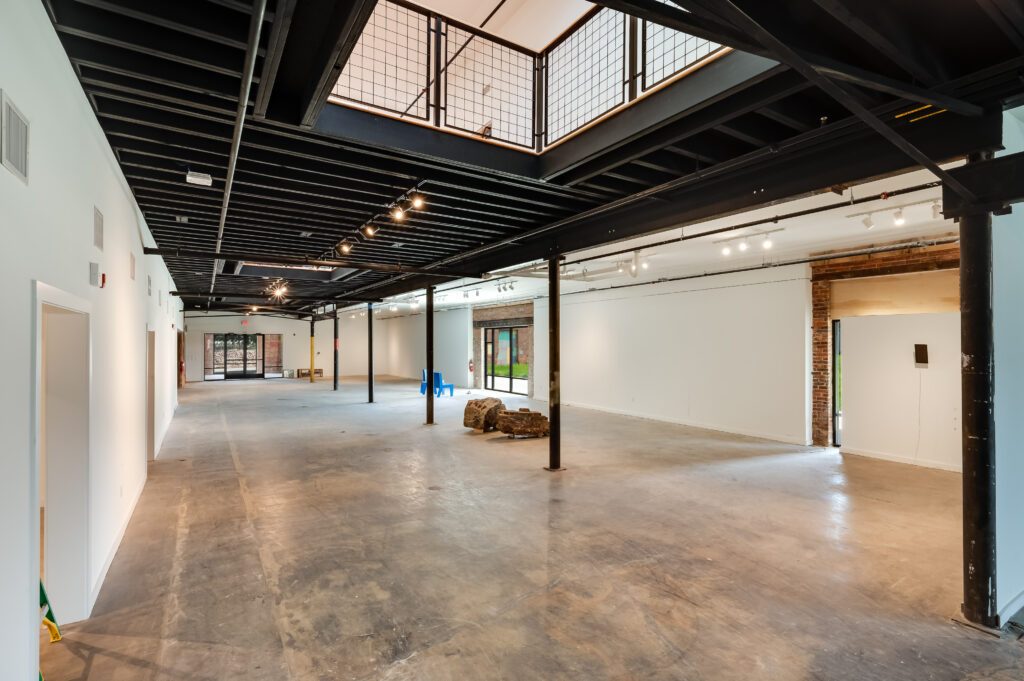
 Contributed Photo from AIA Tennessee / The interior space of Stove Works features oak floors, white walls and roof monitors that splay natural light through the space.
ELEMI ARCHITECTS FOR STOVE WORKS
Category: Restoration/Renovation
Juror notes:
– A high-impact, budget-conscious renovation moment.
– Good example of converting an abandoned building into a variety of spaces.
– Feels like a unique, master-planned, community-building and place-making exercise.
– Use of skylights, gallery walls, etc. and impressive and chic finishes display a passion for bringing something back into use.
Building owner: Charlotte Caldwell, founder and director of Stove Works, a contemporary art gallery.
Project architect: Matt Winget, principal architect and owner of Elemi since 2011.
General contractor: New Blue Construction.
The building: In its previous lives, the 55,000-square-foot building at 1250 E. 13th St. has been home to Tennessee Coffin and Casket Co. and later Tennessee Stove and Manufacturing Co. (now known as Modern Maid), which was founded by Caldwell’s great-great-grandfather. Caldwell bought the building in 2017.
What Caldwell wanted: “It was important to me to maintain a distinction between what was old and what was new,” she said. “I wanted to try not to hide or cover what the building was at the time. Matt perfectly captured how I wanted to see those two things intersect. This building has been standing a hundred years. I wanted to make sure it stands for another hundred.”
Winget’s takeaway: “When I met Charlotte and we talked about her project the first time, I felt pretty confident it was an AIA winner, as long as I did my job as I’m trained to do,” he said.
Interestingly, Winget had little experience in gallery design and little expectation that such projects would regularly come along. His professors at the University of Tennessee told him that art galleries typically account for maybe 1% of their work.
“I told her I had designed about three galleries, and that was during school. That was my experience,” he said.
“Thankfully, she took a chance on me and let me do it,” he said. “We had a great project team. It felt like a celebration of her [family] story.”
Best features: The building now houses private living quarters and public working space for nine artists. The first floor includes a kitchen and artist studios along a wide hallway with oak floors and white walls. Overhead, natural light streams into the gallery space through roof monitors, architectural features that function as giant skylights. A large window overlooks Chattanooga National Cemetery.
“It’s just beautiful,” Caldwell said. “It doesn’t feel clinical or standard. With the oak and the walls and the light shining in, it feels really warm. It feels like a space that’s precious.”
Caldwell’s favorite space: “I love standing and staring down the hallway of the residency through the giant glass window at the end of the hallway.”
What’s next: The second phase of the building, now being designed, will include a restaurant, more studio space and creative office space, Caldwell said.
 Contributed Photo by Morgan Nowland / No dark recesses for the IT staffers at Conversant Group. Their working environment is light, bright and airy. The orange wall is a converted shipping container now used as an office.
FRANKLIN ARCHITECTS FOR CONVERSANT GROUP
Category: Restoration/Renovation
Juror notes:
– Like the use of shipping containers inserted into the converted steel structure of the warehouse shell with containers creating new spaces within the overall volume.
– Has a clean and clear design approach with colors that add fun and interest.
– The structure brings a nice play of light.
Building owner: John Anthony Smith, chief listening officer and chief executive officer of Conversant Group, cybersecurity consultants.
Project architect: Matthew Lyle, who has been with Franklin Architects almost seven years.
General contractor: Morgan Construction Co.
The building: Even with a couple of renovations through the years, the 1950s-era building at 1513 Cowart St. “was a dump,” Smith said. “As a matter of fact, if you look at the old pictures, most people would have probably torn it down. Morgan Construction convinced me to spare the building [to cut costs].” The former auto repair shop also required pollution remediation for potential contaminants.
What Smith wanted: “I basically let them create and do what they wanted to do,” he said. “All I know is what we do and what we need the space to do and how many people we need to put in it. Beyond that, show me something cool.”
Lyle’s takeaway: “He said, ‘I hire nerds, and they all want to be in the dark. I want it bright and light, sunshiny, vibrant colors. I don’t want them in their little caves. I want them interacting and having fun.’
“It’s not every day we get a client who will entertain a wild-hair idea [installing shipping containers inside the building], but when we sat down and initially started talking through it with him, that was where he wanted to go with it.”
Why it works: “The ultimate design has been very good for our business,” said Smith, who founded Conversant Group in 2009. “What we do is hard to show tangibly because everything we do is digital. The building basically showed the larger world who we are and that we are highly successful and capable.”
Best features: Smith said the design of the building often inspires awe among clients and other visitors with its use of shipping containers – boxcars – as offices, a kitchen area and room dividers.
An upstairs mezzanine, with tables and TVs, offers a place for the staff to gather for lunch, coffee or movie-watching.
“Generally, IT people are in the dark recesses,” Smith said. “The sheer brightness of the space really aligns with who we are. We’re very much about shining a light on risk factors and shining a light on threat actors around the globe.”
Smith’s favorite space: The main lobby. “There’s a lot of light in the lobby, and you can see all of the characteristics from here – the three primary shipping containers, the mezzanine, the exposed ceilings, all the metal. All of the great qualities are visible when you walk in the front door.”
What’s next: Smith said he has purchased a nearby parking lot for another construction project to accommodate the growing company. “Our staff is constantly increasing,” he said. “Our company will double – more than double – in the next year.”
In addition to the projects singled out for awards, the Tennessee chapter of the American Institute of Architects also honored 11 architects “whose efforts and achievements have significantly improved the presence of AIA Tennessee, the profession of architecture and/or the built environment in Tennessee.”
Two Chattanoogans were among the honorees for the 2021 Presidential Award of Excellence, given to those who have contributed time and energy over and above what would normally be expected to enhance and improve the profession.
– Matthew “Matt” Lyle of Franklin Architects was honored for his service and commitment to AIA Tennessee’s advocacy program, SpeakUp 2021, which was the first completely virtual advocacy program focused on advocacy initiatives, engaging membership and educating state legislators.
– Tilman “Trey” Wheeler of Tinker Ma was recognized for his significant, ongoing impact on the profession as the chair of AIA Tennessee’s government relations committee and his dedication to advance and promote the built environment in Tennessee.