
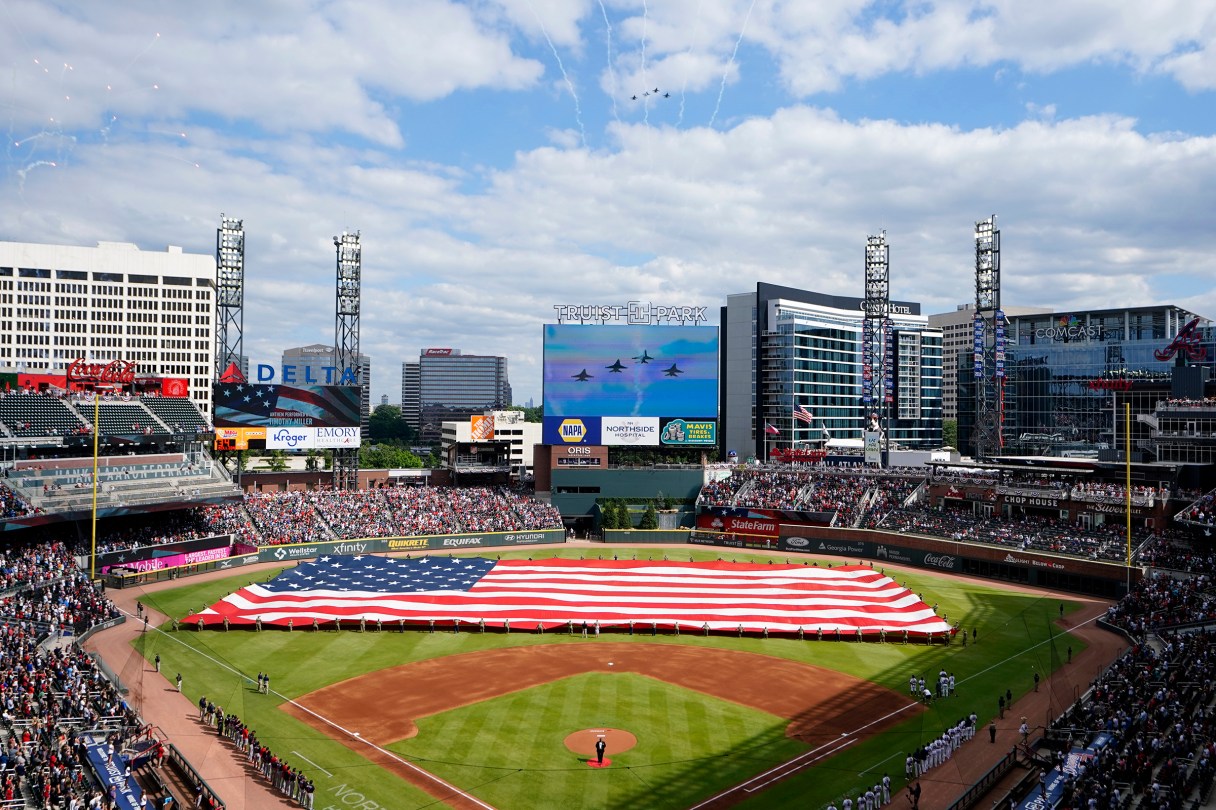
It will end up being 157 days between the moment the Atlanta Braves won last year’s World Series – with first baseman Freddie Freeman’s glove wrapping around the ball for the final out against the Houston Astros – and the start of Major League Baseball’s 2022 season.
Everything in between? It’s tough to sum that up quickly.
A record spending spree on free agents. A bitter work stoppage that pushed back and shortened spring training and delayed opening day.
Maybe most unthinkable of all: Freeman isn’t even in Atlanta anymore.
There’s a lot to catch up on before the Milwaukee Brewers visit the Chicago Cubs at Wrigley Field at 2:20 p.m. Eastern on Thursday, the first of seven games that day. Certainly, the sport is ready to move forward and wash off a winter when team owners and players fought – fiercely and occasionally publicly – over how to split the game’s billions.
Luckily, the legal work is now moved to the side, and the real fun can begin.
What can Los Angeles Angels star Shohei Ohtani possibly do for an encore after an unprecedented year of dominance on the mound and at the plate? Will the many millions spent by New York Mets owner Steve Cohen bring a championship trophy to Queens? Can anyone stop the Los Angeles Dodgers after they lured Freeman back to his Southern California home after spending his entire pro career with the Braves?
It’s time to find out after an unusual offseason split into two segments: a flurry of action before the 99-day lockout began Dec. 2, and a scramble to get rosters set when it lifted March 10.
The Texas Rangers were champions of part one. They signed shortstop Corey Seager and second baseman Marcus Semien for a combined $500 million, solidifying their middle infield with two monster contracts.
Those deals were part of a one-day-record $1.4 billion spent on free agents just before the offseason went dark. American League Cy Young Award winner Robbie Ray left Toronto for the Seattle Mariners, and the Blue Jays replaced the left-hander with former San Francisco Giants right-hander Kevin Gausman. The Detroit Tigers ponied up for shortstop Javier Báez and starting pitcher Eduardo Rodriguez. Even the Miami Marlins tried making a splash, dropping $53 million on outfielder Avisaíl García.
After starting last season with the Washington Nationals before being traded in July to the Dodgers, Max Scherzer also signed early, joining Cohen’s Mets on a $130 million, three-year deal. Scherzer then turned his attention to baseball’s labor fight, where he was one of the lead voices for players at the bargaining table. He’s back to his day job now, and that’s a good thing for the Mets with Jacob deGrom – a two-time NL Cy Young Award winner – beginning the season on the injured list.
When team activities resumed in March, the most notable drama surrounded Freeman, who became a free agent after last season, and his longtime club. Braves general manager Alex Anthopoulos appeared to end any hopes for a reunion when he traded for Oakland Athletics first baseman Matt Olson and a day later announced a $168 million, eight-year deal for the Atlanta-area native.
Freeman landed with the Dodgers for $162 million over six years, then acknowledged during his introductory news conference that he always figured on being a lifelong Brave.
Instead, the World Series banner will be raised Thursday night at Truist Park without Freeman present. The Braves’ 8 p.m. opener against the Cincinnati Reds will be televised by ESPN2, the start of a four-game series that will included a Saturday ceremony for the presentation of championship rings.
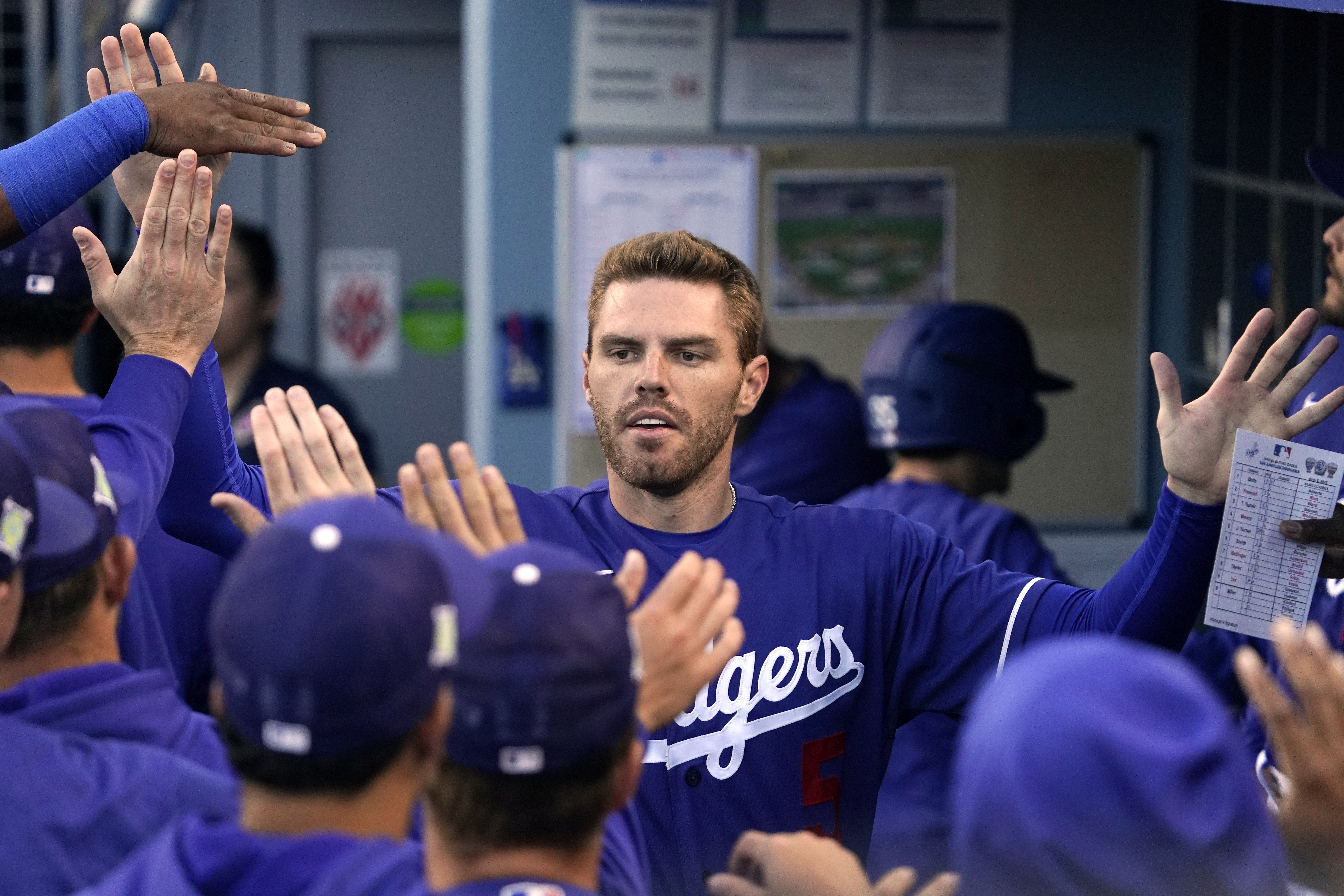 AP photo by Mark J. Terrill / Atlanta Braves fans are going to have to get used to the sight of former longtime first baseman Freddie Freeman, center, in a Los Angeles Dodgers uniform.
The Minnesota Twins made another huge deal after the lockout, convincing former Astros shortstop Carlos Correa to sign a $105.3 million, three-year deal with player opt-outs after the first two seasons. His stay might be short, but Correa has pledged to help instill a “championship culture” in the Twin Cities, where the club has lost 18 straight postseason games dating to 2004.
Other notable moves: free agent pitcher Clayton Kershaw stayed with the Dodgers, the rival Giants locked up lefty Carlos Rodón, and the Colorado Rockies signed Kris Bryant. Also new in the NL West Division is San Diego Padres manager Bob Melvin, who was granted his release by Oakland after 11 years to lead Fernando Tatis Jr. and Co.
Melvin’s old job went to Mark Kotsay, getting his first crack at managing after a 17-year playing career. The St. Louis Cardinals are under new direction, too, promoting 35-year-old Oliver Marmol after Mike Shildt was stunningly fired despite being a finalist for NL manager of the year last fall.
The rules weren’t immune to change, either. The new collective bargaining agreement brought with it several alterations that fans will notice quickly – most notably that the designated hitter has been adopted by the NL on a full-time basis.
Also, the postseason field was expanded to 12 teams from 10, with the top two teams in each league getting first-round byes and a best-of-three wild-card round replacing the old one-game playoffs.
Back for one more season, due to concerns about players’ health with the season condensed to fit in 162 games – there will be plenty of doubleheaders – is the tiebreaker rule that automatically places a runner at second base for each team to begin each inning after the ninth.
One change fans may like: Umpires will now be given microphones and asked to explain rulings after replay reviews.
One they might not like: The league now has the right to place advertising patches on team uniforms, though the earliest they would appear is the postseason.
The uniforms will be completely new in Cleveland as that city’s team debuts a new name and logos this season, transforming into the Guardians after years of acrimony of their former name of Indians, which many considered offensive. They’ll play their first official game as the Guardians on Thursday.