
Monday, November 16, 2026Nov 16

Racism to peace prize: Woodrow Wilson’s legacy on display

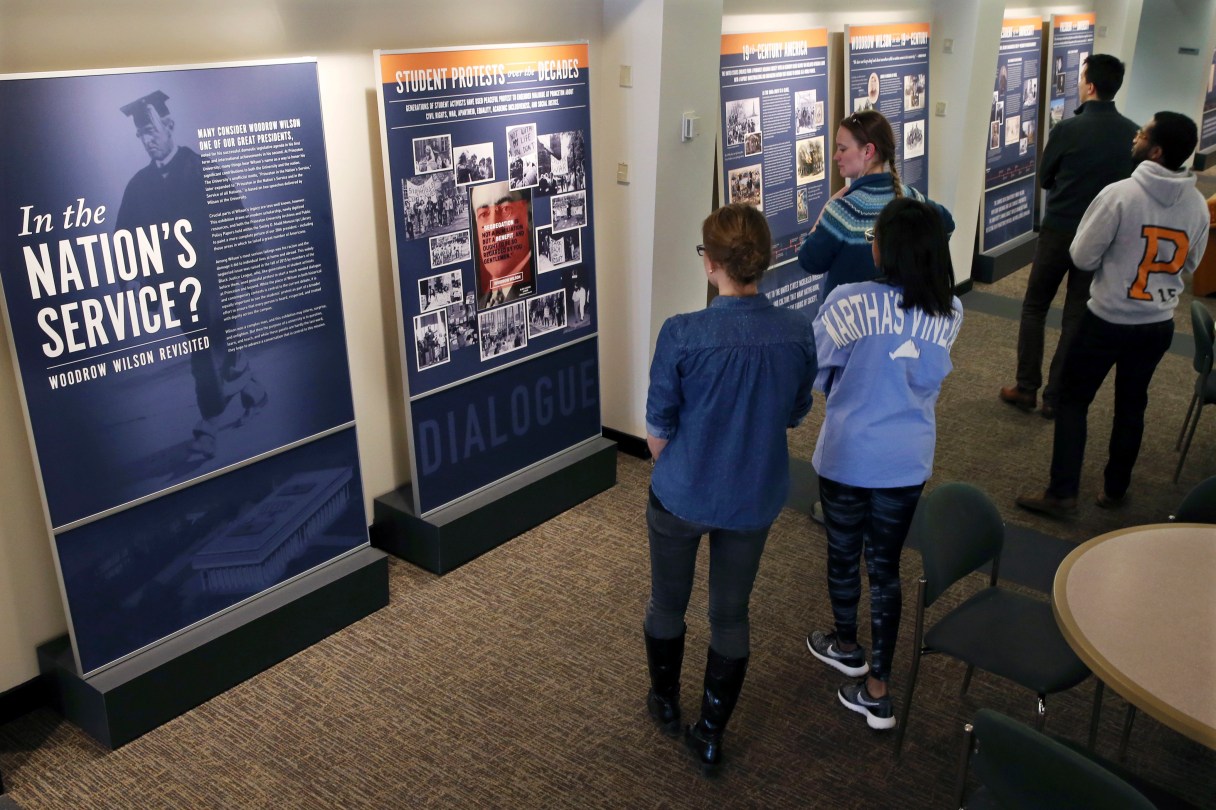
Princeton University students walk through an exhibit titled, "In the Nation's Service? Woodrow Wilson Revisited," Sunday, April 3, 2016, at the Woodrow Wilson School of Public and International Affairs in Princeton, N.J. As Princeton University officials weigh whether to remove alumnus and former President Woodrow Wilson's name from its public policy school, the college is launching an exhibit meant to more fully air his legacy. The Nobel Peace Prize winner heralded as a progressive hero has also faced criticism as a racist who encouraged segregation in his administration. (AP Photo/Mel Evans)

PRINCETON, N.J. (AP) – Princeton University is launching a new exhibit aimed at exploring the legacy of former President Woodrow Wilson.

“In the Nation’s Service? Wilson Revisited” opens Monday at the Woodrow Wilson School of Public Policy and International Affairs. The exhibit features panels highlighting Wilson’s life that acknowledge his bigotry alongside his progressivism.

In November, a black student group demanded Wilson’s name be removed from the public policy school. A decision is expected soon.

Wilson served as president of Princeton from 1902 to 1910 and became the country’s 28th president in 1913, serving until 1921. He won the Nobel Peace Prize in 1919.

But he also supported segregation, including in the federal government, rolling back progress for the emerging black middle class in the nation’s capital.