
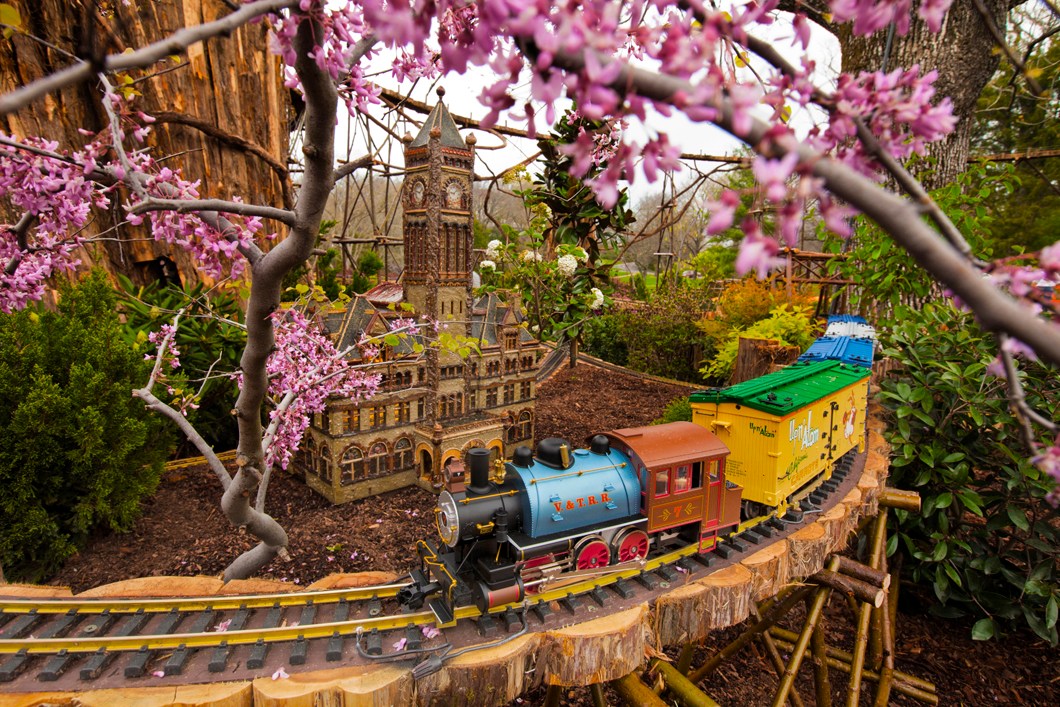
 One of the replicas of Tennessee landmarks on display at Cheekwood in “Trains! Tennessee in G” is the Union Station in Nashville.
Photo by Bob Schatz
On display at The Frist through Aug. 21 is “Gather Up the Fragments: The Andrews Shaker Collection.” This exhibit highlights the items collected by Faith and Edward Deming Andrews, who pioneered Shaker studies from the 1920s through the 1960s. More than 270 items – furniture, drawings, household objects, textiles, baskets and kitchen implements – comprise the show. They provide insight into this intriguing religious group who espoused equality, pacifism, community, sustainability, responsible stewardship of the land, simplicity and quality in work.
Opening June 24 is “Warhol Live: Music and Dance in Andy Warhol’s Work.” The exhibit brings together more than 220 works and objects, including paintings, silk-screen prints, photographs, works on paper, installations, films, videos, album covers and documents from Warhol’s personal archives.
Following Warhol’s career chronologically and thematically, the show is organized into 10 major sections and begins with the film music he adored and the stars he idolized in his youth. It concludes with his images of celebrities enjoying the nightlife in such famous New York hotspots as Max’s Kansas City and Studio 54.
Throughout the exhibition are major paintings and prints of such icons as Elvis Presley, Liza Minnelli, Dolly Parton, Mick Jagger and the artist himself, as well as works from the Campbell’s Soup Can and Disaster series. Also on view will be works that show Warhol’s embrace of other disciplines, including a room filled with buoyant silver Mylar balloons (through which visitors may walk), which composed the stage set he designed for choreographer Merce Cunningham’s “RainForest.”
The section “Warhol and the Avant-Garde” includes a selection of minimalist films that employ the repetitive principles of avant-garde music. Other sections are devoted to Warhol’s studio, known as the Silver Factory, and to his work as the producer of the Velvet Underground – illustrating the artist’s orchestration of both the assembly-line creation of his own art objects and the production of performances.