
It makes it more difficult and makes us less competitive as a state the more major manufacturing that we have that are not operating as a merit [nonunion] shop.
Former Chattanooga Mayor Ron Littlefield recalls a time three decades ago when heavy union membership at companies in the city was used against it in efforts to recruit new businesses.
“There was a time when economic development interests would steer people away from Chattanooga because of a heavy presence of unions,” he said. “I know that for a fact.”
But U.S. Sen. Doug Jones, D-Alabama, said that if there’s a decision by Volkswagen workers to support the United Auto Workers, it will not impact broader economic development recruitment.
“There are a number of different factors that make the Southeast attractive to both employers and workers,” said Jones in an email. “I support free and fair elections and think that Volkswagen and other businesses should not be afraid of a unionized workforce if that is what the workers at the plant decide is in their best interests.”
What’s Next
Voting in the union election at Volkswagen’s Chattanooga plant will end at 8:30 p.m. Friday. Ballots will be counted and the results released later Friday, according to the automaker.
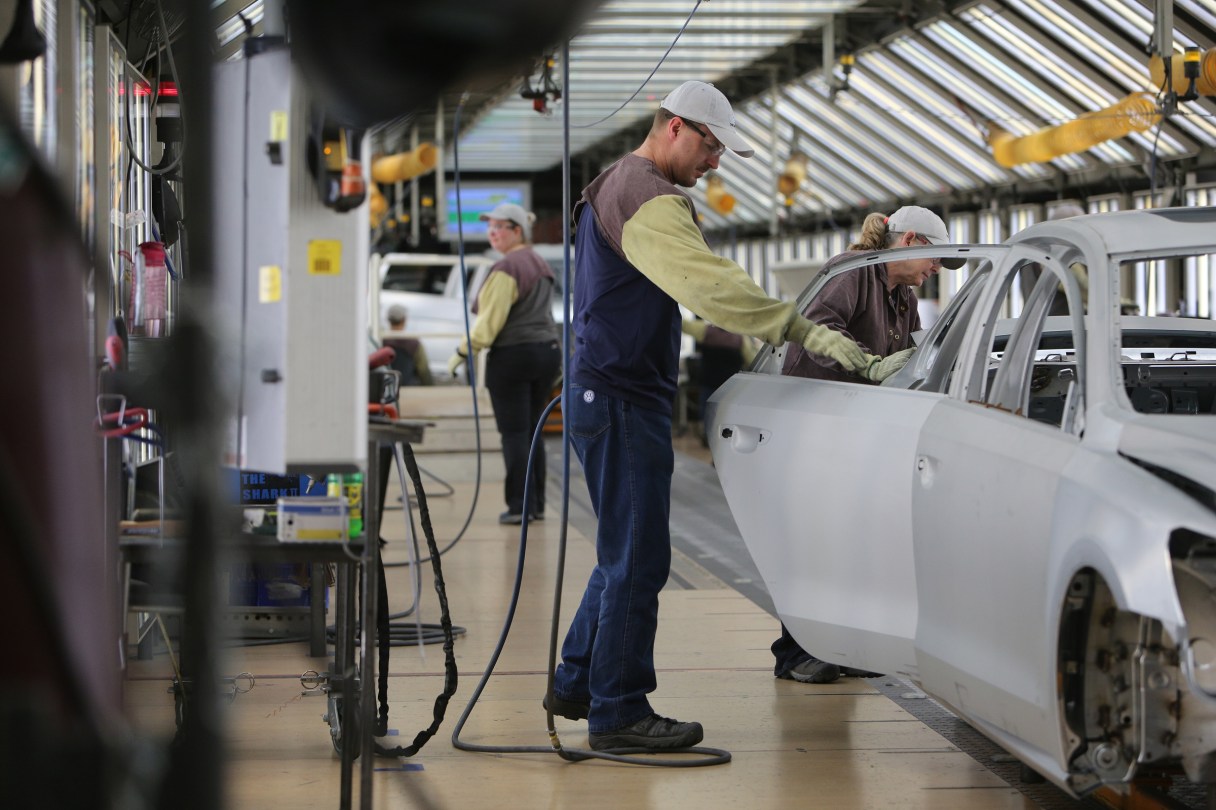
About 1,700 VW workers are voting in a three-day election through Friday on whether to align with the UAW.
Billy Dycus, president of the Tennessee AFL-CIO, said unions work hard to make sure that they collaborate with companies to remain competitive.
At General Motor’s Spring Hill, Tennessee, plant, Dycus said the UAW and the company “have collaborated and worked together to save that plant and it’s now one of GM’s best in the country.”
“It’s odd that we like to advertise ourselves as a low-wage, non-union state and we fail to realize that we’re near the bottom of the country in education and health care,” he said. “If you want to attract business, wouldn’t you want to say that you have the best educated and healthiest work forces as opposed to a non-union or a right-to-work state.”
Littlefield said he’s not anti-union, adding that he had “a long and mostly happy relationship” with unions while at the Chattanooga Area Chamber of Commerce, as city public works commissioner and as mayor.
But, he said, the unions he has dealt with in the past, such as the International Brotherhood of Electrical Workers, were locally focused such as on training members.
“I don’t know the UAW brings that kind of discipline to the table,” Littlefield said. “The UAW is an alien to our environment here. The experience other companies have had with the UAW is not as positive as we have had here.”
The former mayor who helped recruit VW to Chattanooga also said the UAW wouldn’t be a positive in terms of selling Chattanooga to the outside world.
There are a number of different factors that make the Southeast attractive to both employers and workers.
John Healy, a Chattanooga commercial real estate broker and developer, said he believes the city becoming more unionized “has the potential to hurt us” from an economic development standpoint.
“Recruitment people like to say that,” he added. “I don’t know the answer. I’d rather not have to find out. I’m concerned that they might be right.”
Tennessee’s chief economic recruiter, Economic and Community Development Commissioner Bob Rolfe, said unionization elections like the UAW vote at Volkswagen “do not go unnoticed by corporate decision-makers looking for the next place to call home.
“While it is ultimately the decision of the workers at the plant, I truly believe that allowing unionization to occur at Volkswagen could negatively impact the livelihoods of thousands more Tennesseans,” Rolfe said.
Dycus, however, said union members are more likely to be paid higher wages and enjoy pension benefits than their non-union counterparts.
According to the Bureau of Labor Statistics, non-union workers had median weekly earnings averaging $860 last year, or 18 percent less than the $1,051 average weekly earnings made by the average union member.
Still, Littlefield said that he’s concerned that the UAW, if it wins the election, will use the vote “as a launching pad” to organize other plants and that it’s not interested in employees’ welfare first and foremost.
“I’m more interested in what’s good for employees and the Chattanooga area,” he said. “I not so worried about the UAW and their status on the world stage.”
Tennessee Gov. Bill Lee said earlier in Chattanooga that he hopes VW workers vote down the union. Lee said an influx of labor unions to Tennessee will hurt the state’s economic competitiveness.
“It makes it more difficult and makes us less competitive as a state the more major manufacturing that we have that are not operating as a merit [non-union] shop,” he said.
But a UAW spokesman said the union already has “a rich history” in Tennessee, citing the GM Spring Hill plant.
“The governor must have forgotten the UAW and the GM local,” said Brian Rothenberg of UAW International. “The governor must have forgotten the hug he gave to [UAW Local 1853 Chairman] Mike Herron at the GM plant earlier this year.”
Lee said that if the union wins, “I think we will move forward in a way that is productive. I mean, we’ll take the situation we have and work forward to make sure that Volkswagen remains an important piece of who we are and that force is developed in a way that helps them to continue to expand. So we’ll take what happens and move forward.”
The new union election is the third vote at the plant since 2014. That year, the UAW lost by a margin of 712 to 626.
In 2015, a smaller unit of maintenance workers agreed to affiliate with the union 108 to 44, but VW refused to bargain with them, saying it preferred a vote by all production workers. The case was tied up before the National Labor Relations Board and in court for years before an agreement was reached last month for the new election.
Business editor Dave Flessner and staff writer Andy Sher contributed to this story.
Contact Mike Pare at mpare@timesfreepress.com or 423-757-6318. Follow him on Twitter @MikePareTFP.