
Until recently, a traffic report filed by a Chattanooga police officer could take more than 200 days to reach the Tennessee Department of Safety headquarters.
Now the same action should take less than 15 days.
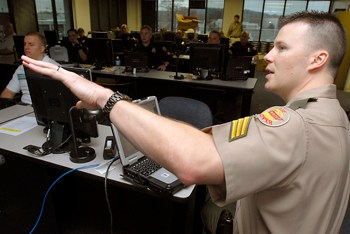
Chattanooga police officers are training this week on the Tennessee Integrated Traffic Analysis Network, or Titan. The safety department developed the system in 2007 and started using it for the Tennessee Highway Patrol in 2008. Later that year, it began adding larger departments such as Knoxville and Memphis.
“You have almost no mistakes to an accident report. It’s a more accurate reporting base and faster,” said Sgt. Chad Sullivan, who works in the Chattanooga police traffic division.
The system replaces reports that previously were typed by the patrol officer as a paper document, corrected for mistakes by a supervisor and then sent to the state for further correction and approval before being entered into the statewide database.
Cutting traffic accident report times and having searchable databases of driver and criminal information in the car mean police can spend more time patrolling neighborhoods and looking for criminals, said Sgt. Charles Brown, technology coordinator for Chattanooga police.
The former lengthy process hurt police efforts to be more responsive in areas with high rates of DUIs, wrecks, speeding or other traffic-related problems, said Sgt. Marty Pollock, Titan project director for the highway patrol.
“By the time (supervisors) would get it in their hands, it’s a year and a half old,” Pollock said.
The information helps the safety department apply for federal grants. With better numbers, the safety department can target trouble areas — for example, paying overtime to local police for targeted enforcement, he said.
ABOUT THE NETWORK* 2007: Tennessee Integrated Traffic Analysis Network begins development* 2008: Tennessee Highway Patrol begins using system, other departments added* 176: Agencies that process reports through the system* 40: Percent of state police agencies using system* 80,000: Number of reports received by the Department of Safety* 200: Number of days for safety department to receive paper reports* 15: Number of days for safety department to receive TITAN reportsSource: Tennessee Department of Safety
The electronic system, now used by 40 percent of police agencies in Tennessee, allows police to be “more proactive with countermeasures,” he said. Partner agencies can access their own information and find out detailed information, such as the number of a certain type of crashes in a specified time.
The reporting system is just one of several technology changes Chattanooga police have seen that help modernize the force, Deputy Chief Mike Williams said.
“In the last few years we’ve made more strides technologywise than I can remember in such a short period of time,” he said.
Williams said Police Chief Bobby Dodd appointed Brown three months ago.
Brown said that years of work to win U.S. Justice Department grants to buy newer equipment, and finding tools like TITAN at no cost to the city, have helped officers speed up policing, Brown said.
A no-injury traffic accident typically takes an hour or more to resolve, he said.
But through a combination of the TITAN system, new scanners that instantly retrieve vehicle and driver information and faster Internet connections through broadband service purchased under a $600,000 federal grant, that time is cut in half.
“Everything in our industry is moving at light speed to quick access to information at the street level,” Brown said.
Without other tools, such as higher Internet connection speed and newer model laptops, Web-based programs such as TITAN wouldn’t have been possible for Chattanooga police to use just two years ago, he said.
Officers with slow connections and older computers see service drop off while in the field, frustrating their search for background information on a suspect or driver information during a traffic stop.