
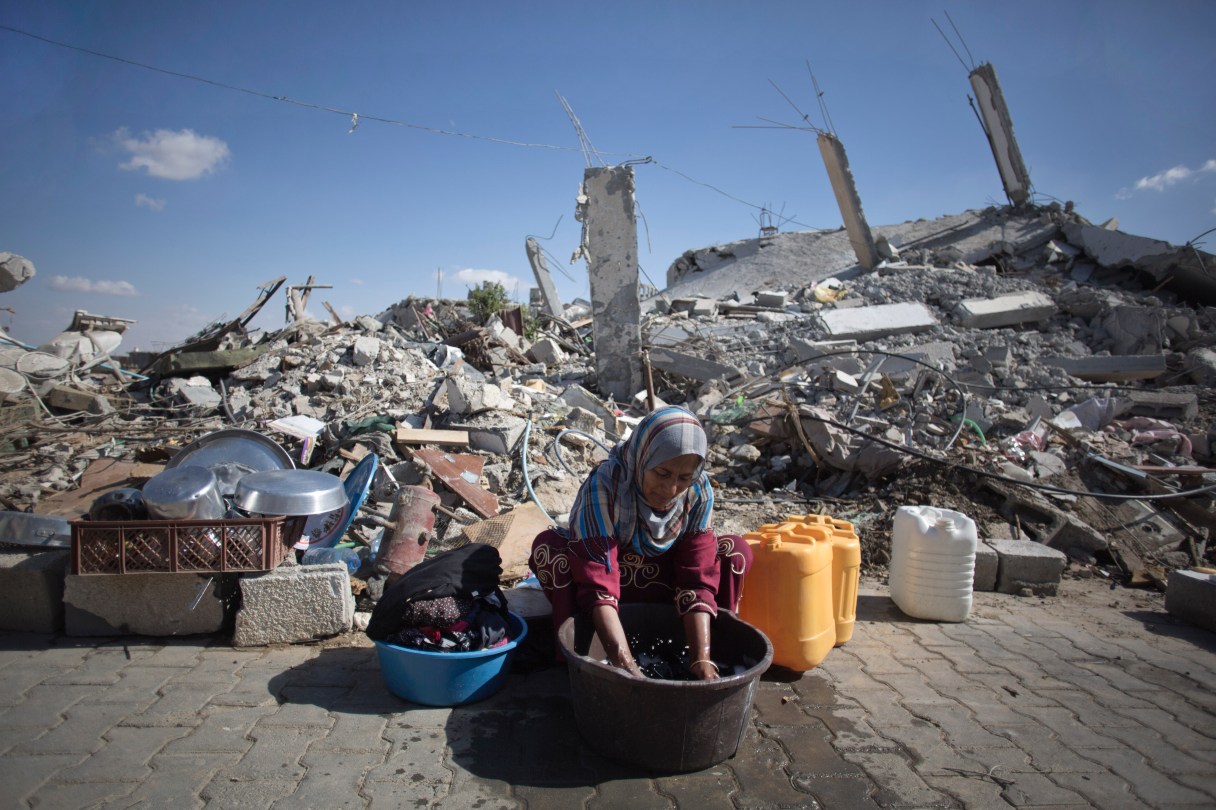
KHUZAA, Gaza Strip (AP) – More than five weeks after the Israel-Hamas war in the Gaza Strip, tens of thousands of people whose homes were destroyed or badly damaged in the fighting still live in classrooms, storefronts and other crowded shelters. In some of the hardest-hit areas, the displaced have pitched tents next to the debris that once was their homes.
Yet despite their pressing needs, reconstruction efforts appear stymied by a continued Israeli-Egyptian border blockade of Gaza and an unresolved power struggle between the Islamic militant group Hamas and Western-backed Palestinian President Mahmoud Abbas.
Those involved in rebuilding say the post-war paralysis finally will come to an end next week, with an international pledging conference in Cairo. There, Abbas is to ask for $4 billion for Gaza, including for the rebuilding or repair of more than 60,000 homes and 5,000 businesses.
Once the money is raised, a United Nations deal is to ensure that large amounts of building materials get into Gaza, despite the blockade. Under the arrangement, Israel would gradually ease restrictions, while Abbas – who lost Gaza to Hamas in 2007 – is to regain some control there and make sure cement and steel meant for reconstruction aren’t diverted.
But James Rawley, a senior U.N. official involved in the reconstruction, acknowledged the deal is fragile.