
Tuesday, November 10, 2026Nov 10

Israel edges closer to early election

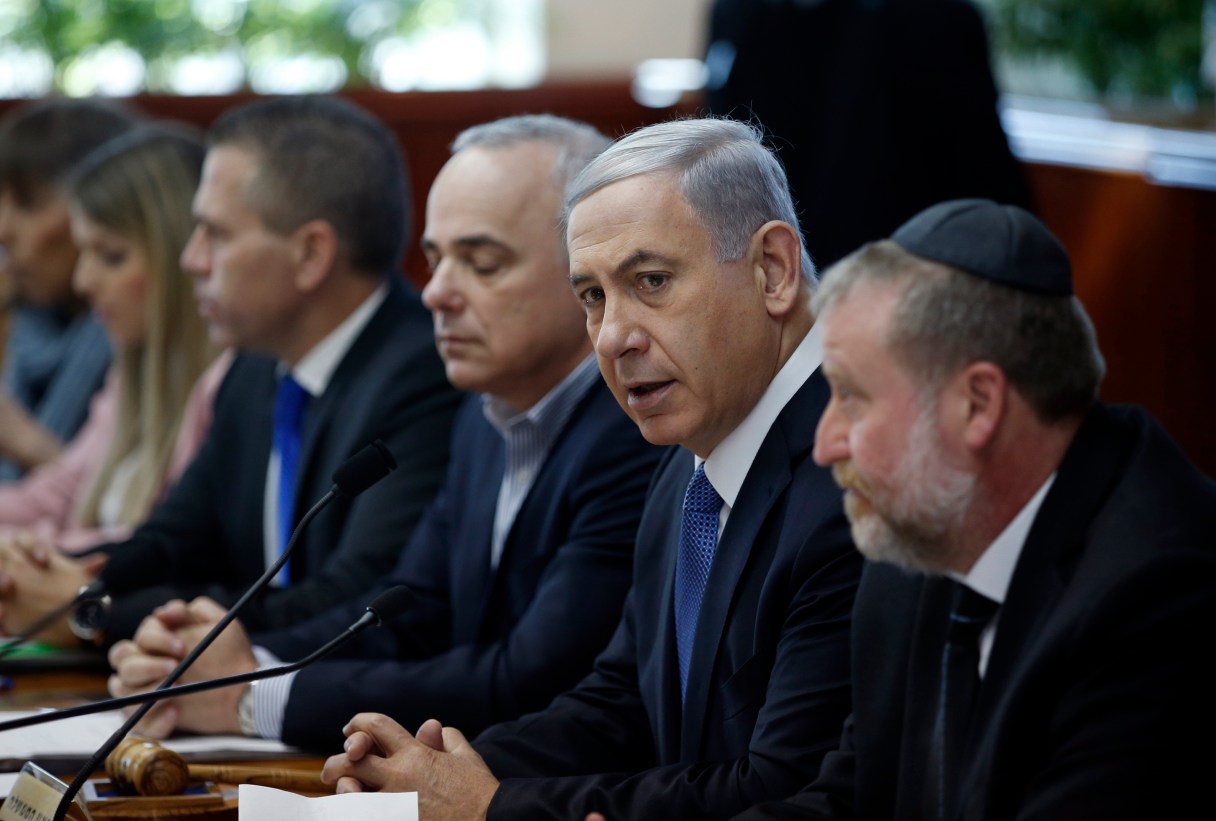
Israel's Prime Minister Benjamin Netanyahu, second left, chairs the weekly cabinet meeting in Jerusalem, Sunday, Nov. 30, 2014. Israel's prime minister said Sunday that the public expects the government to "return to normal conduct" and hinted at the possibility of early elections if his coalition does not overcome a crisis linked to a contentious nationality bill that would enshrine Israel's status as a Jewish state. The proposal would also make Jewish law a source of legislative inspiration and delist Arabic as an official language. (AP Photo/Ronen Zvulun, Pool)
Israel's Prime Minister Benjamin Netanyahu, second left, chairs the weekly cabinet meeting in Jerusalem, Sunday, Nov. 30, 2014. Israel's prime minister said Sunday that the public expects the government to "return to normal conduct" and hinted at the possibility of early elections if his coalition does not overcome a crisis linked to a contentious nationality bill that would enshrine Israel's status as a Jewish state. The proposal would also make Jewish law a source of legislative inspiration and delist Arabic as an official language. (AP Photo/Ronen Zvulun, Pool) Israel's Prime Minister Benjamin Netanyahu, second left, chairs the weekly cabinet meeting in Jerusalem, Sunday, Nov. 30, 2014. Israel's prime minister said Sunday that the public expects the government to "return to normal conduct" and hinted at the possibility of early elections if his coalition does not overcome a crisis linked to a contentious nationality bill that would enshrine Israel's status as a Jewish state. The proposal would also make Jewish law a source of legislative inspiration and delist Arabic as an official language. (AP Photo/Ronen Zvulun, Pool)

JERUSALEM (AP) – Israel’s fractious coalition government seems headed for a breakup that could spark new elections against a backdrop of security turmoil inside the country, disputes over nationalist legislation and a deep freeze in peace efforts with the Palestinians.

With little to gain from a vote that would come two years early, the country’s top politicians could still pull back from a brink that none seem to relish. But the vitriolic attacks of recent days suggest another angry campaign could soon be at hand.

If that happens, it seems likely for now that Prime Minister Benjamin Netanyahu would be returned for a fourth term. Despite sagging popularity amid economic doldrums and increasing global isolation, his divided opposition lacks a credible unifying figure.

Under Israel’s political system, the leader is the elected parliament member who can show majority support in the 120-seat house.

Netanyahu’s current coalition consists of a diverse array of partner parties that includes the centrist “Yesh Atid,” which rose to power with promises of economic relief for Israel’s struggling middle class; “Jewish Home,” a hard-line party closely identified with the West Bank settlement movement; “Hatnuah,” which was elected on a platform pushing peace with the Palestinians; and “Yisrael Beitenu,” a nationalist party that seeks to redraw Israel’s borders to rid the country of many Arab citizens. His own Likud party is itself riven with disputes.