
Monday, November 9, 2026Nov 9

British university says Quran parchment among oldest

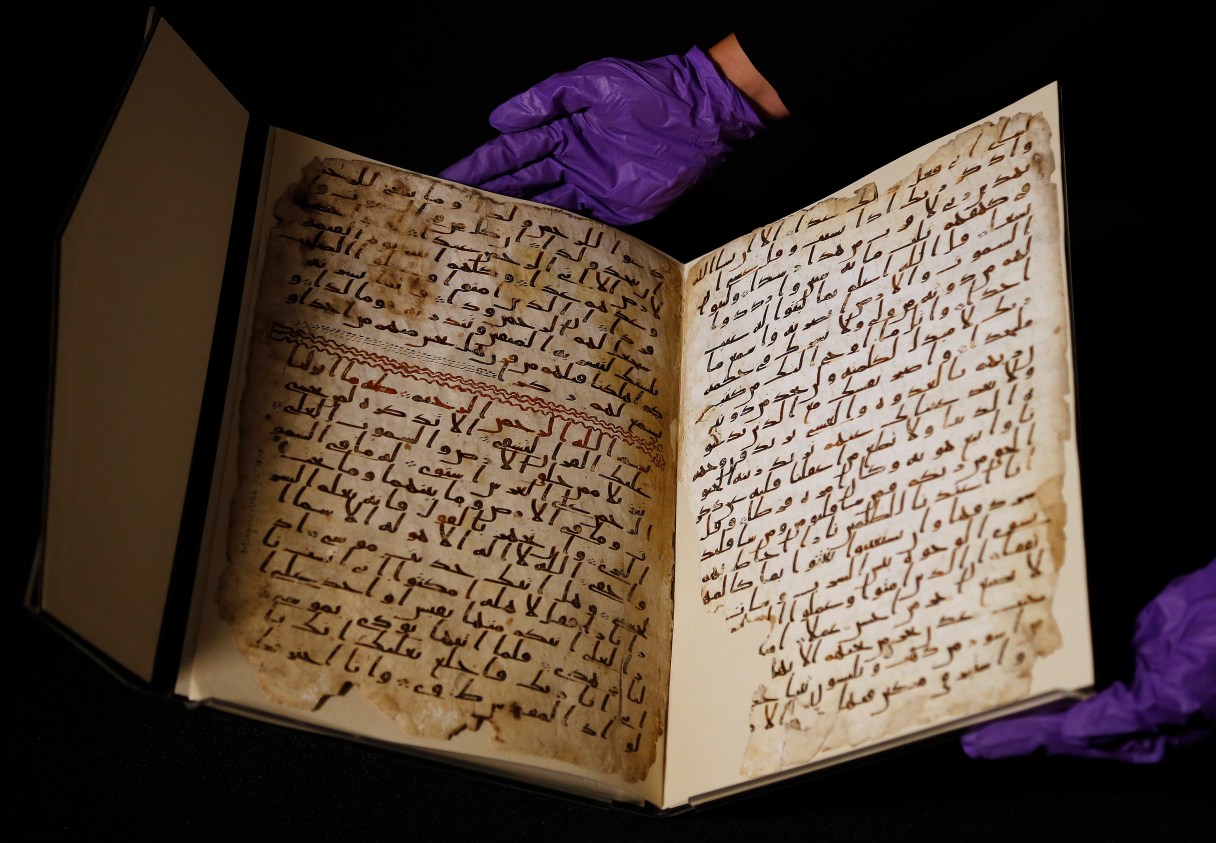
A university assistant shows fragments of an old Quran at the University in Birmingham, in Birmingham central England Wednesday, July 22, 2015. The University of Birmingham said Wednesday that scientific tests prove a Quran manuscript in its collection is one of the oldest known and may have been written close to the time of the Prophet Muhammad. Radiocarbon testing at Oxford University dated the parchment to the time of the prophet, who is generally believed to have lived between 570 and 632.(AP Photo/Frank Augstein)
A university assistant shows fragments of an old Quran at the University in Birmingham, in Birmingham central England Wednesday, July 22, 2015. The University of Birmingham said Wednesday that scientific tests prove a Quran manuscript in its collection is one of the oldest known and may have been written close to the time of the Prophet Muhammad. Radiocarbon testing at Oxford University dated the parchment to the time of the prophet, who is generally believed to have lived between 570 and 632.(AP Photo/Frank Augstein) A university assistant shows fragments of an old Quran at the University in Birmingham, in Birmingham central England Wednesday, July 22, 2015. The University of Birmingham said Wednesday that scientific tests prove a Quran manuscript in its collection is one of the oldest known and may have been written close to the time of the Prophet Muhammad. Radiocarbon testing at Oxford University dated the parchment to the time of the prophet, who is generally believed to have lived between 570 and 632.(AP Photo/Frank Augstein)

LONDON (AP) – A British university disclosed Wednesday that scientific tests prove a Quran manuscript in its collection is one of the oldest known and may have been written close to the time of the Prophet Muhammad.

The announcement by the University of Birmingham thrilled Muslim scholars and the local community, which boasts one of the country’s largest Muslim populations. The find came after questions raised by a doctoral student prompted radiocarbon testing that dated the parchment to the time of the prophet, who is generally believed to have lived between 570 and 632.

“This manuscript could well have been written just after he died,” said David Thomas, a professor of Christianity and Islam at the University of Birmingham.

“Parts of the Quran that are contained in those fragments are very similar indeed to the Quran as we have it today. This tends to support the view that the Quran that we now have is more or less very close indeed to the Quran as it was brought together in the early years of Islam.”

Muslim tradition says the prophet received the revelations of the Quran between 610 and 632 – but it wasn’t written down immediately. The first leader of the community after Muhammad’s death, Caliph Abu Bakr, ordered the book to be written and it was completed by the third leader, Caliph Uthman, in 650.