
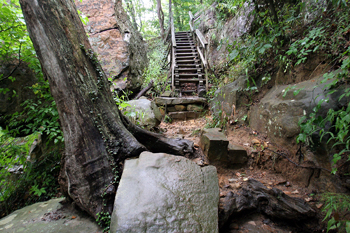
 The 300-plus mile Cumberland Trail is among the top 10 places in the South “that face immediate, potentially irreversible damage in 2011,” according to an annual list released by the Southern Environmental Law Center.
The Cumberland Plateau has been named to the Top 10 Endangered Areas in the South for 2011.
The alert, sounded by the Southern Environmental Law Center, was made because the plateau – like the other nine endangered areas – are affected by the region’s energy policies.
“Our region is headed down a path that threatens to overwhelm the Southern landscapes we love – our mountains, rivers, coast, and rural countryside,” said Marie Hawthorne, SELC’s director of development.
“Decisions made today about how we extract and produce energy will have consequences for decades to come,” she said. “The key message behind our Top 10 list is that there is still time to save these special places — but we need to act now.”
The Cumberland Plateau, world-renowned for its lush diversity, continues to face coal mining threats because few landowners also own the mineral rights to their properties.
Mary Priestley, president of the Friends of South Cumberland State Recreation Area on Monteagle Mountain, said she is thankful SELC is “holding up this travesty in hopes of saving that part of the Cumberlands.”
She suggests people visit the Ilovemountains.org website.
“If you enter your ZIP code, Google Earth will draw a line from the power plant where you get your electricity to the very mountains that are losing their tops to warm your house, wash your clothes, and cook your dinner,” she said. “It’s on all of us — not just TVA or the mining companies.”
Even the state doesn’t own the mineral rights on all of the 300-mile-long Cumberland Trail State Park and other state-owned lands on the plateau. Much of the land was purchased in recent years from timber and coal companies, according to SELC attorneys Deborah Murray and Sarah Francisco.
The northern plateau is vulnerable to mountaintop removal, while rock mining is a threat in the southern plateau.
In 2007, rock miners tore up a section of the volunteer-built Cumberland Trail near Soddy-Daisy. The state eventually won a lawsuit to protect that section of the trail and bought the mineral and coal rights there, according to Francisco.
Murray said the plateau’s diversity depends on its remoteness and areas of undisrupted space.
“The idea is that you need large tracts of land that aren’t fragmented for some species to thrive,” she said.
TOP 10
• Alabama’s coast, threatened by offshore drilling and the BP oil spill
• Georgia’s cypress forests, threatened by timbering for cypress mulch
• Georgia’s Oconee River, where a proposed coal-fired power plant would siphon about 13.5 million gallons a day
• North Carolina’s Pea Island National Wildlife Refuge, threatened by a bridge replacement plan
• North Carolina’s Snowbird Mountains, threatened by a highway plan
• North Carolina’s Cape Fear Basin, where a proposed cement plant would destroy 1,000 acres of wetland habitat
• South Carolina’s Santee River Basin, where hydroelectric dams degrade wetlands and wildlife habitat
• Tennessee’s Cumberland Plateau, whose diverse ecosystem is endangered by extractive industries and related mineral rights issues
• Virginia’s George Washington National Forest, threatened by possible hydraulic fracturing for natural gas extraction linked to water contamination
• Virginia and Maryland’s Chesapeake Bay, for continued air, land and water pollution.
Source: Southern Environmental Law Center